





The difference between a healthy sender reputation and one struggling with spam filters and bounces often comes down not just to whether you validate emails, but where and how you do it.
This article explains why non-US (especially EU-based) email verification isn’t merely a GDPR checklist item, but a strategic choice that impacts deliverability, legal risk, and operational control. Along the way, you’ll see how Bouncer — an EU-based verification tool built with GDPR compliance and high accuracy at its core — illustrates what best-in-class non-US verification looks like.
The Importance of Email Verification in 2026
At its heart, email verification ensures that an email address is valid and capable of receiving mail. But modern verification goes far beyond checking whether the formatting is correct. Vendors make a series of network calls and risk assessments that tell you whether sending to a given email is likely to bounce, end up in a spam folder, or trigger a complaint.
A robust verification service typically:
- Confirms the domain and mail exchange (MX) records exist,
- Contacts the mail server (SMTP) to see whether the mailbox is responsive,
- Detects disposable, role, and catch-all addresses,
- Flags addresses that are likely spam traps, high-risk, or “toxic.”
These checks translate directly into business outcomes. If you don’t verify, you waste money sending to dead or risky addresses. More importantly, repeated hard bounces can damage your domain’s sender reputation, meaning your carefully crafted campaigns are more likely to land in spam folders or be throttled by inbox providers. Improving list hygiene via verification consistently improves deliverability, opens, and overall engagement.
Verification also matters throughout the lifecycle of your contact data. It’s not just for a one-time sweep of your CRM. It’s most effective when integrated into signup forms (via real-time APIs), used before major campaigns, and embedded into ongoing hygiene workflows within CRM or ESP systems.

Why Geography Still Matters in the Verification Era
Many of the well-known verification tools in the market today — including ZeroBounce, NeverBounce, Hunter, and others — are headquartered in the United States or operate with significant US-hosted infrastructure. These vendors are capable and widely used, but for organisations with EU data subjects and compliance requirements, that setup comes with additional legal and operational complexity.
From a regulatory perspective, tools that physically process or store email data outside the EU trigger cross-border data transfer assessments under the GDPR and related EU law. Even when Standard Contractual Clauses (SCCs) are in place, privacy teams often must conduct detailed Data Protection Impact Assessments (DPIAs) to justify transfers to jurisdictions where data protection adequacy is not recognised. This is especially the case in the wake of ongoing legal scrutiny following decisions such as Schrems II and Schrems III, which highlighted the risks of foreign government access to personal data outside the EU.
By contrast, EU-hosted verification tools simplify many of these concerns. When email verification processing and storage happens entirely within the EU and under GDPR governance, organisations reduce the amount of legal overhead tied to data transfers, DPIAs, and supplementary safeguards. In practice, this means legal teams spend less time on vendor risk assessments, and operational teams can implement list hygiene workflows with greater confidence about compliance.
Bouncer as an Example of EU-Centric Verification
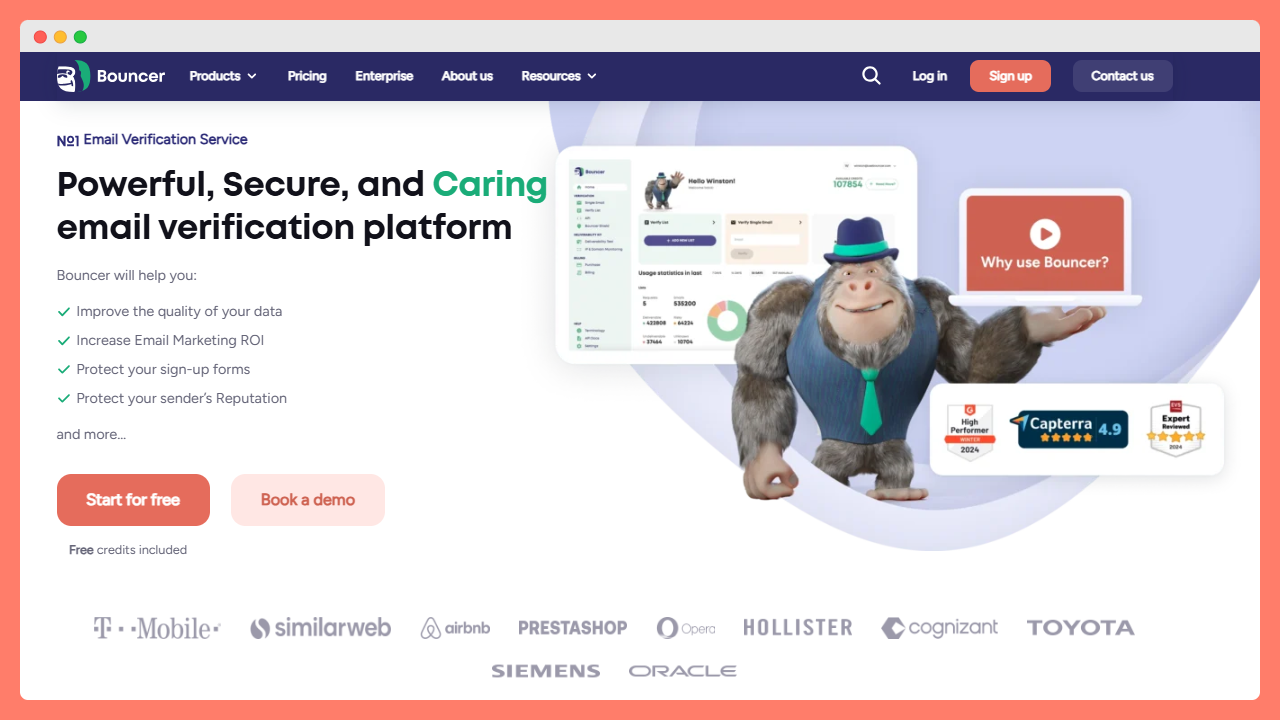
Bouncer exemplifies this model. It operates with EU data residency, fully adheres to GDPR requirements, and anonymises emails during processing. The company emphasises its GDPR-compliant design, including data anonymisation and retention policies, aligning with European privacy expectations and easing the compliance burden for customers handling EU data.
This EU focus doesn’t come at the expense of performance either. Independent reviews and user experiences suggest Bouncer delivers industry-leading accuracy and coverage, with low rates of “unknown” results and robust handling of even complex catch-all and hosted domains — a critical part of modern verification.
Understanding GDPR in the Context of Email Verification
To fully grasp why non-US verification matters, it helps to look at GDPR through the lens of verification workflows.
At a fundamental level, GDPR requires that personal data be:
- Collected and processed lawfully, fairly, and transparently,
- Used only for specified, explicit purposes,
- Limited to what is necessary (data minimisation),
- Stored no longer than necessary,
- Properly secured.
When you run a list through a verification provider that holds data in or transfers data to non-EU jurisdictions, you need to demonstrate that these principles are upheld — often through additional contractual safeguards, technical measures, and compliance documentation.
For EU marketers, proper GDPR adherence in email verification means ensuring:
- Users have given clear consent or meet another lawful basis for processing,
- Verification processes are explained in privacy policies,
- Only the email address (and no unnecessary personal data) goes to the verifier, and
- Logs and verifier results are retained only as long as necessary.
Tools like Bouncer prioritise these practices by default. Bouncer explicitly builds compliance into its service model, including data anonymisation, EU-based data centres, and limited retention periods. These features align with GDPR’s data minimisation and storage limitation principles and help organisations demonstrate compliance more easily when reviewed by a Data Protection Authority.
What’s more, GDPR isn’t static. Future laws such as the EU ePrivacy Regulation will likely layer on additional requirements, meaning that early alignment with best practices for verification positions organisations to adapt more smoothly as the regulatory environment evolves.
How Non-US/EU Verification Tools Compare in Practice
When assessing email verification tools, geography is just the starting point. The real test is whether the tool delivers accuracy, integration breadth, and operational reliability that meets modern email workflows.
Here’s how EU-centric solutions like Bouncer tend to differentiate:
- Accuracy and coverage. Great verification tools don’t just mark addresses as good or bad — they categorise risk levels and provide clear reasons for classifications. European providers focused on accuracy report very low “unknown” outcomes and deep SMTP checks that reach even sophisticated mail server configurations. Independent reviews frequently point to Bouncer’s high deliverability insights and accuracy.
- Rich metadata. Beyond deliverable/undeliverable labels, advanced verifiers provide signal flags for free domains, role accounts, disposable addresses, and toxicity indicators. This spectrum helps teams tailor engagement logic and prioritise lists more intelligently.
- Developer and integration experience. A modern email workflow rarely stands alone. Verification must connect via API to CRMs, ESPs, and form builders. Many EU-centric tools, including Bouncer, offer developer-friendly APIs alongside direct integrations into common ecosystems like HubSpot.
- Operational control and transparency. GDPR-aligned tools often include built-in privacy controls, clear retention policies, and transparent sub-processor lists — all of which matter when your legal team evaluates vendor risk.
Use Cases: Verification in the Real World
To bring this to life, consider how verification plays out across common business scenarios:
SaaS / PLG Sign-Ups
In high-velocity signup flows where every new email triggers onboarding sequences, real-time verification helps stop typos, disposable addresses, and bad data before it impacts campaign metrics. EU-centric verification amplifies this by keeping primary data handling within the EU, easing compliance concerns for teams with European users.
B2B Outbound and SDR Workflows
Sales teams operating with prospect lists from enrichment tools or data vendors benefit from bulk verification that discriminates between deliverable business addresses and riskier categories like catch-all or role accounts. Clean lists reduce bounce spikes that can harm domain reputation and sales automation performance.
Agencies and Multi-Tenant Environments
Agencies managing multiple clients face additional operational and legal complexity. Tools designed with multi-workspace controls, billing structures, and data residency options help these teams deliver consistent, compliant services across client portfolios.
E-Commerce and Newsletter Programs
Retail and publishing teams often face rapid subscriber growth during peak seasons. Embedding verification at capture and maintaining ongoing hygiene directly protects campaign performance during these high-volume moments — without sending data outside GDPR-aligned processing zones.
Making Your Decision: Practical Guidance
Any evaluation of email verification vendors should start with the fundamentals — accuracy, speed, and integration — but for teams handling EU data, that list must include compliance posture, data residency, and legal simplicity.
A robust exercise is to run the same list through both your current verifier and an EU-based alternative, compare results, and measure not just technical differences but operational and legal impact.
For many organisations, the difference isn’t marginal. Tools like Bouncer offer a combination of GDPR-by-design compliance with EU data residency, strong accuracy and metadata, and developer-friendly integration options — all of which reduce risk without sacrificing performance.
Conclusion
Email verification today is not a peripheral tactic. It’s a strategic lever that influences deliverability, cost efficiency, privacy compliance, and long-term reputation. For teams operating in and around the EU, choosing a non-US, GDPR-centric verifier isn’t just about avoiding fines; it’s about simplifying compliance, strengthening data governance, and unlocking better outcomes from your email investments.
Tools like Bouncer show how a non-US-based solution can meet these needs without compromise, delivering high accuracy, strong regulatory alignment, and integration depth required by modern email programs.
In 2026 and beyond, verification truly is foundational — and choosing where and how it’s done matters.
Try Bouncer for free today, you have nothing to loose.


