





Yet not every address is real.
Typos, throwaway domains and malicious bots pollute contact lists. Invalid entries waste money and distort metrics. Bad data also fuels fraud prevention challenges. A real person may never see your message, while a fake subscriber might use your site for bad purposes.
That’s where email verification comes in.
This article explores what verification is used for and how different industries benefit from it.
We’ll review the email verification process, discuss key email marketing outcomes, highlight common use cases across sectors and show why choosing a dedicated email verification service like Bouncer makes sense.
Understanding the email verification process
The core of any verification program is a series of technical checks that decide if an address is reachable. These checks go beyond simple email validation (format only) to test DNS records, server responses and mailbox existence.
Bouncer’s process, for example, performs a syntax check, queries the domain’s Mail Exchange (MX) records, connects to the email server and pings the mailbox. All without delivering a message.
It also flags temporary email addresses, role‑based inboxes and spam traps. The result is a verdict: valid, risky or undeliverable.

Syntax, domain and server checks
First, the service examines the address for invalid characters and missing symbols. Common mistakes like john.smith@hotmial.con are caught here. Next, it checks whether the domain exists and whether a valid MX record points to a server that accepts mail. If the mail server is unreachable or misconfigured, the address is marked undeliverable.
Mailbox ping and disposable detection
After confirming the domain, the verifier pings the mailbox using an SMTP handshake. This step identifies catch‑all domains and full inboxes. Many services also maintain lists of disposable domains and role‑based accounts (like info@) and warn you when an address may be a trap. This layered approach keeps false positives low and protects your sender reputation by removing bad addresses before they harm your list.
Why businesses use email verification
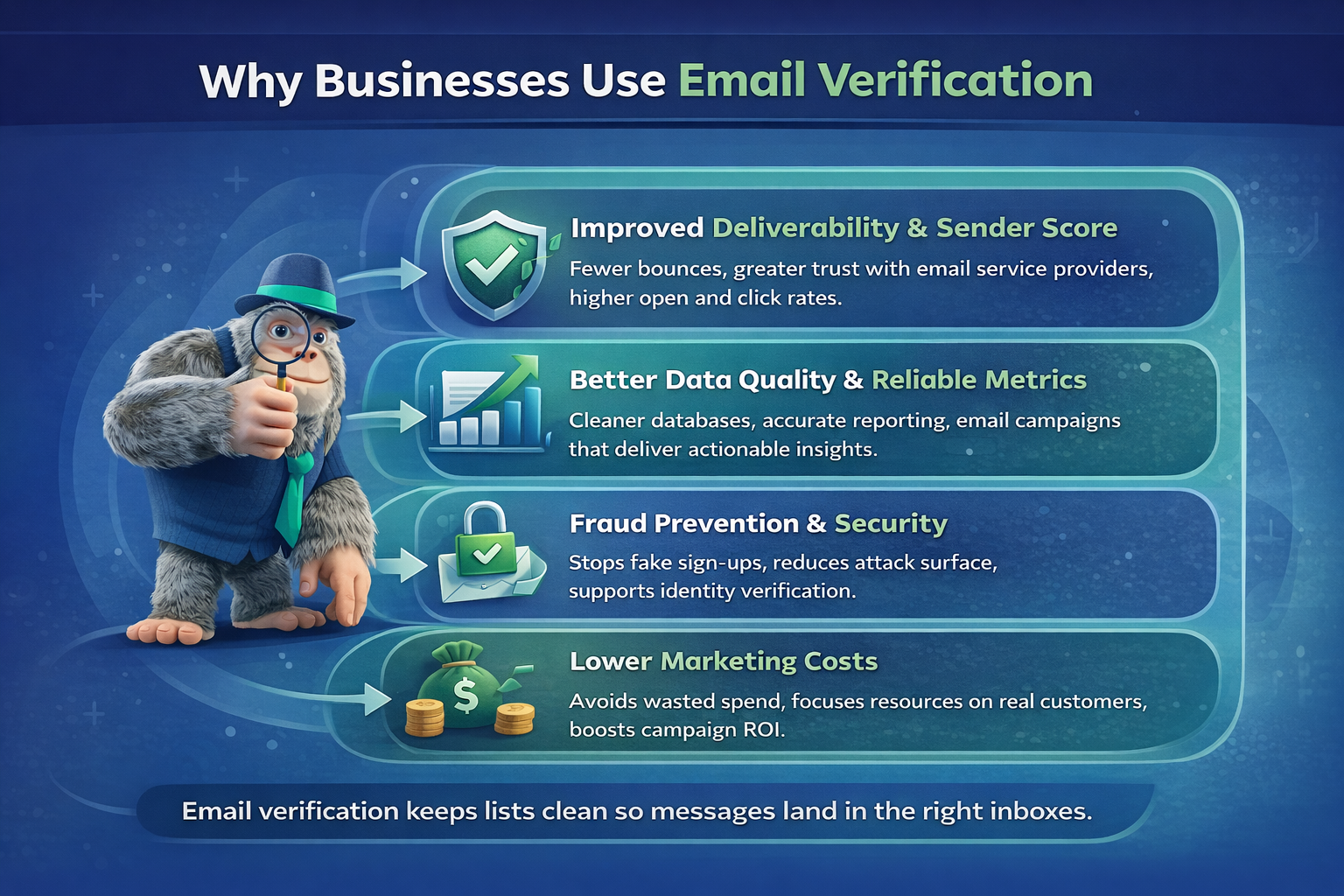
The most common reasons for using email verification by businesses are:
Improved deliverability and sender score
Working with a verified mailing list has tangible benefits. Bounce rates drop when undeliverable addresses are removed. Sending to invalid addresses raises bounce rates and can lead to your domain being blacklisted.
By verifying before sending, you protect your email deliverability, keep messages out of spam folders and build trust with email service providers. Verified lists also improve open and click rates, making campaigns more profitable.
Better data quality and reliable metrics
Clean data means accurate reporting. When you send 100 emails and 20 bounce, your response rate looks worse than it is. If those 20 invalid addresses are removed, your response rate increases from 20% to 25%.
Reliable metrics help email marketers decide what content works and where to invest. An annual database decay rate of 22.5% means that even good lists need regular cleaning, so verification isn’t a one‑off project.
Fraud prevention and security
Email is an identity anchor for user accounts, so verifying it helps stop fraud. Email is the most attacked identifier; cybercrime losses linked to email topped $16.6 billion in 2024. Hyper‑disposable domains, which spin up and disappear in days, fuel fake sign‑ups.
Verifying addresses during onboarding and periodically through the customer journey reduces the attack surface. It also supports KYC and risk‑based authentication: confirmation codes prove mailbox ownership, and verification catches fake or stolen addresses.
Lower marketing costs
Every email you send costs money – whether it’s bandwidth, a per‑message fee or time spent designing campaigns. Verified lists shrink bounce percentages so more of your messages land in inboxes. Sending fewer but accurate emails uses resources to their full potential, yielding the best ROI.
Good data also prevents your team from chasing dead leads and helps your contact lists focus on customers who are ready to buy.
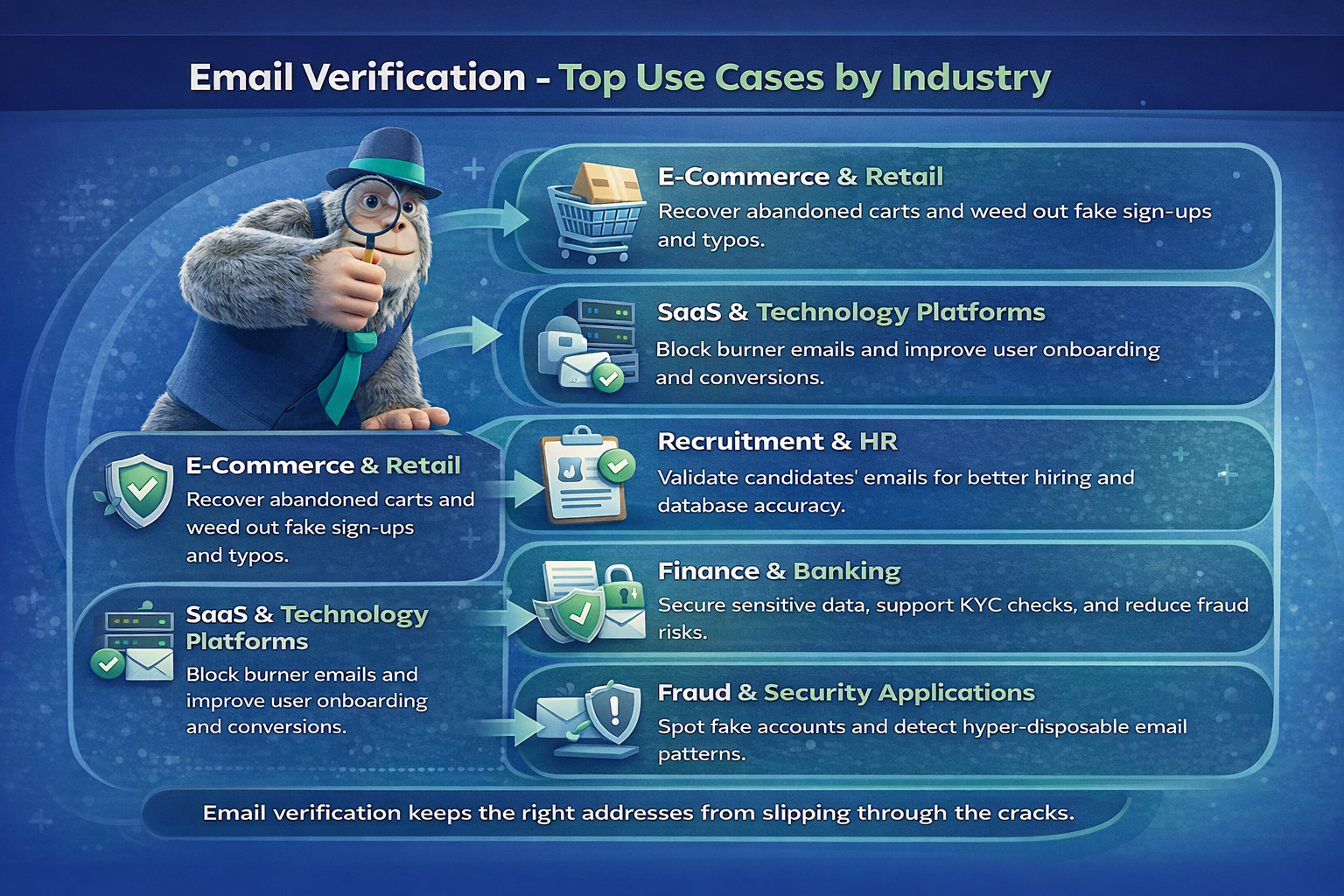
Email verification – top use cases by industry
Email verification isn’t one‑size‑fits‑all. Different industries have unique reasons to check addresses, from marketing purposes to compliance. Here are common scenarios where verification matters:
E‑Commerce and retail
Online stores rely on email to drive sales, recover abandoned carts and keep shoppers engaged. Fake sign‑ups and typos undermine campaigns. Verification helps by filtering out bad addresses at checkout and keeping promotional lists clean.
It prevents lost revenue from misdirected receipts and improves engagement rates. Verified data also reduces customer support issues when shoppers never receive order confirmations.
SaaS and technology platforms
Trial accounts and free plans often attract throwaway emails. SaaS platforms need accurate contact data to onboard users and track conversions. Verification blocks fake or disposable accounts, ensures onboarding messages reach real users and maintains accurate analytics. This leads to smarter product decisions, together with reduced server waste and higher trial‑to‑paid conversion rates.
Recruitment and human resources
Recruiters send interview invitations, assessments and updates via email. Invalid addresses slow down hiring and waste recruiters’ time. Email verification confirms applicants’ addresses before outreach, filters spam submissions and strengthens candidate databases. Verified contact data speeds up shortlisting and improves the candidate experience.
Finance and banking
Financial institutions handle sensitive data and must comply with regulations. Fake accounts and incorrect email data create fraud risks. Verification screens new sign‑ups, supports KYC compliance and protects sensitive communications.
Verifying email ownership with one‑time passcodes reduces multi‑accounting and account takeovers. Combining ownership checks with validation keeps contact lists safe and helps meet AML and GDPR requirements.
Healthcare and government
In healthcare, missed appointment reminders and incorrect patient emails can affect care quality. Email verification ensures scheduling notes, lab results and secure messages reach the right person.
Government agencies also use email to deliver tax forms, benefits updates and emergency notices; verifying addresses helps them reach citizens reliably and comply with data protection regulations.
Digital marketing and outreach
Across all industries, email marketing remains a key channel. Half of all media planners use email because it delivers an impressive ROI. But success depends on reaching real people.
Verified lists keep bounce rates low, protect domain reputation, and let you segment by engagement patterns. Real‑time verification on forms and lead magnets stops typos and fake entries before they pollute your CRM. Combined with periodic cleanups, this keeps lists fresh and improves campaign performance.
Fraud and security applications
Beyond marketing, verification is central to identity systems. Email shows up at every critical moment of a customer journey: sign‑up, password change, security notices and transactions. When addresses are checked early and often, the attack surface shrinks.
Modern verification also helps detect hyper‑disposable emails that fuel fake account farms. By catching these patterns, organizations can block suspicious accounts and avoid account takeovers.
Integrating verification into your workflow
Getting started with email verification is easier than it sounds. Let’s go through some of the most common methods.
Real‑time form checks
One of the simplest verification methods is real‑time form validation. As soon as a user submits a sign‑up form, the system performs a quick server‑side check. Real‑time checks on sign‑up and content forms keep typos, throwaway inboxes and obvious risks out of your CRM, aiming for latency under 300 ms. If the response is slow, accept the submission, queue a re‑check and flag the record for review.
CRM and marketing ingestion gates
New contacts often enter your system through data enrichment, CSV imports or partner feeds. Running verification at this stage stores a status and reason code on each contact, then routes them: accept good addresses, quarantine risky ones and suppress bad entries. This keeps junk out of segments before campaigns are built and improves segmentation accuracy.
Pre‑send checks for campaigns
Before sending bulk emails, many teams run a final verification to catch addresses that have turned invalid or risky. We recommend calling the API when a cadence is scheduled so bounces, traps and complainers are blocked. A short cache window prevents repeated lookups while keeping decisions fresh. This step is especially helpful for high‑volume outreach programs.
Scheduled hygiene for existing databases
Data decays; people change jobs or abandon inboxes. Scheduled verification jobs re‑check older cohorts and newly imported lists on a quarterly or monthly basis. B2B databases decay at 2.1% per month, so regular hygiene is essential. Writing results back to a single “email_status” field lets downstream lists inherit the latest status and reduces manual effort.
Choosing the right email verification tools
When selecting a verification tool, consider:
- accuracy,
- speed,
- integration,
- and privacy.
High accuracy helps you keep genuine users while filtering out fake addresses. Bouncer offers over 99% accuracy.
Speed matters for a smooth user experience; real‑time checks should return in milliseconds.
Look for an API that integrates with your forms, CRM and marketing automation; APIs automate checks across capture, CRM and pre‑send, keeping data clean without exports. Privacy and compliance are also critical.
Bouncer anonymizes uploaded data, stores it in EU centers and deletes it on demand.
Finally, think about user experience. Tools should support bulk uploads and real time verification, have a clear dashboard and connect with popular form plugins. When evaluating services, prioritize those with verification email support, valid MX checks and operational efficiency features like caching and retries.
Bouncer: your trusted email verification service

Bouncer is a specialized email verification service that performs all the checks described above. It scans syntax, DNS records, and server responses, then pings the mailbox without sending a message.
It detects temporary email addresses, role‑based inboxes and full mailboxes. Bouncer also highlights addresses protected by spam filters and catch‑all domains, giving you granular control over list hygiene.
What sets Bouncer apart is its attention to privacy and compliance.
It anonymizes addresses, stores data in EU data centers and allows you to delete results. Integrations with popular form builders and CRM platforms make it easy to add real‑time checks and bulk verification.
Bouncer’s high accuracy and transparent pricing make it a strong choice for businesses looking to clean their lists without adding complexity.
Don’t wait – grab your 100 free credits and try Bouncer now.

Email validation process wrapped up
Email verification is no longer optional. In 2026, it’s a core part of marketing, security and customer experience.
If you haven’t yet invested in verification, now is the time. Start by integrating real‑time checks on your forms, cleaning existing databases and running pre‑send checks on campaigns. Choose a tool that fits your workflow and respects privacy.
Bouncer can help you get there. With accurate checks, fast API and strong privacy safeguards, Bouncer is built to support teams of all sizes. Use it to clean up old lists, integrate checks into sign‑up flows and protect your domain from fake email.
Ready to see the difference? Head over to Bouncer and sign up for a free trial.
The sooner you start verifying, the healthier your email campaigns, the stronger your sender reputation and the more you can focus on connecting with real customers instead of chasing bounces.


