





Mailboxlayer aims to fix that with instant email address validation, smart typo hints, and checks that mirror a would be email server conversation — so you send with confidence, not guesswork.
TL;DR
- Mailboxlayer helps verify email addresses through layered email address validation with syntax validation, SMTP checks, and MX records lookups.
- The Mailboxlayer API is a REST-based JSON API with an API key and free plan, so teams can plug it into forms and apps quickly.
- It uses regularly updated databases to detect free email addresses, disposable email providers, and free providers from individual domains, plus did you mean suggestions and typo checks to clean inputs.
- For pure deliverability at scale, Bouncer remains the most useful alternative focused on accuracy, hygiene, and sender reputation.
What is Mailboxlayer?
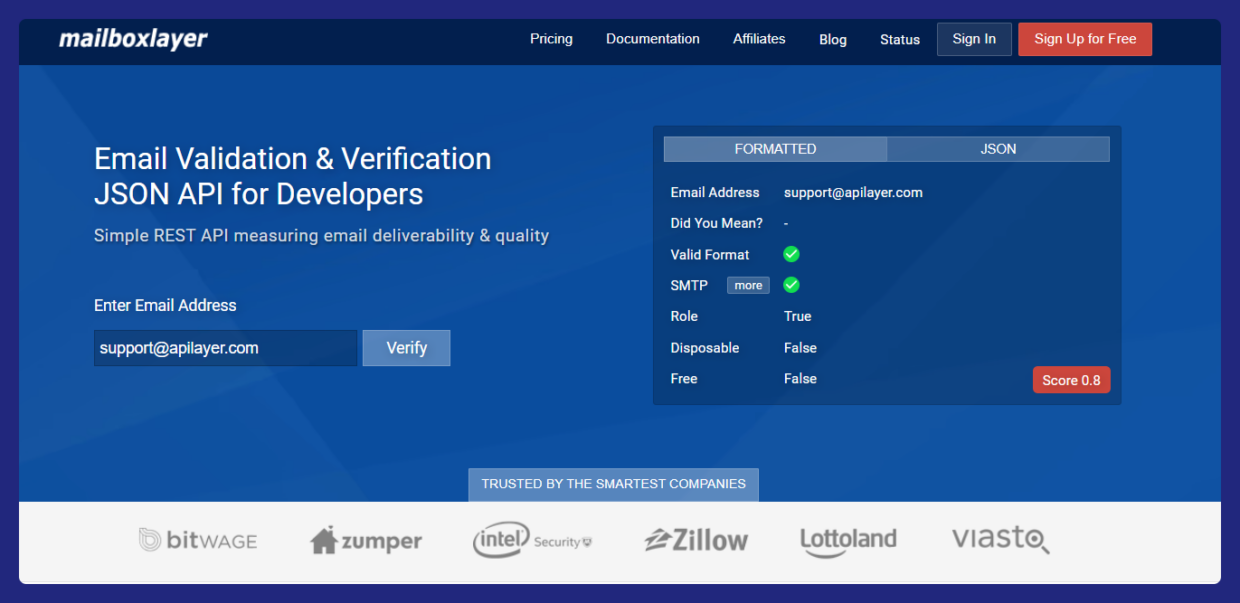
Mailboxlayer is an email verification service for assisting developers and growth teams
that need to check and verify email inputs at the moment they arrive: sign-up forms, CRMs, and bulk imports. The system runs verification via syntax checks, real time SMTP probes, DNS and MX records validation, plus disposable provider filtering to keep data accuracy high.
Under the hood, Mailboxlayer offers a simple REST-based JSON API. Developers call a single API request with an access key (API key), then receive a simple JSON response that includes a quality score, flags for free and disposable providers, and a numeric score reflecting deliverability risk.
Mailboxlayer features
Layered validation: syntax, DNS, SMTP
Mailboxlayer offers multi-step email address validation verification that aims for data accuracy without too much latency:
- Syntax + DNS – Thorough syntax validation and syntax checks confirm if an address follows RFC rules and if DNS contains valid MX records for the domain. This helps thouroughly check basic structure before deeper work.
- SMTP & mailbox – Through simple mail transfer protocol tests, SMTP handshakes, and requested mailbox checks, the API pings the remote server to confirm actual existence. A would be email server conversation happens behind the scenes, although the API returns a simple JSON response instead of a delivered mail. Some servers use greylisting, so Mailboxlayer notes that in the output.
This verification via syntax checks and live server contact gives a stronger view than syntax alone.
Risk scoring, hints, and typo checks
Mailboxlayer adds a numeric score reflecting deliverability risk — a quality score or score reflecting the quality of the address. This lets applications automatically filter or gate users:
- Risk score – A numeric score signals how safe an address looks, so teams can tune their thresholds.
- Typo checks & spelling checks – The API performs typo checks, checks typo and spelling, and typo and spelling checks to catch common mistakes.
- Email suggestions – It supports did you mean suggestions / you mean suggestions. For example, if a user types gamil.com instead of gmail, the system can offer an immediate hint.
These features reduce fat-finger errors and increase response rates for confirmation and reset flows.
Provider intelligence & disposable provider filtering
Mailboxlayer connects to regularly updated databases of available email providers. The API can:
- Flag free email providers / free providers such as Gmail or Yahoo.
- Detect disposable providers, disposable email providers, and checks free and disposable addresses.
- Identify catch-all setups on individual domains where the requested mailbox always seems valid.
This disposable provider filtering allows apps to automatically filter junk sign-ups, fight against fraudulent users, and keep incoming mail traffic closer to real people.
Additional features for devs
Beyond checks, Mailboxlayer offers some additional features that help with implementation:
- Simple rest based JSON outputs – a rest based json api that keeps payloads small and clear.
- Batching and rate stats – you can send multiple addresses, monitor throughput, and track credit usage.
- Security – traffic runs over HTTPS with 256-bit encryption, so the API remains safe for production use.

Mailboxlayer pros
Here’s what teams and users tend to like.
Fast integration
One API endpoint with an API key or access key gives a simple JSON response that drops into forms, sign-up flows, or back-office tools. Guides for PHP, JS, and other stacks help assisting developers get live quickly.
Strong hygiene through filtering
Checks free and disposable addresses, disposable provider filtering, and typo hints automatically filter junk out of registration funnels. That improves list quality and increasing success rates for email campaigns later on.
Affordable start and free plan
A generous free plan — with a fixed number of monthly requests — makes it easy to test instant email address validation before full rollout. Paid tiers scale with email addresses checked and API volume. [CTA — TEXT]
Want deeper deliverability, not only validation? Try Bouncer →
Mailboxlayer cons
A few trade-offs to keep in mind.
Edge cases and greylisting
When a mail server uses greylisting or throttling, simple mail transfer protocol checks may fail on the first attempt. For these cases, the API returns a less certain quality score, and teams often need re-tries to get full clarity.
Context limits
The API can verify email addresses and label free email addresses, yet a status that says “valid” does not predict opens, clicks, or revenue. Risk on free email providers tends to vary, so teams still need good targeting and content for real gains.
Scoring nuance
The numeric score reflecting risk needs calibration per brand. What passes for one customers group might not fit another. You tune thresholds against your own database and conversion data.
Mailboxlayer reviews
According to developer reviews and tutorials, teams check and verify email at the point of entry, see fewer invalid email addresses, and gate suspicious users before they enter a CRM. Many note that the docs stay clear, and the rest based structure keeps integration light.
Some customers mention occasional error code or error message responses when an upstream server drops or stalls. In those cases, a delayed re-try often clears the issue.
Mailboxlayer pricing
You can sign up for a free API key with a limited monthly quota on the marketplace, then move to paid tiers that scale with API request volume. An entry plan supports a few thousand checks, while higher tiers cover heavier incoming mail traffic. Pricing remains transparent on the official page and on the APILayer marketplace.
Why consider alternatives to Mailboxlayer?
Mailboxlayer offers a good email verification layer for dev-led teams, although you might explore alternatives when you need more than gatekeeping.
- Deliverability depth – Mailboxlayer focuses on email address validation. If you want warm-up insights, blocklist checks, or inbox placement testing, a deliverability-first platform fits better.
- Engagement focus – Validation alone does not solve targeting, content, or funnel issues. You might want tools that connect list hygiene with open-rate and conversion metrics.
- Enterprise policies & data flows – Some enterprises require EU data centers, SOC 2, or specific integration paths. In these cases, a specialized deliverability stack brings stronger guarantees and native ESP/CRM connectors.
Best Mailboxlayer alternatives
If your priority is maximum inbox placement and list health instead of only point-in-time checks, these tools deserve a closer view.
#1 Bouncer: best email verification alternative

Bouncer focuses on deliverability & hygiene so inbox providers trust your mail and your email campaigns reach real customers. It handles bulk and real-time checks and slots into existing stacks through integrations and a high-performance API.
Key features
- High-accuracy verification across bulk and real-time – Bouncer validates email addresses with multi-step checks: syntax, domain, MX, SMTP, and proprietary logic for the most accurate result.
- Spam-trap & disposable email detection – It detects risky addresses, disposable email providers, role accounts, and toxic contacts, which protects reputation and success rates.
- Role-based address filtering and list checks – Role addresses such as support@ stay flagged so you can treat them differently from one-to-one contacts.
- Native integrations to CRMs and ESPs – Bouncer connects with HubSpot, Mailchimp, Klaviyo, and other platforms, so you can verify email addresses at capture instead of clean-up only.
- Reports that ops can act on – Clear breakdowns signal what to keep, what to send with care, and what to suppress, so ops teams can protect sender reputation and list health.
Explore Bouncer deliverability tools.
Why Bouncer makes a good alternative to Mailboxlayer
Mailboxlayer focuses on rest based json api checks at entry. Bouncer centers on deliverability outcomes. Teams get:
- Clear risk tiers, not just a single numeric score.
- Automatic suppression rules that help with fighting fraudulent users and toxic records.
- A platform that protects long-term reputation, not only sign-up flows.
Best use cases
- Guarding forms and CRMs against junk while keeping UX smooth.
- Cleaning old imports and historic lists without heavy code.
- Rolling validation across products, brands, and regions with consistent logic and reporting.
Bouncer reviews
Marketers share that Bouncer cuts bounce rate, keeps lists healthy, and boosts inbox placement over time. Reviews also mention strong support and simple application setup.
Pricing
Bouncer uses usage-based pricing with fair steps at scale and a free test allocation, so teams can trial risk scoring and verification flow without immediate commitment.
#2 NeverBounce
A one-purpose validator with fast bulk throughput.
- Pros: Very fast batch processing, solid API, straightforward UI.
- Cons: Fewer scoring hints, little enrichment, price curve climbs at higher volume.
Pricing: around $0.008 per verification on typical plans.
Verdict: strong for short bursts; Bouncer still leads on hygiene depth and deliverability view.
#3 ZeroBounce
A validator plus enrichment and deliverability extras.
- Pros: Spam-trap detection, demographic enrichment, advanced dashboards.
- Cons: Heavier UX, higher cost, more complex setup.
Pricing: roughly $16 for 2,000 checks.
Verdict: powerful feature set; Bouncer feels simpler for teams who just want clean, deliverable lists.
#4 Clearout
SMB-friendly validator.
- Pros: Easy setup, quick checks, fair SMB pricing.
- Cons: Limited analytics, fewer integrations, lighter deliverability focus.
Pricing: near $31 for 3,000 verifications on public plans.
Verdict: good starter choice; Bouncer scales better when campaigns grow.
#5 EmailListVerify
Budget validation for small projects.
- Pros: Low cost, quick runs, simple UX.
- Cons: Light API and reporting, no advanced hygiene logic.
Pricing: about $4 for 1,000 checks.
Verdict: cheapest route; Bouncer delivers stronger outcomes for serious senders.
Comparison table
| Tool | Best for | Strength | Weakness | Free trial | Verdict |
| Bouncer | Deliverability & hygiene | Accuracy, scale, clarity | None major | ✅ | ⭐ Best overall |
| mailboxlayer | Dev-led validation | Fast API, typo hints, filtering | Scoring nuance, limited depth | ✅ | Great for builders |
| NeverBounce | Bulk runs | Throughput | Price at scale | ❌ | Reliable sprinter |
| ZeroBounce | Validation + enrichment | Deep signals | Complexity, higher cost | ❌ | Power user pick |
| Clearout | SMBs | Simplicity | Limited depth | ✅ | Entry-level |
| EmailListVerify | Micro budgets | Low price | Minimal features | ✅ | Budget basic |
Over to you
If you want a developer-friendly way to check and verify email inputs, Mailboxlayer gives a clean rest based API, instant email address validation, typo hints, and checks free and disposable addresses, so frontends and backends can thouroughly check sign-ups before they hit your systems.
The Mailboxlayer API fits well when teams care about fast guardrails, simple code, and light-weight email address validation on individual forms.
If your main goal sits closer to long-term deliverability, list health, and ROI from email campaigns, Bouncer becomes the more useful alternative. It focuses on accurate verification at scale, helps with fighting fraudulent users, and supports senders who need clean lists and steady inbox placement.
Start with Bouncer: verify email addresses and protect your campaigns


