





For security service providers, law enforcement agencies, and managed security service providers, clean, reliable email data isn’t just a marketing concern—it’s a matter of threat response.
WhoisXML Email Verifier extends the company’s whoisxml api tools ecosystem to help organizations verify domain names, detect suspicious domains, and maintain a secure and transparent internet through validated contact channels.
TL;DR
- WhoisXML offers an email verification solution that helps identify fake or malicious addresses within threat datasets.
- It integrates with whoisxml api technology and dns data sources to improve cyber threat intelligence accuracy.
- The tool assists security operations centers (SOCs) and security service providers MSSPs in maintaining superior network visibility.
- Bouncer remains the better choice for marketing teams focused purely on deliverability and clean subscriber management.
What is WhoisXML Email Verifier?
The WhoisXML Email Verifier is part of the whoisxml api suite—a platform specializing in domain, IP, and DNS intelligence. Unlike traditional validation tools, it’s designed for cyber security, law enforcement units, brand protection agencies, and commercial security platforms SIEM systems.
The verifier checks domain ownership, dns records, and ip addresses to identify invalid, fake, or compromised emails that might belong to threat actors.
WhoisXML Email Verifier features
The verifier combines whois data, ip and dns data, and domain data to enable security operations teams to investigate deeper.
- Deep email inspection – Goes beyond syntax checks by correlating domain and dns intelligence with real ip records.
- Threat context enrichment – Adds cyber threat intelligence context to potentially malicious email addresses, enabling better detection.
- API access – Integrates directly through an api key into security platforms SIEM SOAR environments.
- Real-time monitoring – Designed for security operations centers to monitor suspicious domains and alert teams instantly.

WhoisXML Email Verifier pros
Here’s why it stands out for the cybersecurity industry:
- High accuracy – Uses domain IP and DNS correlation for pinpoint results in threat detection.
- Data aggregation – Leverages over a decade of collected whois, ip, and dns data to uncover connected domains.
- Seamless integration – Works across commercial security platforms, sumo logic, and custom SOC pipelines.
WhoisXML Email Verifier cons
Despite its sophistication, the tool may not fit every type of organization:
- Complexity – Built for security operations centers, not casual email marketing teams.
- Cost structure – Its data feeds and api access can be expensive for smaller companies.
- Limited UI – Requires engineering support for setup and integration.
WhoisXML Email Verifier reviews
Analysts and security operations specialists praise it for its precision in identifying suspicious domains and threat actors. Users say it has been proven invaluable in helping security operations centers achieve superior network visibility, but note it’s not a lightweight verifier for marketing lists or CRM usage.
WhoisXML Email Verifier pricing
Pricing depends on volume, api usage, and the type of data feeds subscribed to. Clients can purchase access through tiered plans or enterprise agreements. A trial api key can be requested via the official whoisxml website.
Why should you consider alternatives to WhoisXML Email Verifier?
While WhoisXML dominates in cyber threat intelligence, it’s not built for marketers managing email campaigns or CRM data. You might consider an alternative when you need:
- Simpler usability – No engineering overhead or integration setup.
- Email marketing optimization – For improving deliverability rather than threat detection.
- Lower costs – Security-grade data aggregation can exceed marketing budgets.
Best WhoisXML Email Verifier alternatives
If your goal is clean contact lists and marketing efficiency instead of forensic-level intelligence, these alternatives make more sense.
#1 Bouncer: best email verification alternative
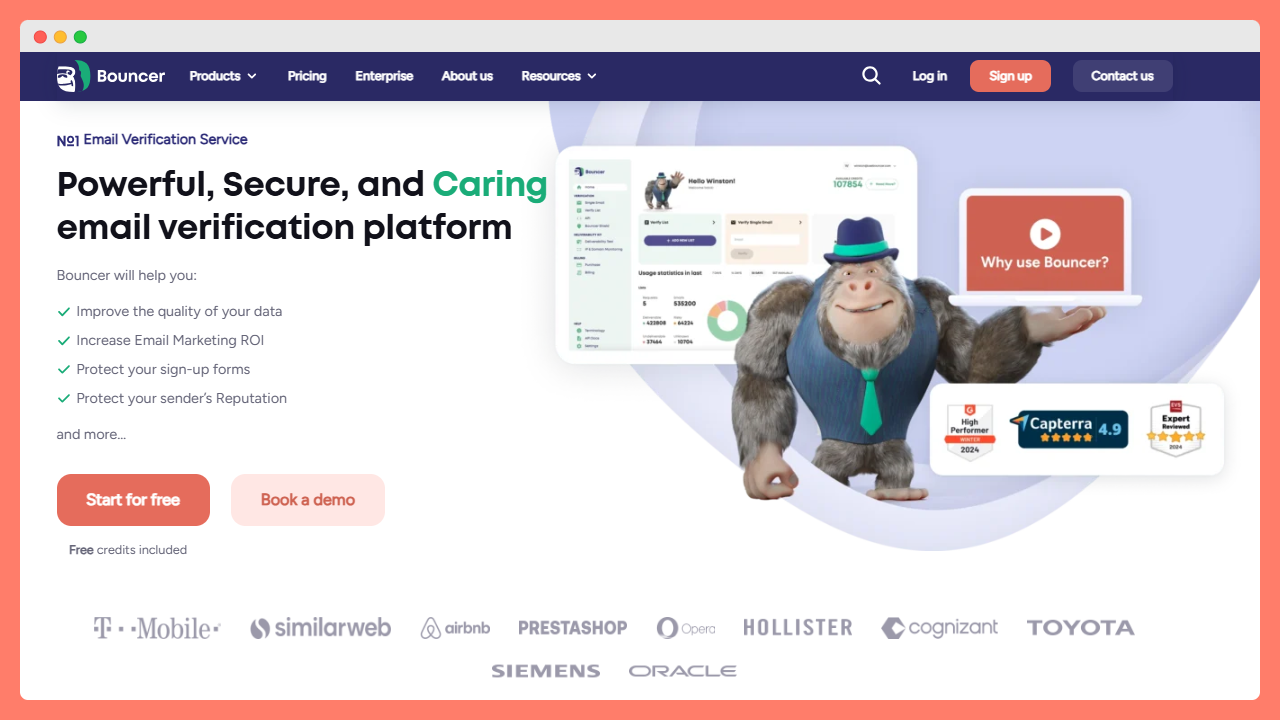
Bouncer focuses on accurate email validation for businesses running large-scale email marketing campaigns. It ensures valid email addresses, reduces bounces, and helps brands maintain strong sender reputation without technical setup.
Key features
- Real-time API email verification – Validate new signups instantly.
- Bulk cleaning – Process massive email lists quickly.
- Spam trap detection – Prevents sending to risky or compromised contacts.
- High accuracy – Continuous improvement through data-driven validation algorithms.
- Integrations – Connects easily to marketing platforms and CRMs.
- And many, many more options: AutoClean, Data enrichment, Shield or Email engagement insights.
Why does it make a good alternative to WhoisXML?
Bouncer prioritizes usability, affordability, and deliverability, making it perfect for marketing teams rather than security operations centers. It doesn’t provide predictive threat intelligence, but it delivers unmatched ease, speed, and reliability for outreach-focused workflows.
Best use case
- Businesses sending newsletters and product updates.
- Agencies managing multi-client campaigns.
- Marketers needing scalable, non-technical list cleaning.
Bouncer reviews
Users highlight Bouncer’s accuracy, simplicity, and affordability. Many report higher deliverability and fewer bounces after implementing it.
Pricing
Flexible pay-as-you-go model with transparent pricing and immediate access to verification.
Try Bouncer today — keep your lists clean, your emails deliver, and your outreach truly effective.
#2 ZeroBounce
ZeroBounce bridges email hygiene and enrichment.
Pros
- Spam trap and abuse detection.
- Domain scoring and accuracy reports.
- Enrichment via geolocation data.
Cons
- Premium pricing.
- Limited developer automation for free plans.
- Complex for non-technical teams.
- Overkill for smaller marketing departments.
Pricing: $99 in ZeroBounce ONE plan
Bouncer offers a simpler, faster experience with similar accuracy.
#3 NeverBounce
NeverBounce specializes in bulk validation for business communications.
Pros
- High processing speed.
- Clear reporting.
- Easy export options.
Cons
- No built-in enrichment or ip intelligence.
- Slight delays for large volumes.
- Doesn’t integrate with all CRMs out-of-the-box.
- Not tailored for threat or domain analysis.
Pricing: $0.008 per validation.
NeverBounce is reliable, but Bouncer provides better integration and pricing transparency.
#4 Clearout
Clearout provides a balance of accuracy and ease for marketers.
Pros
- Quick setup.
- Simple UI.
- Affordable for SMBs.
Cons
- Fewer technical checks.
- Limited whois or domain correlation features.
- Basic reporting.
- Slower response time during large jobs.
Pricing: $14 for 3,000 verifications.
Clearout works well for small businesses but lacks the sophistication of whoisxml tools for enterprise data.
#5 EmailListVerify
EmailListVerify focuses on affordability and simplicity.
Pros
- Low-cost plans.
- Simple interface.
- Good for freelancers and startups.
Cons
- No advanced domain analysis.
- No dns records correlation.
- Fewer security protections.
- Minimal reporting features.
Pricing: 5 euro per 1,000 validations.
EmailListVerify is practical, but Bouncer offers superior usability and precision.
Comparison table
| Tool | Best for | Strength | Weakness | Free Trial | Verdict |
|---|---|---|---|---|---|
| Bouncer | Marketing deliverability | Accuracy, ease of use | None | ✅ | ⭐ Best overall |
| WhoisXML Email Verifier | Cyber intelligence | DNS & WHOIS correlation | Technical complexity | ✅ | Best for cybersecurity |
| ZeroBounce | Enrichment & hygiene | Deep data | Cost | ❌ | For data-heavy users |
| NeverBounce | Bulk cleaning | Speed | Fewer integrations | ❌ | Good for volume |
| Clearout | Small business lists | Simplicity | Basic analytics | ✅ | Entry-level |
| EmailListVerify | Budget cleaning | Price | Minimal reporting | ✅ | For lean teams |
Over to you
For security operations centers, government agencies, and law enforcement agencies, WhoisXML’s email verification adds unique value—linking domain IP, dns intelligence, and whois data to uncover threat infrastructure.
But if your goal is improved email deliverability, better list hygiene, and easier usability, Bouncer remains the simpler, more effective choice. It’s built for marketers, not analysts—helping your emails reach people, not firewalls.
Why don’t you give Bouncer a try?


