





Even strong email marketing tools struggle when the list is polluted.
Email verification services solve that gap. A good email verification tool helps you verify email addresses at scale, remove invalid emails before they receive a send, and protect sender reputation. With a clean Klaviyo integration in place, you maintain healthier campaign metrics, stronger email deliverability, and safer sending every day.
TL;DR
- Klaviyo performance depends on clean data — invalid, disposable, and risky emails quickly damage deliverability and inflate costs.
- The best verification tools for Klaviyo must integrate smoothly, support real-time and bulk checks, and return clear, reliable results you can automate.
- Bouncer leads for Klaviyo users thanks to its native AutoClean workflow, strong accuracy, and simple Keep/Suppress logic that protects sender reputation automatically.
What to look for in an email verification tool for Klaviyo
Choosing the best email verification services for Klaviyo starts with understanding what actually matters for day-to-day sending. Klaviyo users don’t just need a basic email checker. They need tools that validate emails at scale, sync clean data back into the platform, and support both bulk verification and real time validation.
Here’s what separates the best email verification tools from the rest.
A verification workflow that fits Klaviyo
The tool should plug into your Klaviyo account without hacks, broken links, or manual exports. A proper Klaviyo integration lets you select lists, run bulk verification, and sync verification results directly back to your email marketing tool.
Strong accuracy with clear results
High accuracy matters when you verify emails. You want a service that flags invalid email addresses, syntax errors, disposable email detection, and other risky addresses with clear categories. Reliable email scoring also helps you avoid addresses that look valid but still risk sending issues.
Support for real-time email verification
Real-time validation stops invalid emails before they enter your list in the first place. A good tool offers a clean email verification API, form protection, or Zapier integrations to validate signups the moment users submit.
Bulk verification that doesn’t slow you down
Klaviyo users often import larger email lists, so bulk email verification needs to be fast and painless. The tool should handle big CSVs, support list cleaning in one go, and return clean data without forcing you to repeat the process.
A user friendly interface
Many teams share access to their marketing tools, so the email validation dashboard must be easy to navigate. Clear steps, transparent verification results, and straightforward filters prevent mistakes when managing big lists.
Protection for sender reputation
Look for tools that help reduce spam complaints, spot spam traps, and detect temporary or disposable emails. Some even assist with domain authentication or dmarc monitoring, which supports long-term deliverability.
Flexible workflows and pricing models
Klaviyo users often switch between bulk cleaning and ongoing verification. The best platforms support both without locking you into an oversized plan. A free plan or free credits also helps teams test the verification process before committing.
Compatibility with other marketing platforms
Many businesses use tools like Constant Contact, Google Sheets, Gmail, or other email marketing tools alongside Klaviyo. Pick a service that can verify emails in these places as well, reducing risk across your full stack.

Best email verification tools for Klaviyo
Bouncer
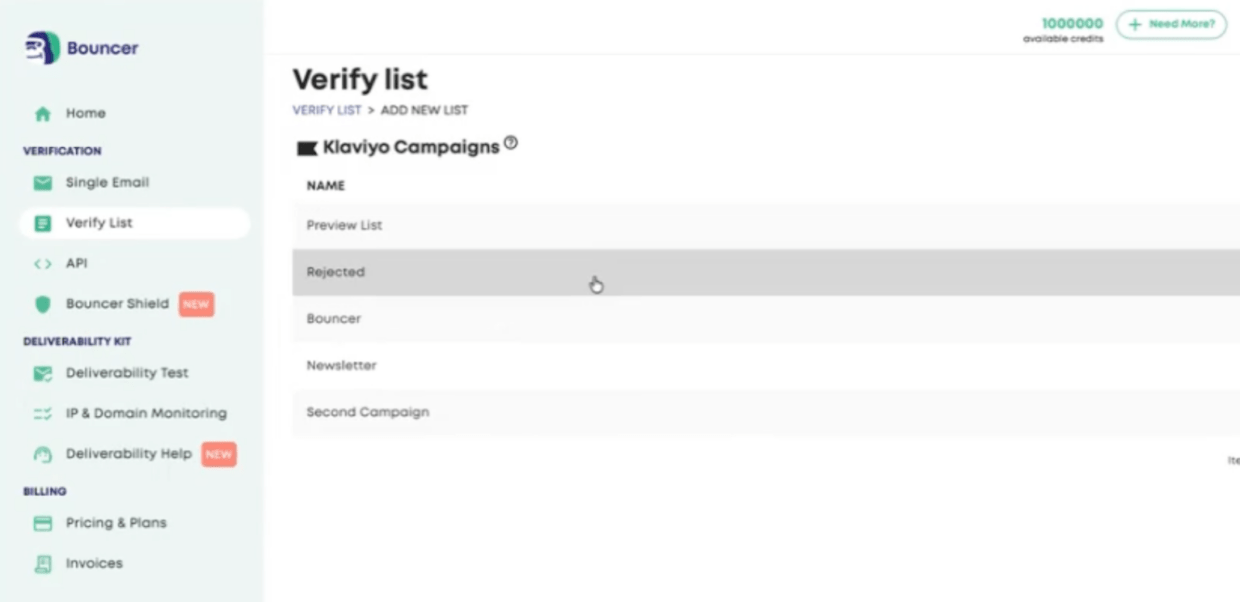
Bouncer stands out because it doesn’t just verify email addresses — it keeps Klaviyo lists clean automatically. Once you connect your Klaviyo account through the secure login flow, Bouncer imports only the email addresses from your lists. Nothing else is touched. In the interface, your Klaviyo lists appear exactly as shown in the screenshot: clean list names, ready to select.
After you pick the list, you set up AutoClean. The scheduling options are simple: verify the entire list immediately, check every new contact hourly, and reverify existing emails on a cycle of your choice (for example, every 30, 90, or 180 days). Each option is optional, so you can enable or disable them independently.
Once the schedule is active, Bouncer applies the rules you see in the Export Config panel. For safe contacts, it assigns Keep. For undeliverable, disposable, or higher-toxicity addresses, it assigns Suppress. If something needs closer attention, it goes to Quarantine. These values are added inside your Klaviyo profile field called Bouncer Recommends, which becomes the foundation for your automations. A common setup is: if value = suppress → mark as non-marketing, or even remove the profile completely to lower your Klaviyo bill.
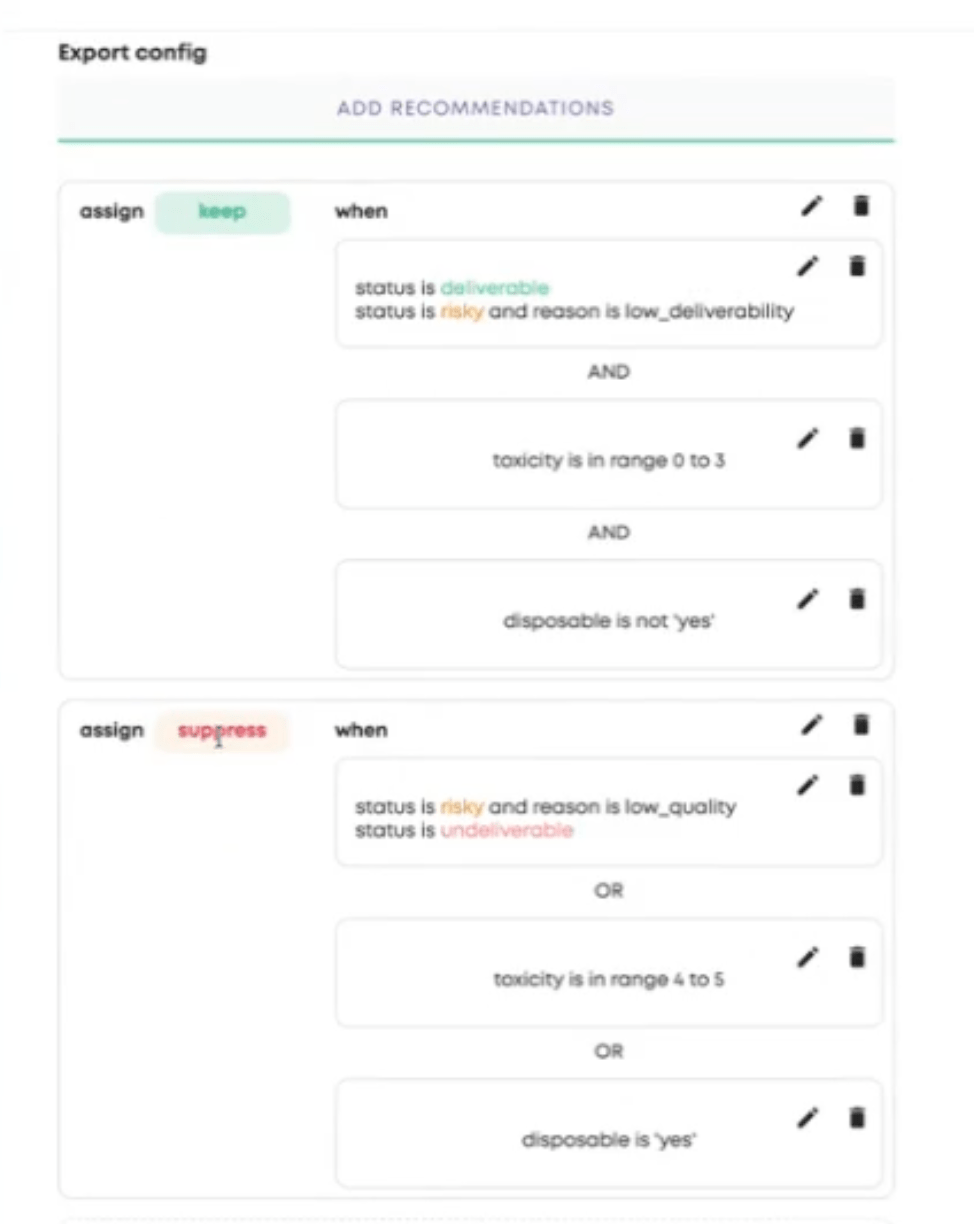
When AutoClean starts for the first time, it loads the entire list from Klaviyo and verifies it in one pass. From that point onward, every new signup is checked automatically. You can monitor these cycles in your dashboard, and run a manual verification at any moment. The screenshots match this flow precisely, showing where you see the list, how the automation toggles look, and how the Keep/Suppress logic is built.
For Klaviyo users who want continuous list hygiene without touching CSV files or running repeated bulk checks, Bouncer delivers a clean, automated process that protects sender reputation and keeps email deliverability stable.
⚠️ What other email-verification tools struggle with
ZeroBounce
- ZeroBounce packs a lot — bulk verification, real-time API, spam-trap detection, even inbox-placement tests and domain-level diagnostics.
- That depth comes at a price: for those who only need regular list hygiene or basic validation, the interface and feature set feel heavy and complex. Some users report that for disposable, catch-all, or otherwise risky addresses, the results are less reliable than desired.
- As a result, the “all-in-one deliverability platform” can overdeliver for simple Klaviyo users — which means you might pay for features you never use.
NeverBounce
- NeverBounce promises high accuracy (claims up to 99.9%) and offers real-time verification plus bulk list cleaning.
- However, real-world tests and reviews suggest accuracy isn’t always consistent, especially with catch-all domains and more subtle “risky” patterns.
- The process tends to be more manual if you use it for Klaviyo: often it requires CSV exports/imports or third-party automation (e.g. Zapier). That adds friction compared with a native integration.
Kickbox
- Kickbox offers a simple, lightweight verification flow, with bulk checks and real-time API as well. It also has a “SendEx” quality score to highlight risky addresses.
- But in exchange for simplicity, it limits depth: fewer built-in tools around deliverability (spam-trap detection, domain scoring, disposable-email profiling) than more mature platforms.
- For large mailing lists or high-volume senders, Kickbox can get slow, and its reporting lacks detail when it flags an address as risky — making it harder to decide whether to keep or suppress that contact.
They may be fine for one-off list cleans, but fall short when you need continuous Klaviyo-ready hygiene.
- Many of these tools treat email validation as a one-time job — good for occasional CSV imports, but inconvenient if you want ongoing list health.
- Their integrations with ESPs or CRM systems like Klaviyo are often indirect or require manual exports/imports or third-party connectors; that adds overhead and leaves room for human error.
- Their ability to detect “risky but not obviously invalid” addresses — like disposable domains, catch-alls, or borderline spam traps — tends to be weaker or inconsistent. That’s a liability for deliverability and sender reputation.
- For users focusing on Klaviyo, the workflow friction and uncertainty with deliverability-critical contacts can outweigh the “bulk verification” benefits.
How verification improves Klaviyo performance
Email verification has a direct influence on how your Klaviyo emails land.
Klaviyo reacts to data quality fast, and any spike in bounce rates or risky sign ups can pull down domain reputation and weaken future email campaigns.
The first improvement comes from removing invalid contacts early. Proper email validation services go beyond a basic syntax check and catch disposable domains, spam traps, and other risky patterns that slip through standard forms. When these addresses stay in your list, they create hard bounces and signal to mailbox providers that the sender isn’t in control of their data. Cleaning them out helps improve deliverability across all sends.
A second benefit is stability across drip campaigns and automated flows. When a workflow relies on real contacts only, engagement rises and negative signals drop. That makes your email marketing platform more effective with less effort. It also supports GDPR compliance because you avoid storing invalid or fake sign-ups that never belonged in your system.
Another gain is cost. Klaviyo charges based on profiles, so removing invalid profiles means you spend more credits on real subscribers and less on addresses that never engage. Compared with manual exports or other email verification software that requires extra steps, a tool integrated directly with Klaviyo keeps this process ongoing rather than reactive. Even well-known platforms like the ZeroBounce platform rely on periodic bulk cleaning, which leaves more room for risky contacts to linger.
With a continuous verification process in place, you maintain a cleaner list, protect domain reputation, and improve email deliverability over time. The result is simple: stronger campaign performance from the same audience and fewer surprises when you scale.
When to verify your Klaviyo list
Klaviyo users get the best results when verification happens at consistent points in the lifecycle. These moments matter most:
1. Before importing a CSV or migrating from another platform
Any time you add contacts from outside Klaviyo, run verification first. Older files often contain invalid emails, outdated domains, or risky addresses that drag down performance the moment they enter your Klaviyo account.
2. After a surge in sign ups
Seasonal promos, giveaways, paid ads, or influencer campaigns tend to attract temporary emails and low-quality sign ups. A verification pass right after the spike keeps those contacts from hurting campaign performance.
3. Before major email campaigns or heavy seasonal sends
Cleaning your list ahead of Black Friday, a new product launch, or a multi-step promotion helps improve deliverability. Only active, valid contacts enter high-stakes flows.
4. When engagement drops or bounce rates rise
If open rates dip or bounce rates suddenly climb, it’s a sign your list has accumulated invalid addresses. Verification clears those issues before they influence sender reputation.
5. When testing new sources, tools, or forms
If you add a new sign-up form, switch marketing tools, or introduce a new acquisition channel, validate incoming contacts during the early weeks. Poor-quality form setups often generate fake or malformed submissions.
6. As part of routine maintenance
Even with strong acquisition practices, lists decay. Emails go dormant, domains expire, and subscribers churn quietly. A periodic verification cycle keeps your Klaviyo lists clean without guesswork.
Conclusion
Choosing the right email verification tool keeps your Klaviyo account healthier, your domain reputation safer, and your email campaigns more consistent. Clean data reduces bounce rates, improves deliverability, and helps your messages reach real people instead of spam filters or dead inboxes. Klaviyo users gain the most when verification becomes part of their daily workflow rather than a one-time clean-up.
If you want automated protection, real-time checks for new sign ups, and verification results that plug directly into your Klaviyo flows, Bouncer offers the smoothest setup and the most practical features for ongoing list hygiene.
Try out Bouncer and feel the difference.


