





Newsletter hard bounces are easiest to prevent before send day. Once the campaign report shows the failure, the invalid address has already been attempted.
A healthy newsletter program therefore treats bounce prevention as a lifecycle: protect signup, store quality status, suppress known failures, reverify stale segments, and inspect the source when bounce rates change.
The workflow is more useful than a rule such as “verify the entire list before every campaign.” Active first-party subscribers and a three-year-old reactivation segment should not be managed the same way.
1. Catch errors at signup
Newsletter forms collect typos, fake addresses, disposable inboxes, and occasionally automated junk. Catching those entries at the form is cheaper than cleaning them after they enter the ESP.
Custom newsletter signup logic can use the Email Verification API, while Bouncer Shield is useful when the form itself needs a lighter protection layer.

Keep the UX gentle. A likely typo should usually trigger a correction suggestion. A newsletter signup does not need the same strict disposable-email policy as a heavily abused free trial.
2. Store verification and source with the subscriber
If the result disappears after the form, the team loses useful context.
Store verification status, verification date, source/form, and relevant flags inside the CRM or ESP. Source matters because a popup, webinar, paid landing page, checkout, and partner import can produce very different list quality.
3. Make suppression durable
Hard-bounced contacts should not return because an old file was imported. The same applies to complaints, unsubscribes, and do-not-contact records.
Suppression needs to survive migrations, list rebuilds, and tool changes. A new campaign name does not make an old hard bounce valid again.
4. Reverify stale segments before reactivation
Active subscribers do not need a full list check before every newsletter. Dormant, imported, old, and uncertain segments deserve more attention.
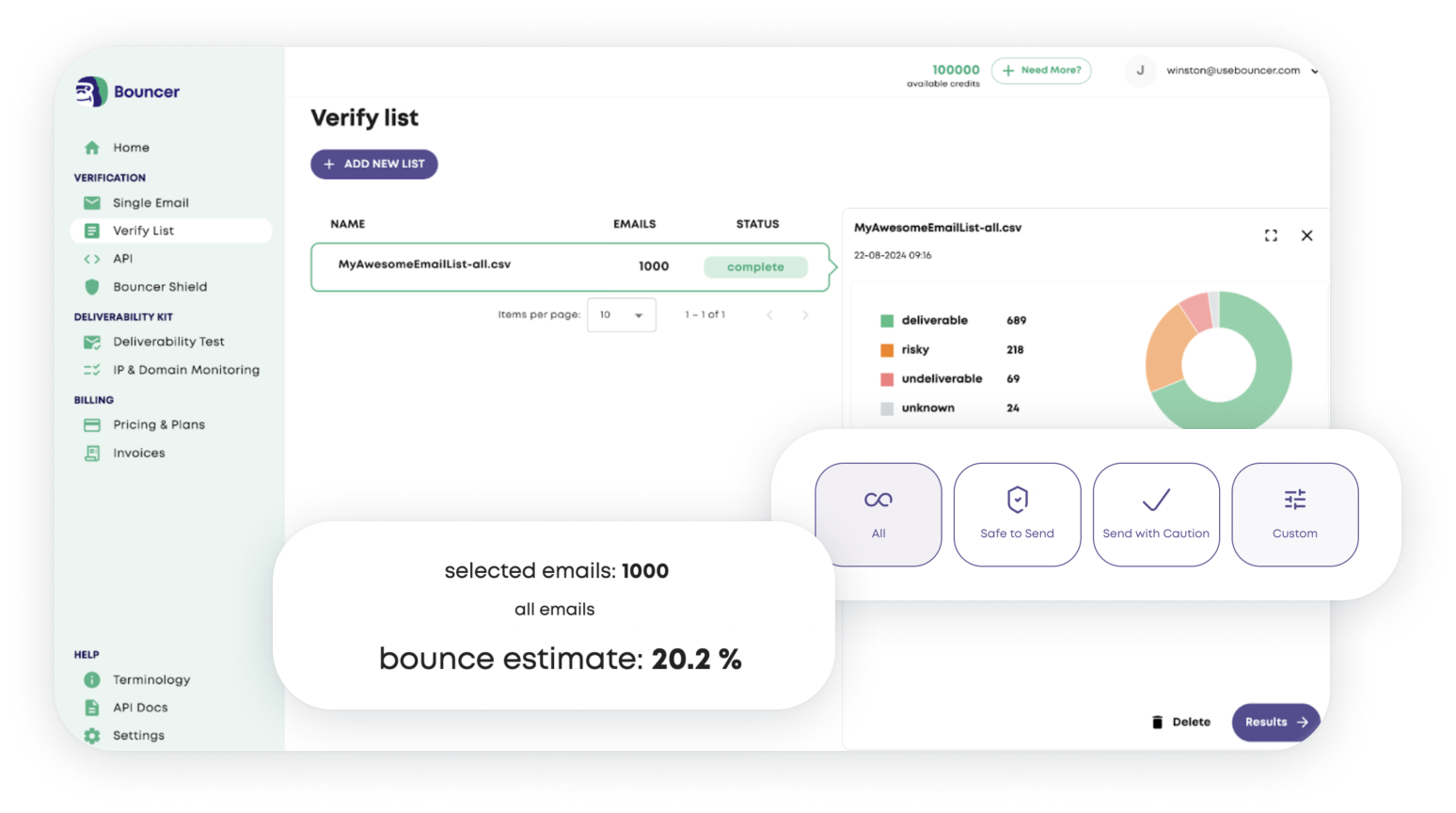
Use bulk email verification before a large win-back, seasonal reactivation, or send to records that have not been contacted for a long time.
5. Treat catch-all and unknown results separately
Do not put every non-invalid result into the same sendable bucket.
Catch-all domains are common in B2B and can reduce mailbox-level certainty. Unknown results also deserve a different rule from clearly deliverable contacts.
For a consumer newsletter, uncertain records may stay out of the riskiest reactivation send. For a small B2B newsletter with manually sourced contacts, the business may accept more uncertainty.
6. Track bounce rate by acquisition source
An account-wide bounce rate tells you that something changed. Source-level data tells you where to look.
| Source | Typical quality issue | What to review |
|---|---|---|
| Footer/newsletter form | Typos | Form correction and verification |
| Popup | Low-intent or disposable signups | Offer and form rules |
| Giveaway | Fake entries | Abuse protection |
| Webinar | Typos and partner data | Source separation |
| Partner import | Unknown provenance | Permission and verification |
| Old customer export | Stale addresses | Reverification before reactivation |
If one source repeatedly produces more invalid records, fix or remove the source. Cleaning the same bad channel every month is a process failure.
7. Use different rules for active and dormant subscribers
An active subscriber who clicked last week is a different risk profile from somebody who has not heard from the brand for two years.
Create inactivity bands and handle them separately. The older the audience, the stronger the reason to reverify and test a smaller cohort first.
8. Check sender readiness before a major newsletter
Lower hard bounces support sender health, but they do not guarantee inbox placement. Before high-volume sends, use Deliverability Kit to check placement, blocklists, SPF, DKIM, and DMARC.
This is particularly useful after a long pause, a sender-domain change, an ESP migration, or a major increase in audience size.
A newsletter bounce-prevention flow
↓
CRM/ESP: store verification + source + suppression state
↓
Audience build: exclude prior failures
↓
Before reactivation: reverify stale/uncertain segments
↓
Before major send: check sender readiness
↓
After send: review bounces by source and cohort
What not to overreact to
A single soft bounce is not the same as an invalid address. Temporary mailbox or server conditions can create soft bounces. Your ESP should already have handling logic for repeated temporary failures.
The workflow in this guide is primarily about reducing avoidable hard bounces and preventing obviously weak records from entering the newsletter audience.
How often should verification run?
There is no universal calendar. Frequency depends on how quickly contacts enter, how old the list is, and how often inactive segments return to campaigns.
- high-volume signup programs benefit from real-time validation
- active first-party newsletters can use a regular hygiene cadence
- old or imported segments should be checked before reactivation
- large migrations deserve a pre-import cleanup
Measure the prevention system
| Metric | Why it matters |
|---|---|
| Hard bounce rate | Shows obvious address-quality failures |
| Invalid rate by source | Finds weak acquisition channels |
| Form correction/rejection rate | Shows bad data stopped at entry |
| Dormant-segment bounce rate | Measures reactivation risk |
| Complaint rate | Adds sender-reputation context |
| Inbox placement | Confirms health beyond bounces |
Example: diagnosing a bounce spike after a partner webinar
A newsletter normally sees very few hard bounces. After a partner webinar, the next campaign jumps noticeably. The temptation is to clean the whole newsletter database.
A source-level view shows that most new failures came from the webinar import. The fix is narrower: isolate the partner list, verify it, check how registration emails were collected, and keep the rest of the healthy first-party audience unchanged.
This is why source tagging matters. Without it, one weak import can trigger unnecessary work across the entire database.
Do not use open rate as the bounce-prevention trigger
Open tracking has become less reliable as a measure of individual engagement. More importantly, an address can be invalid regardless of its old open history. Use source, age, bounce history, suppression, and verification status for hygiene decisions.
Build a reactivation rule that marketing can follow
| Subscriber state | Action |
|---|---|
| Active recent subscriber | Normal send cadence |
| Inactive but recently verified | Smaller re-engagement test |
| Inactive + stale verification | Reverify before reactivation |
| Old + unknown source | Strong review or exclude |
| Prior hard bounce/complaint | Keep suppressed |
A simple table like this is easier for campaign teams to follow than a vague instruction to “clean the list regularly.”
Use a bounce spike as a source audit trigger
Define a simple internal rule: when hard bounces move materially above the normal baseline, pause expansion and inspect source mix before the next send. The exact threshold can depend on the ESP and program, but the action should be agreed in advance.
This avoids the common pattern where a team notices a spike, removes the failed addresses, and sends again without asking where the new invalids came from.
Keep newsletter growth reporting honest
A signup is not equally valuable if it is invalid, disposable, or immediately suppressed. Consider reporting verified new subscribers alongside raw form submissions for acquisition channels where data quality varies.
This is especially useful for paid lead magnets, giveaways, and partner campaigns. It prevents a channel from looking successful because it generated a large number of contacts that never became usable subscribers.
Document the re-verification cadence
Write the rule into the campaign process so it does not depend on one person’s memory. For example: reverify dormant contacts before a win-back campaign, recheck large imported lists before activation, and validate new high-volume signup sources at entry.
The cadence should follow risk and age rather than a random calendar reminder.
Make the rule visible to campaign builders
Do not hide hygiene logic in an operations document nobody reads. Put the subscriber state directly in the audience-building workflow: active, reactivation-ready, needs verification, suppressed, or review.
When the campaign builder can see why a contact is excluded, they are less likely to bypass the rule by uploading a fresh CSV.
FAQ
Should I verify my newsletter before every send?
Not necessarily. Active first-party lists can use a regular hygiene cadence. Reverify old, dormant, imported, or uncertain segments before major sends.
Can signup validation stop all hard bounces?
No. Addresses can become unavailable later. Signup validation reduces bad data at entry; suppression and re-verification handle later decay.
Does a low bounce rate guarantee inbox placement?
No. Placement also depends on authentication, complaints, engagement, sender reputation, volume, and provider behavior.


