





That is why an email hygiene checklist for B2B marketing teams needs to cover more than “remove invalid emails.” It should protect campaigns, CRM trust, sales productivity, and sender reputation before the next send starts.
You’ll learn
- What email hygiene means for B2B marketing teams
- How to check list sources before campaigns
- Which records need verification, suppression, enrichment, or review
- How Bouncer fits into B2B email hygiene workflows
- How to connect hygiene with CRM, segmentation, and deliverability
- Which checks matter before cold outreach, nurture campaigns, and reactivation
- How to build a repeatable checklist for marketing ops and RevOps
Why B2B teams need an email hygiene checklist
B2B email data changes quickly. People switch jobs, companies change domains, departments restructure, inboxes close, and old contacts stop engaging. A contact that looked usable last quarter may no longer be reachable. A company domain may accept mail through a catch-all setup. A role-based address may technically receive email but rarely create a useful sales conversation.
That makes B2B list quality more fragile than many teams expect.
For marketing teams, poor hygiene creates several problems at once. Campaigns bounce. Sender reputation weakens. Segments become unreliable. Sales receives leads that cannot be reached. CRM reports look more optimistic than reality. Lead source quality becomes hard to judge.
An email hygiene checklist for B2B marketing teams creates a repeatable process. Instead of cleaning lists only after deliverability drops, the team checks data quality before campaigns, imports, automation, and sales handoff.
This matters more now because mailbox providers expect senders to authenticate properly, keep spam complaints low, and make unsubscribing easy. Clean lists do not solve every deliverability issue, but bad lists can make all other email work harder.
What email hygiene covers in B2B marketing
Email hygiene is the process of keeping contact data accurate, usable, permission-aware, and safe for sending. In B2B, it sits between marketing operations, sales operations, RevOps, CRM management, and deliverability.
It includes email verification, list cleaning, duplicate review, consent checks, suppression logic, source auditing, segmentation, engagement review, CRM updates, and deliverability monitoring.
| Hygiene area | What it checks | Why B2B teams need it |
| Email verification | Whether addresses appear valid and deliverable | Reduces hard bounces before campaigns |
| Source quality | Where the contacts came from | Helps identify risky vendors, imports, or forms |
| Consent and permission | Whether the team can contact the person | Keeps marketing aligned with legal and trust standards |
| Suppression | Who should not receive emails | Protects opt-outs, bounces, complaints, and risk rules |
| Deduplication | Whether records repeat across CRM | Prevents duplicated sends and broken attribution |
| Engagement review | Whether contacts still interact | Supports smarter reactivation and frequency control |
| Segmentation | Whether contacts belong in the right audience | Improves relevance and campaign performance |
| Deliverability checks | Whether technical and inbox signals look healthy | Catches domain, blocklist, and placement issues |
| Form protection | Whether new leads are clean at entry | Stops fake or invalid records earlier |
A spreadsheet can help with some formatting tasks, but it cannot handle real verification, toxicity checks, or inbox placement testing. That is where dedicated tools become useful.
Step 1: audit every source of B2B email data
Start with source quality. Bad email hygiene often begins before a campaign list exists.
B2B contacts may enter your CRM from demo requests, gated content, webinars, partner campaigns, cold outreach files, event badge scans, paid lead gen, product signups, enrichment tools, manual sales imports, old CRM migrations, or purchased databases.
Each source needs a risk label.
| Source | Typical risk level | What to check before use |
| Demo requests | Low to medium | Validate email, check company fit, confirm consent context |
| Webinar registrations | Medium | Verify before nurture, separate attendees from no-shows |
| Gated content forms | Medium | Watch for personal, fake, or disposable emails |
| Cold outreach lists | High | Verify, check toxicity, review source quality |
| Event badge scans | Medium to high | Verify and segment by conversation quality |
| Partner lists | Medium to high | Confirm permission and source terms |
| Old CRM imports | High | Verify before campaigns or reactivation |
| Enrichment tool exports | Medium | Verify emails before sales sequences |
| Purchased data | Very high | Avoid or apply strict review and suppression |
| Product signups | Low to medium | Use real-time validation and routing rules |
Do not treat every list as equally safe. A recent demo request is not the same as a three-year-old event export. A webinar attendee is not the same as a cold prospect found through an enrichment tool.
This source audit should happen before verification because source context affects decisions later. A catch-all email from a strategic inbound account may deserve review. A catch-all email from a weak purchased list may not.
Step 2: verify emails before major campaigns
Email verification should be a standard step before high-impact B2B sends.
Use verification before nurture launches, webinar follow-ups, outbound sequences, partner list imports, reactivation campaigns, old CRM sends, database migrations, and large newsletter campaigns.
Bouncer’s email list verification helps B2B marketing teams check whether email addresses appear safe and deliverable before sending. For larger files, bulk email verification helps process CRM exports, prospect files, event lists, and campaign segments without relying on manual spreadsheet checks.
For uncertain databases, free email list sampling can help estimate list quality before verifying the full file. This is useful when a team receives an old CRM segment, a partner list, or a large cold outreach file and needs to understand risk before spending time on the whole list.
Verification should not live in a downloaded CSV forever. After verification, update your CRM with status, verification date, and suppression reason where possible. Otherwise, the same bad contacts may return to future campaigns.
Step 3: define rules for each verification result
Running verification is not enough. The team needs rules for what happens next.
A good email hygiene checklist for B2B marketing teams should define how to handle valid, invalid, risky, unknown, catch-all, disposable, role-based, duplicate, and toxic records.
| Result type | Recommended action | Why |
| Valid | Use in appropriate campaigns | Lower delivery risk |
| Invalid | Suppress from sends | Reduces hard bounces |
| Disposable | Suppress or exclude from lead scoring | Often weak intent or temporary access |
| Catch-all | Segment or review based on source | Common in B2B, but uncertain |
| Unknown | Avoid high-volume sends | Too much uncertainty for risky campaigns |
| Role-based | Review by campaign type | Shared inboxes may not fit every workflow |
| Toxic | Suppress | Protects sender reputation |
| Duplicate | Merge or keep one active record | Prevents repeated sends and attribution issues |
| Hard bounced | Keep suppressed | Do not reintroduce through imports |
| Complained or unsubscribed | Keep suppressed | Respect negative signals and opt-outs |
Bouncer’s Toxicity Check can help identify potentially harmful email addresses, such as widely circulated, breached, complaining, litigating, or potential spam-trap-related records. This is especially useful for old lists, cold outreach files, and uncertain imports.
Step 4: protect forms before bad emails enter
B2B teams often clean lists after the damage has already entered the CRM. A better workflow stops bad emails at the point of capture.
Forms that need protection include:
- Demo requests
- Contact sales forms
- Free trial signups
- Newsletter forms
- Webinar registrations
- Gated content downloads
- Partner campaign forms
- Event landing pages
- Product signup flows
If these forms accept fake, invalid, disposable, or typo-heavy addresses, the CRM becomes less trustworthy. Sales wastes time. Marketing reports inflated lead volume. Automated nurture flows send to bad records.
Bouncer’s Email Verification API can validate emails in real time inside forms, apps, and workflows. Bouncer Shield helps protect forms from invalid, fake, or malicious emails without a heavy technical build.
A practical rule: if a form creates an MQL, routes to sales, starts onboarding, or enters a paid campaign report, it should have validation.
Step 5: separate consent from verification
A verified email is not automatically a contact you can email.
Verification tells you whether the email address appears usable. Consent and permission determine whether you should contact the person. These are different checks.
B2B marketing teams should track:
- Consent source
- Consent date
- Subscription type
- Region or country
- Opt-out status
- Legitimate interest review where applicable
- Suppression status
- Purpose of communication
Sales vs marketing permissions
This matters for global B2B teams because rules can vary by region, list source, message type, and relationship. A contact may be valid but unsubscribed. Another may be deliverable but collected for a different purpose. Another may be a sales contact but not a marketing subscriber.
Your email hygiene checklist should keep deliverability and permission connected but separate.
Step 6: clean duplicates and record conflicts
Duplicate records make email hygiene harder.
The same person may appear twice with different emails, company names, lifecycle stages, or engagement histories. A contact may hard bounce on one record but remain active on another. A sales owner may work from one record while marketing sends from another.
Before major campaigns, review duplicate rules. Merge records carefully. Preserve consent, source, engagement, and suppression data. Do not let the “cleaner looking” record overwrite important history.
Useful CRM fields include:
- Email verification status
- Verification date
- Suppression reason
- Lead source
- Original source
- Consent status
- Last engagement date
- Lifecycle stage
- Account domain
- Merged record ID or duplicate flag
This is where CRM hygiene and email hygiene overlap. Email verification helps confirm reachability, but CRM cleanup keeps the data usable.
Step 7: segment by engagement before sending
Engagement matters for sender reputation and campaign performance. Sending every campaign to every contact is rarely a good B2B strategy.
Segment contacts by activity before campaign launches. Recent engagers, active opportunities, recent webinar attendees, current customers, inactive leads, old subscribers, and cold prospects should not all receive the same treatment.
| Engagement segment | Signal | Recommended hygiene action |
| Recently engaged | Opens, clicks, replies, form activity, meetings | Keep in active campaigns |
| Moderately engaged | Some activity in recent months | Send relevant nurture |
| Inactive | No engagement for several months | Reverify before reactivation |
| Dormant | No engagement for a long time | Suppress or run cautious reactivation |
| Hard bounced | Delivery failure | Suppress |
| Complained | Spam complaint or abuse signal | Suppress |
| Unsubscribed | Opted out | Do not send |
| Unknown source | Weak or missing source | Verify and review before campaigns |
If engagement is low, do not only change the subject line. Check list quality, source, consent, segmentation, and deliverability first.
Step 8: verify before reactivation campaigns
Reactivation campaigns are risky because the audience is already inactive.
Some contacts may still be real prospects. Others may have changed jobs, abandoned inboxes, or lost interest years ago. Sending a large reactivation campaign to an unverified old list can increase bounces and complaints.
Before reactivation:
- Export the inactive segment.
- Separate contacts by last engagement date.
- Verify the email list.
- Suppress invalid, toxic, and high-risk records.
- Start with the warmest inactive segment.
- Use lower volume.
- Monitor bounces, complaints, and inbox placement.
- Stop if negative signals rise.
Bouncer’s Deliverability Kit can support reactivation planning by checking inbox placement, authentication, and blocklist status before or after a risky send.
Step 9: check authentication and sender setup
Email hygiene is not only list quality. Authentication and sender setup matter too.
B2B marketing teams should work with IT or RevOps to check SPF, DKIM, and DMARC. These records help mailbox providers confirm that your emails come from an authorized sender. For bulk senders, authentication and low spam complaint rates are now baseline expectations.
- Before important campaigns, check:
- SPF passes for the sending platform
- DKIM is active and aligned
- DMARC exists and is monitored
- Sending domain matches the brand
- Unsubscribe links work
- One-click unsubscribe is available where required
- Reply-to address works
- Sending volume is not spiking suddenly
- Suppression lists are active
If authentication is broken, a clean list may still struggle. If list quality is poor, authentication alone will not save the campaign. Both layers matter.
Step 10: monitor bounce, complaint, and unsubscribe signals
A checklist should continue after the campaign.
Review bounce rate, soft bounces, hard bounces, spam complaints, unsubscribes, click rate, reply rate, and segment-level performance. Look at trends, not only one campaign.
HubSpot and other marketing platforms often suppress contacts that hard bounce, unsubscribe, or mark messages as spam. That helps, but it is reactive. The goal is to reduce those events before they happen.
| Signal | What it may indicate | What to do next |
| Hard bounces | Invalid or stale emails | Verify source and suppress bad records |
| Soft bounces | Temporary issue or provider response | Watch pattern by domain |
| Spam complaints | Poor expectations or weak targeting | Review consent, content, and frequency |
| Unsubscribes | Mismatch or fatigue | Review segmentation and cadence |
| Low clicks | Weak relevance or poor audience fit | Segment by intent and source |
| Low replies | Weak targeting or stale leads | Review lead source and enrichment |
| Blocklist warning | Reputation or data quality issue | Pause risky sends and investigate |
| Gmail reputation drop | Sender trust issue | Check complaints, engagement, and authentication |
This review should feed the next campaign. If one list source keeps causing bounces, fix the source. If one segment keeps complaining, rethink the message or remove it from bulk campaigns.
Step 11: build a recurring list hygiene cadence
B2B email data decays. That means hygiene needs a cadence.
A one-time cleanup can help today, but the database will age again. People will change roles. Forms will collect new typos. Sales will import new prospects. Events will add fresh lists. Enrichment tools will push records into the CRM.
A practical cadence might look like this:
| Frequency | Hygiene task |
| Before every major send | Verify risky or old segments |
| Weekly | Review new form submissions and invalid records |
| Monthly | Check bounce trends and source quality |
| Quarterly | Reverify key nurture and newsletter segments |
| Before reactivation | Verify inactive contacts |
| Before CRM migration | Verify and deduplicate records |
| After major imports | Verify imported contacts before campaigns |
| After deliverability drops | Check lists, authentication, and inbox placement |
Bouncer’s Bouncer AutoClean can help teams automate parts of this process in connected platforms such as HubSpot, User.com, Brevo, and Klaviyo. This is useful when manual exports become too slow or inconsistent.
Step 12: review lead source quality
Email hygiene should reveal which sources create good data and which sources create problems.
Track verification results by source. Compare demo forms, webinar campaigns, paid lead sources, enrichment vendors, event scans, sales imports, and partner lists.
| Source metric | Why it matters |
| Invalid rate | Shows whether source creates bad emails |
| Disposable rate | Shows weak intent or form abuse |
| Catch-all rate | Helps evaluate B2B domain uncertainty |
| Toxicity rate | Shows potential reputation risk |
| Bounce rate after send | Confirms real-world delivery quality |
| Complaint rate | Shows expectation or consent problems |
| Reply or conversion rate | Shows commercial usefulness |
| Sales acceptance rate | Shows whether leads are worth follow-up |
| MQL-to-SQL rate | Shows lead quality beyond email validity |
A lead source with cheap volume may become expensive if many records are invalid, toxic, or unreachable. Email hygiene helps marketing teams evaluate sources more honestly.
Step 13: connect hygiene with sales handoff
B2B marketing teams do not clean lists only for campaigns. They also support sales.
Before handing leads to sales, verify whether email addresses are usable. Add verification status to CRM records. Flag risky or unknown contacts. Do not route invalid or disposable emails as MQLs.
A cleaner sales handoff should answer:
Is the email valid?
When was it verified?
Where did the lead come from?
Is the contact subscribed?
Has the person engaged recently?
Is the address role-based?
Is the domain catch-all?
Should sales contact this person now?
Does the lead need enrichment?
This prevents sales from wasting time on unreachable contacts. It also improves trust between marketing and sales because lead quality becomes more visible.
Step 14: use enrichment after verification
Enrichment can help B2B teams improve segmentation, routing, and personalization. But enrichment should not replace verification.
A contact may have a company name, job title, and industry, but if the email is invalid, the record is not useful for email campaigns. Verify first when reachability matters.
Bouncer’s Company Data Enrichment can help teams add company-level context to verified lists. This is useful for segmentation, account matching, regional workflows, and sales routing.
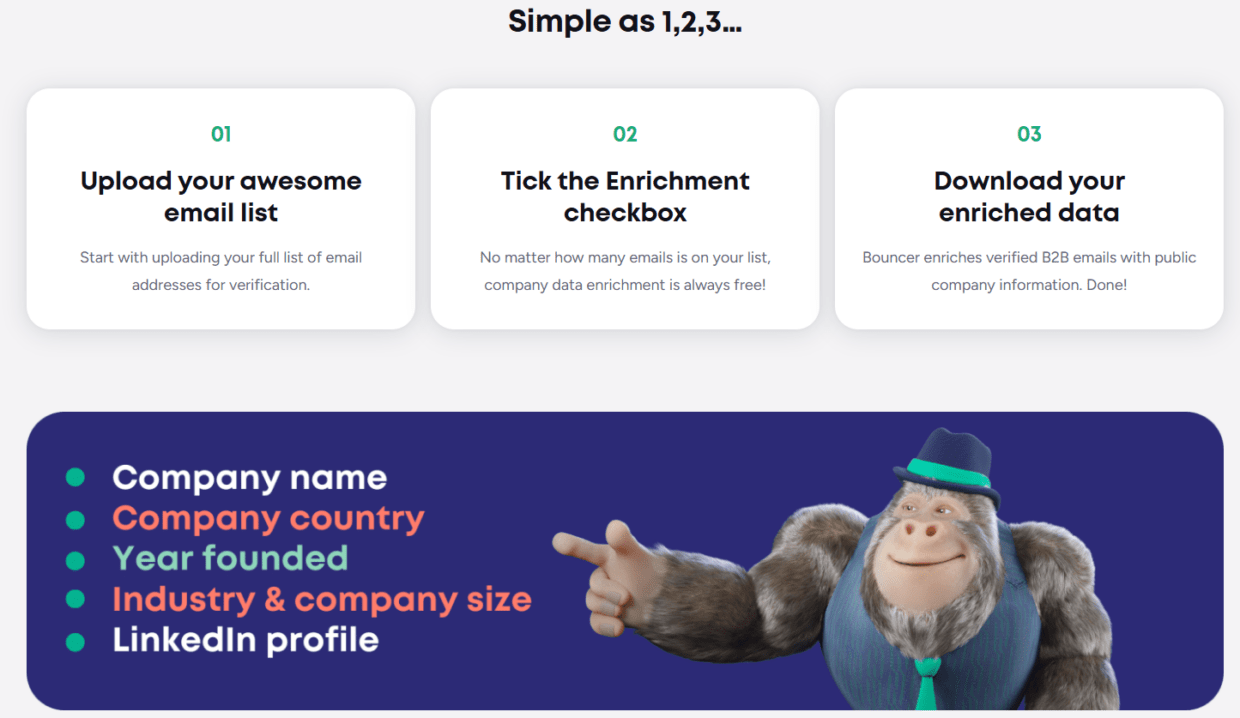
A practical sequence:
- Verify email address.
- Suppress invalid or risky records.
- Enrich usable records.
- Deduplicate CRM data.
- Segment based on company, region, engagement, and lifecycle.
- Send only to eligible contacts.
This keeps enrichment from becoming another layer of noise.
Step 15: create a pre-send QA checklist
Before every important campaign, run a short QA process.
| Check | Owner | Pass condition |
| Source reviewed | Marketing ops | Segment source is known and acceptable |
| Verification complete | Marketing ops or RevOps | No invalid records in send list |
| Suppression applied | Marketing ops | Bounces, unsubscribes, complaints removed |
| Consent checked | Marketing or legal ops | Audience can receive this message |
| Engagement reviewed | Campaign owner | Cold or dormant contacts handled separately |
| Authentication checked | RevOps or IT | SPF, DKIM, DMARC pass |
| Unsubscribe tested | Campaign owner | Link works and is visible |
| Inbox placement checked | Deliverability owner | No major red flags |
| CRM updated | RevOps | Verification status stored |
| Post-send review scheduled | Campaign owner | Metrics will be reviewed after send |
This kind of checklist keeps email hygiene operational. It also stops teams from treating deliverability as a vague responsibility shared by everyone and owned by no one.
Tools to support the checklist
The right tools help teams run the checklist without too much manual work.
Bouncer can support email verification, bulk verification, API validation, Bouncer Shield, Toxicity Check, Deliverability Kit, AutoClean, Company Data Enrichment, and integrations.
HubSpot or your CRM can store source, consent, verification status, lifecycle stage, and campaign history.
Your ESP can report bounces, complaints, unsubscribes, clicks, and campaign performance.
Google Postmaster Tools can help monitor Gmail-specific reputation when volume is high enough.
DNS and DMARC tools can help check authentication and domain setup.
Inbox placement tools can help review whether campaigns land in inboxes or spam folders.
| Checklist need | Tool type | Bouncer fit |
| Verify lists | Email verification | Email list verification |
| Clean large files | Bulk verification | Bulk email verification |
| Protect forms | Form validation | Bouncer Shield or API |
| Detect risky contacts | Risk analysis | Toxicity Check |
| Check deliverability | Inbox and blocklist testing | Deliverability Kit |
| Automate list hygiene | CRM automation | AutoClean |
| Add company context | Enrichment | Company Data Enrichment |
| Connect systems | Integrations | Bouncer integrations |
The goal is not to add tools for the sake of it. The goal is to make hygiene repeatable.
Email hygiene checklist for B2B marketing teams
Use this checklist before campaigns, imports, sales handoffs, and reactivation sends.
- Audit list source and acquisition date.
- Confirm consent, subscription type, and suppression status.
- Remove duplicates and resolve record conflicts.
- Verify emails before high-risk or high-volume sends.
- Suppress invalid, toxic, unsubscribed, complained, and hard-bounced contacts.
- Segment catch-all, unknown, disposable, and role-based emails.
- Protect forms with real-time validation or form protection.
- Add verification status and date to CRM records.
- Reverify old or inactive segments before reactivation.
- Review engagement before sending to large audiences.
- Check SPF, DKIM, and DMARC before major sends.
- Confirm unsubscribe links work.
- Test inbox placement before risky campaigns.
- Monitor bounces, complaints, unsubscribes, clicks, and replies after sending.
- Review lead source quality after every campaign.
- Use enrichment only after verification when possible.
- Schedule recurring hygiene for key lists.
- Keep sales informed about lead quality and reachability.
This email hygiene checklist for B2B marketing teams works best when it becomes part of campaign QA, not a separate emergency task.
Key takeaways
- An email hygiene checklist for B2B marketing teams should cover verification, consent, suppression, source quality, engagement, CRM hygiene, and deliverability.
- Bouncer helps B2B teams with email list verification, bulk email verification, Email Verification API, Bouncer Shield, Toxicity Check, Deliverability Kit, AutoClean, Company Data Enrichment, and integrations.
- B2B email data decays because people change roles, companies, domains, and inboxes.
- Verification should happen before major campaigns, cold outreach, reactivation, CRM imports, and sales handoff.
- Form protection helps stop invalid, fake, disposable, or malicious emails before they enter the CRM.
- Email verification does not replace consent or permission checks.
- CRM fields should store verification status, source, suppression reason, and verification date.
- Hygiene improves campaign performance and sales productivity when it becomes a repeatable workflow.
Conclusion
An email hygiene checklist for B2B marketing teams helps protect more than deliverability. It protects CRM trust, campaign reporting, sales productivity, and the relationship between marketing and sales.
The best workflow starts with source review, verifies emails before risky sends, protects forms at entry, keeps suppression rules intact, and monitors campaign signals after sending. It also connects hygiene to CRM fields so the same bad data does not keep returning.
Bouncer fits this workflow because it helps teams verify lists, protect forms, detect risky contacts, test deliverability, automate hygiene, enrich company data, and connect with existing tools. For B2B marketing teams, that turns email hygiene from a cleanup chore into a revenue operations habit. Don’t wait, try Bouncer for free now.
FAQ
What is an email hygiene checklist for B2B marketing teams?
An email hygiene checklist for B2B marketing teams is a repeatable process for checking list source, email validity, consent, suppression, engagement, CRM quality, and deliverability before campaigns. It helps reduce bounces, protect sender reputation, and improve lead quality.
How often should B2B marketing teams clean email lists?
B2B teams should clean lists before major campaigns, cold outreach, old-list reactivation, CRM imports, and sales handoffs. They should also reverify important segments regularly because B2B data decays as people change roles, companies, and inboxes.
How does Bouncer help with B2B email hygiene?
Bouncer helps with B2B email hygiene through email list verification, bulk verification, Email Verification API, Bouncer Shield, Toxicity Check, Deliverability Kit, AutoClean, Company Data Enrichment, and integrations. These tools support both existing list cleanup and new data protection.
Is email verification enough for B2B marketing?
No. Email verification is important, but B2B teams also need consent checks, suppression rules, source audits, engagement segmentation, CRM hygiene, and deliverability monitoring. Verification tells you whether an address appears usable, not whether the person should receive a message
What should happen to invalid emails in a B2B CRM?
Invalid emails should be suppressed from marketing and sales sends. The CRM should also store the verification status and suppression reason so the same record does not return to future campaigns through imports or workflows.
Should B2B teams email catch-all addresses?
Catch-all addresses need careful handling. Some may belong to real prospects, but they carry more uncertainty. B2B teams should segment them, review source quality, and avoid sending them at high volume without a clear rule.
What forms should use real-time email validation?
Demo requests, contact sales forms, free trial signups, webinar registrations, gated content forms, and high-volume lead capture forms should use real-time email validation or form protection. These forms often feed CRM, sales, and campaign workflows directly.
What metrics should B2B teams monitor after email hygiene work?
B2B teams should monitor hard bounce rate, soft bounce rate, spam complaints, unsubscribes, clicks, replies, inbox placement, blocklist status, MQL-to-SQL rate, and source-level performance. These signals show whether hygiene work improves real campaign and sales outcomes.


