





Without a strong system for email verification for business, this bad data quietly damages campaigns, wastes budgets, and harms sender reputation.
A solid email verification service helps verify email addresses before messages go out, making sure each email address exists and follows valid format rules. For modern teams, verification is no longer optional. It’s a structural layer that protects your email marketing efforts, improves email deliverability, and ensures your messages reach the intended recipient rather than bouncing, getting filtered, or disappearing inside a full mailbox.
Below is a clear explanation of why verification is essential, followed by the best tools to use — starting with Bouncer.
TL;DR
- Business email verification keeps your lists clean, protects sender reputation, and improves deliverability across every campaign.
- The right verification tool filters out invalid emails, risky contacts, disposable inboxes, and formatting errors before they damage performance.
- Bouncer is the strongest choice for accuracy, speed, and business workflows, making it easy to validate emails in bulk, in real time, or through API.
Why email verification matters for business
#1 It improves data accuracy at the source
Businesses collect emails through sign up forms, landing pages, imports, and multiple marketing tools. Without validation, you end up storing invalid email addresses, fake emails, and undeliverable emails that break automated sequences. Validation ensures proper formatting, correct domain structure, and clean inputs that systems can use reliably.
#2 It boosts inbox placement and protects sender reputation
Every bounce, soft bounces, or hit on a disposable email address hurts how internet service providers score you. When your sender reputation drops, even legitimate messages fail to reach the recipient’s inbox. Verification lowers bounce rates and helps messages get delivered successfully, which dramatically improve long-term performance.

#3 It eliminates risky emails before they damage campaigns
Disposable accounts, risky emails, and catch all domains create uncertainty in email campaigns. An accurate email verification tool filters these cases out before they inflate bounce rates or send incorrect signals to mailbox providers and internet service providers.
#4 It keeps marketing automation and CRM workflows clean
A business runs dozens of processes: onboarding, lead scoring, follow-ups, upsell campaigns, and re-engagement programs. When bad records enter your system, every automated workflow breaks. A reliable email verification api or email verifier api ensures data stays usable and accurate across all systems.
#5 It reduces wasted spend in email marketing and lead generation
Marketing teams using bulk email or large databases pay based on volume. If 15–30% of your list is already invalid, you’re wasting money. Using a bulk email verifier or bulk verification tool removes invalid email addresses and preserves your marketing budget.
#6 It keeps customer communication reliable
Important notifications — invoices, security alerts, order updates, onboarding steps — need to reach the correct mailbox. When companies skip verifying emails, customers never receive messages, leading to extra support tickets and a broken experience.
#7 It supports compliance and data hygiene goals
For regulated industries, maintaining clean records is essential. Strong validation helps keep your email list updated, accurate, and free from unnecessary data that doesn’t work properly or creates risk.
#8 It dramatically improves deliverability of future campaigns
By removing invalid emails and improving list hygiene, the email verification process helps improve deliverability over time. Your marketing messages reach people rather than bouncing, and mailbox providers react more favorably to consistent, accurate results.
What good email verification software should do
Before choosing a platform, look for these capabilities:
- Accurate email verification that identifies undeliverable emails, non existent emails, risky emails, and fake accounts
- Reliable checks for mx records, email syntax, domain and email server setup
- Bulk email verification for large datasets
- Real time email verification to stop bad entries at sign-up
- Seamless integration with CRMs, marketing tools, and google sheets
- Email validation rules that catch typos early and verify
- Accurate results returned quickly in just a few clicks
- Tools for verifying emails without sending actual emails
- Flexible pricing, including a free account or pay-as-you-go
- Strong API, such as a time email verification api or email verification api for developers
- Batch or bulk email workflows for cleaning legacy data
When these elements are combined, you get a clean database, smoother campaigns, and less risk to your positive reputation.
Best tools for business email verification
Let’s start with the most attractive option, which is Bouncer.
Bouncer — the best email verification service for accuracy, speed, and business workflows
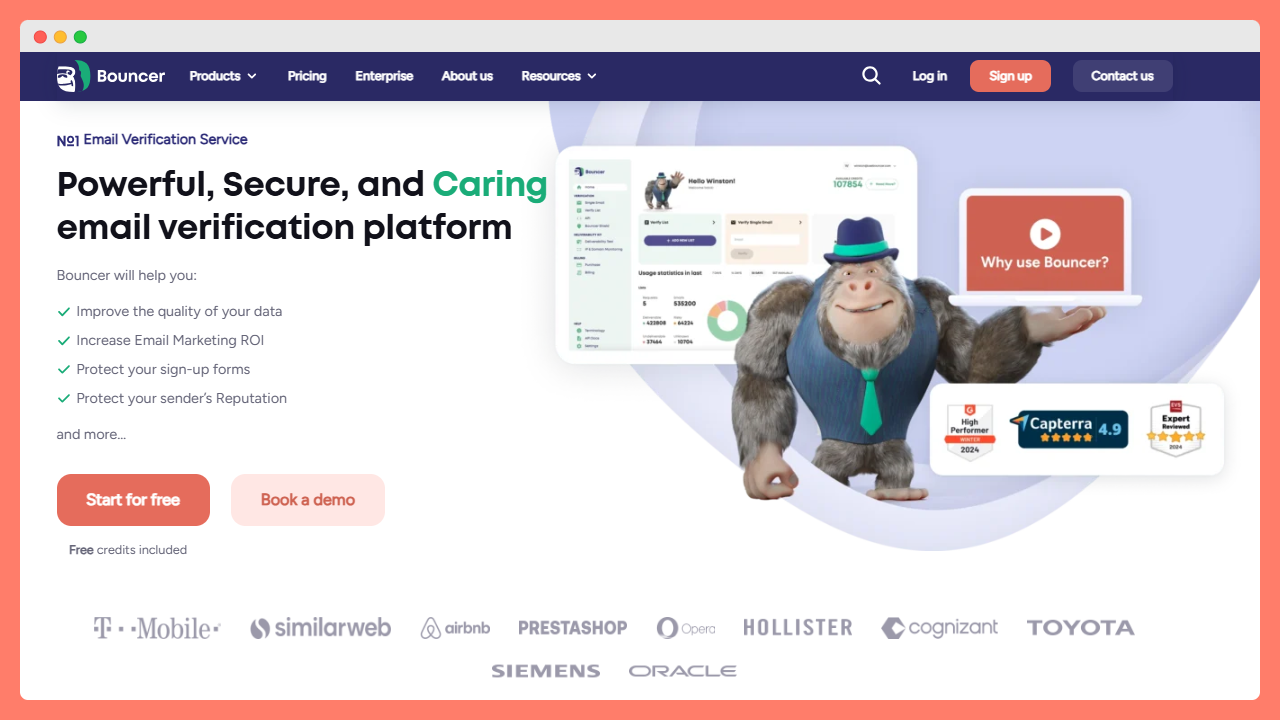
Bouncer stands out as the best email verification service for companies that need accurate results, strong deliverability improvements, and simple setup. Its verification logic checks if an email address exists, handles invalid emails, flags fake emails, identifies catch all domains, and screens disposable email address patterns with high precision.
Why it works well for business:
- Fast, real-time checks at sign-up that protect your forms
- A powerful email verification tool for bulk cleanup
- Strong algorithms for detecting undeliverable emails, risky emails, and improper formatting
- A clean email verifier api for developers
- Email verification software that integrates with CRMs, marketing platforms, and Google Sheets
- Bulk email verification that supports very large datasets
- Easy reports showing what needs removal, correction, or review
- A lightweight UI so teams can check email addresses in a few clicks
- And you can use many advanced features, like AutoClean, Data enrichment, Shield or Email engagement insights
If you want to dramatically improve deliverability, reduce bounce rates, and maintain accurate email across all your marketing tools, Bouncer is simply the most reliable choice.
ZeroBounce — deep analysis, but heavier for everyday use
ZeroBounce offers a wide set of checks and useful add-ons, but it’s more complex and slower than most teams need. Great accuracy, but not the most intuitive option for staff who want simplicity or seamless integration.
NeverBounce — consistent but aging
NeverBounce performs well for basic verification but lacks modern features for handling catch-alls, international domains, and business-scale integrations.
DeBounce — budget-friendly, weaker on corporate domains
DeBounce works well for small businesses with modest needs, but its accuracy drops when validating emails from enterprise-level mail servers.
Hunter — good as a finder, limited as a verifier
Hunter helps you find email addresses but isn’t strong enough as a standalone email checker or bulk verifier for cleanup at scale.
Final thoughts: clean email data is essential for business performance
Email remains one of the highest-ROI channels, but only when your data is clean. Using strong email verification for business helps check email addresses reliably, remove invalid email addresses, and ensure your messages reach the recipient’s inbox — not bounce or land in spam.
A strong email validation service protects senders, improves deliverability, reduces bounce rates, supports lead generation, and makes sure your email marketing efforts stay profitable.
If you want dependable, accurate email verification that fits into any system, Bouncer is the top choice for businesses of all sizes.
→ Try Bouncer and dramatically improve your deliverability, data hygiene, and campaign performance.
FAQ
How to verify your business email?
The easiest way is to run it through a trusted email verification tool. You drop the address in, hit “verify,” and the system checks if the mailbox exists, accepts messages, and isn’t tied to anything risky. Tools like Bouncer email verification do this in seconds and give you a clear result so you know the address is safe to use.
How to validate a business email?
Validation is about checking if the email is deliverable. This includes looking at syntax, domain setup, MX records, and whether the inbox is active. You can do this manually, but honestly, it’s much faster to use a verifier that does all of these checks automatically. Bouncer email verification handles this well and helps you avoid bounce-heavy contacts.
How to authenticate a business email?
Authentication refers to proving you are the sender. To do that, you set up DNS records like SPF, DKIM, and DMARC in your domain host. These records tell inbox providers that your emails are legit and not spoofed. Once they’re in place and tested, your emails look far more trustworthy — and inbox placement improves.
Is it legal to use an email verifier?
Yes, absolutely—email verification is legal. What matters is how you use the data. As long as you’re verifying emails you’ve collected lawfully (e.g., from signups, customers, or leads) and staying compliant with GDPR/CCPA, you’re good. Verification doesn’t access inbox content; it only checks technical signals, so it’s widely accepted as a safe, privacy-friendly practice.


