





The report then shows one neat bounce-rate number, but the cause is rarely neat. That is why learning how to reduce bounce rate in global email marketing means managing the whole data system, not only one campaign list.
You’ll learn
- Why global email marketing creates more bounce risk than local sending
- How Bouncer supports verification, bulk cleanup, AutoClean, API validation, Shield, Toxicity Check, and Deliverability Kit
- Why global bounce-rate reduction depends on source control, suppression, and regional hygiene
- How to treat old, inactive, catch-all, unknown, disposable, and toxic contacts
- Why form validation matters before bad emails enter the CRM
- How to separate email validity from consent and campaign eligibility
- How to make bounce-rate reduction part of ongoing email operations
Why global email marketing creates bounce risk
A local campaign may run from one platform, one list source, one language, and one consent model. Global email marketing rarely works that cleanly.
A global sender may collect emails through ecommerce checkouts, demo forms, newsletter signups, webinars, regional landing pages, events, sales uploads, partner campaigns, product signups, customer databases, and old CRM migrations. Each source enters the system with a different level of quality. Each region may use different forms, vendors, tools, and habits.
The problem is not only volume. It is inconsistency.
A UK list may be well maintained. A US sales team may upload unverified outbound contacts. A German event list may contain manual typos. A Brazilian customer segment may include old ecommerce emails. A global B2B nurture may include catch-all corporate domains. A partner campaign may include contacts that technically validate but have unclear source quality.
When all of this enters one global email marketing program, bounces become a symptom of governance. The campaign report shows the problem late. The database created it earlier.
Reducing bounce rate in global email marketing starts with knowing which data sources deserve trust, which need verification, and which should not enter normal campaigns at all.
Bounce rate is a global operations metric
Bounce rate is often reviewed by campaign managers. It should also be reviewed by marketing operations, RevOps, deliverability, regional teams, and anyone who owns data intake.
A high hard bounce rate points to permanent delivery problems: invalid addresses, closed mailboxes, dead domains, fake records, stale contacts, or poor acquisition. A soft bounce pattern may point to temporary provider issues, throttling, full inboxes, or reputation concerns.
In global email marketing, the total bounce rate can hide the real issue. One region may produce most invalids. One old source may carry the risk. One provider may reject more aggressively. One acquisition form may collect typo-heavy submissions. One CRM migration may have broken suppression.
If you only look at one global metric, the team may clean the wrong thing.
- A better bounce review asks:
- Which source created the bounced contacts?
- Which region or country had the highest bounce rate?
- Which provider showed the strongest rejection pattern?
- Were contacts verified recently?
- Were hard bounces already known in another system?
- Did any unsubscribed or complained contacts re-enter?
- Was the audience old, inactive, or recently collected?
- Were catch-all, unknown, disposable, or role-based addresses included?
- This turns bounce rate from a number into a map.
Bouncer
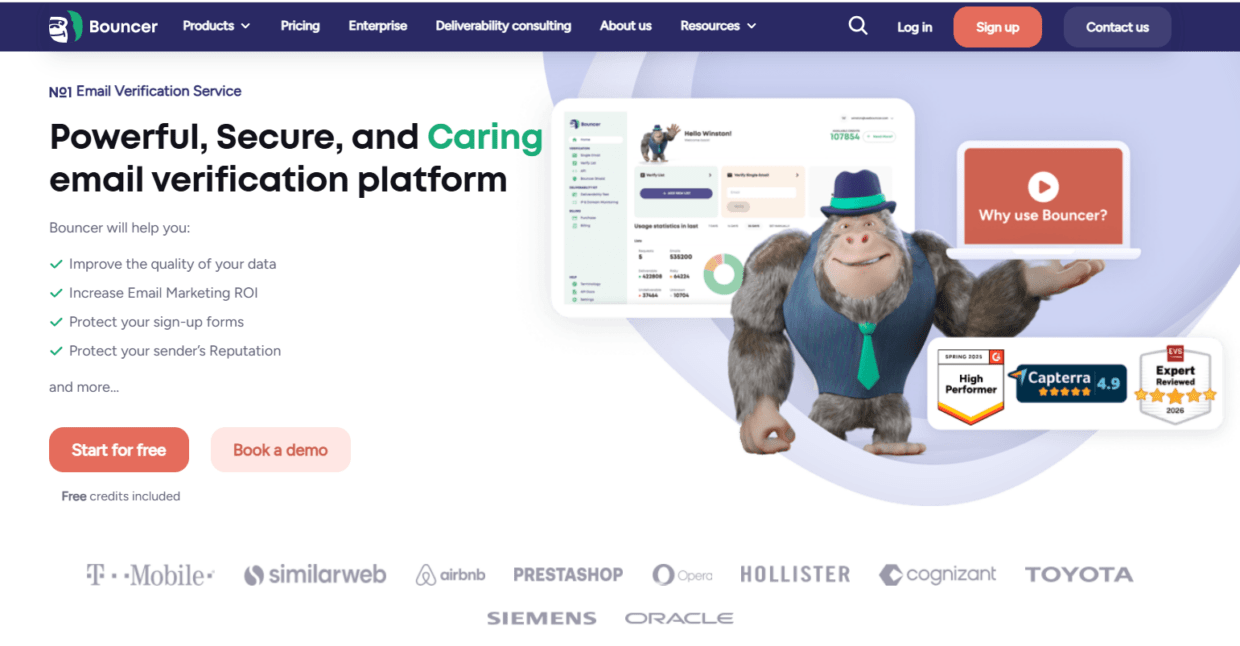
Bouncer is useful for global email marketing because it supports list verification, prevention, risk checks, automation, enrichment, and deliverability testing.
Bouncer’s email list verification helps teams check whether email addresses appear deliverable before sending. Bouncer highlights global adaptability and says it verifies email addresses hosted by global and local email providers across the world. That is important when campaigns span Gmail, Yahoo, Outlook, Microsoft 365, corporate domains, and local mailbox providers.
For large global files, bulk email verification helps process CRM exports, customer databases, newsletter audiences, ecommerce lists, old campaign segments, regional imports, and agency client files. For uncertain databases, free email list sampling can help estimate list quality before verifying the whole file.
For risky sources, Toxicity Check can help identify potentially harmful email addresses. For sender readiness, Deliverability Kit supports inbox placement and technical checks. Bouncer’s public materials also describe an Email Verification API with synchronous and asynchronous endpoints, which helps teams validate emails inside workflows rather than relying only on CSV cleanup.
For ongoing hygiene, Bouncer AutoClean can automatically keep lists clean, monitor jobs, show last and next runs, and use CRM fields such as Bouncer Recommends for segmentation or workflow triggers.
Bouncer does not replace consent management or regional legal review. It gives global teams the email-quality layer they need before a campaign goes live.

Global list sources need different rules
The fastest way to reduce bounce rate in global email marketing is to stop treating every source equally.
A first-party subscriber who joined last week is not the same as a five-year-old CRM contact. A customer who bought recently is not the same as a partner-list contact. A demo request validated at entry is not the same as an imported conference spreadsheet. A product signup is not the same as a purchased lead file.
Global teams need source-level rules.
| Source | Bounce risk | Better handling |
| Recent newsletter signup | Lower | Validate at entry and monitor quality |
| Recent customer record | Lower to medium | Check age, eligibility, and engagement |
| Webinar registration | Medium | Verify before nurture or sales handoff |
| Event scan | Medium to high | Verify before follow-up, especially after manual entry |
| Partner list | High | Review permission and verify separately |
| Sales upload | Medium to high | Verify before campaigns or sequences |
| Old CRM export | High | Verify before any send and segment by age |
| Enrichment export | Medium to high | Verify before routing or outreach |
| Purchased or scraped file | Very high | Avoid or quarantine |
| Unknown source | Very high | Hold until source is explained |
This table should influence campaign inclusion. If a source carries higher risk, it should not go into the same main send without verification and review.
Suppression is the backbone of bounce control
Most global bounce problems become worse when suppression does not work across systems.
A contact hard bounces in one platform, but the CRM still treats them as active. A regional team exports a list without bounce status. A sales tool keeps sending to contacts who unsubscribed from marketing. An ESP migration drops suppression fields. A local agency uploads a file that includes old bounced addresses.
The same bad email keeps coming back under a different campaign name.
To reduce bounce rate in global email marketing, suppression must travel with the contact. Hard bounces, invalids, unsubscribes, spam complaints, do-not-contact records, deleted contacts, restricted contacts, toxic records, and known bad imports should not re-enter sendable audiences.
Store suppression reason clearly. “Removed” is not enough. Use labels such as hard bounce, invalid, spam complaint, unsubscribe, toxic, restricted, duplicate, or do-not-contact. These labels help future campaign owners understand why the contact is not sendable.
Google’s sender guidelines stress easy unsubscribe and authenticated sending, while Yahoo’s sender best practices also emphasize authentication, easy unsubscribe, low complaint rates, and valid DNS. Suppression supports those expectations because it prevents unwanted or failed sends from repeating.
Verification should happen before the campaign gets final approval
In global email marketing, verification often happens too late. The campaign is planned, localized, approved, scheduled, and only then someone asks if the list is clean.
That creates messy surprises.
One region shrinks after invalids are removed. Another source shows too many unknowns. A reactivation segment turns out to be mostly stale. A partner list has weak quality. A segment built around company size contains many catch-all addresses. The campaign team then has to adjust late.
Verification should happen before the audience is treated as final.
This does not mean every single contact in the global database needs daily verification. It means every campaign audience should be built from records with known quality status. Old lists, inactive segments, partner files, cold records, regional uploads, and large reactivation audiences should be verified before they enter planning as sendable reach.
The number that matters is not total database size. It is verified, eligible, source-known, not-suppressed audience size.
Regional hygiene matters
Global email marketing teams often talk about localization, but bounce-rate reduction needs regional data hygiene too.
One region may have strong form validation and clear source labels. Another may rely on event lists and manual uploads. A third may use a local ESP that does not sync suppression properly. A fourth may have older customer records. A fifth may use a partner channel that creates many disposable or invalid emails.
If you only look at the global bounce rate, weaker regional processes can hide for months.
Review each region’s:
- Invalid rate
- Hard bounce rate
- Unknown rate
- Catch-all rate
- Disposable rate
- Toxicity rate
- Suppression errors
- Source mix
- Last verification date
- Engagement level
Bounce-rate reduction becomes much easier when regions see their own data quality. Nobody wants to be “the bad region” in a global report, but the goal is not blame. It is better intake, cleaner sources, and fewer risky sends.
Global provider mix changes the risk
A global email program does not send to one inbox ecosystem.
Gmail, Yahoo, Outlook, Microsoft 365, Apple Mail, corporate domains, local ISPs, university domains, and government domains can behave differently. A campaign may perform well at Gmail and poorly at Outlook. It may bounce more at corporate domains. It may see softer failures at local providers. It may face stricter filtering in one country.
Provider mix affects bounce and deliverability diagnosis.
If bounces cluster around corporate domains, look at B2B catch-all records, role accounts, security gateways, and old job data. If failures cluster around a local provider, review regional list source and technical response codes. If Gmail performance drops, review authentication, complaints, engagement, and spam-rate signals. Google’s FAQ says senders should keep spam rates below 0.1% and avoid reaching 0.3% or higher.
Reducing bounce rate in global email marketing is not only about deleting invalids. It is about understanding where the failures concentrate.
Old lists need a separate lane
Old lists are one of the biggest bounce drivers in global email marketing.
They look valuable because they contain volume. Old newsletter subscribers, past customers, long-quiet leads, dormant product users, old event attendees, and past webinar registrants all look like possible reach. But email data decays. People switch jobs. Mailboxes close. Domains change. Abandoned addresses may become risky. Old subscribers may no longer remember the brand.
Do not mix old lists into normal global campaigns.
Old audiences need a separate lane. Verify them. Segment by last engagement. Suppress invalids and toxic records. Hold unknown-source records. Start with the warmest inactive group if reactivation makes sense. Avoid sending a large campaign to the coldest records first.
The goal is not to delete history blindly. The goal is to stop old records from damaging current sender reputation.
Catch-all, unknown, and role-based records need policy
Global B2B lists often contain catch-all, unknown, and role-based email addresses.
Catch-all domains accept mail broadly, so mailbox-level verification is less certain. Unknown results lack enough confidence. Role-based accounts such as info@, sales@, office@, admin@, and support@ may not belong to the intended recipient.
These records should not enter global campaigns automatically.
| Record category | Why it affects bounce risk | Better global rule |
| Catch-all | Mailbox-level certainty is lower | Segment by source and business value |
| Unknown | Verification confidence is weak | Hold from large global sends |
| Role-based | Shared inbox and weak targeting | Exclude or use only for specific cases |
| Disposable | Temporary inbox risk | Suppress |
| Toxic | Reputation risk | Suppress |
| Stale valid | Old verification may be unreliable | Reverify |
| No source | Quality and permission unclear | Hold for review |
| Prior hard bounce | Known failure | Suppress globally |
| Invalid | Permanent delivery risk | Suppress |
| Duplicate | May create repeated sends | Merge or pick primary record |
A clear policy prevents each regional marketer from making different choices.
Forms are where future bounce rates are created
Many bounce problems begin long before the campaign. They begin at the form.
A checkout form accepts a typo. A newsletter form accepts a disposable email. A demo form accepts fake leads. A webinar form allows invalid business domains. A gated content form collects personal addresses with no quality check. A regional landing page has no validation while the global one does.
Then, months later, the global email marketing team sees bounce risk.
Bouncer’s Email Verification API and Bouncer Shield help validate email addresses at the point of entry. This matters because prevention beats cleanup. If bad records never enter the CRM, they do not need to be removed from global campaigns later.
High-impact forms should have validation first:
- Newsletter signups
- Demo requests
- Free trial signups
- Checkout pages
- Webinar registrations
- Event landing pages
- Gated content
- Partner campaigns
- Product waitlists
- Contact sales forms
For global teams, entry-point validation should be standardized. Every market should collect cleaner email data, not only the central team.
Consent and bounce reduction are connected, but separate
A valid email address can still be ineligible for a campaign.
This is especially important in global email marketing. A contact may be valid but unsubscribed. A customer may be eligible for transactional email but not marketing. A B2B contact may have been collected for sales outreach, not a newsletter. A regional law or internal policy may require a different rule. A partner list may validate well but still need source review.
Email verification answers: can this address likely receive mail?
Consent and eligibility answer: should this person receive this campaign?
Do not use verification results to override consent, subscription type, opt-out scope, or regional rules. A “valid” status is not permission. It is only a deliverability signal.
A clean global workflow stores both fields separately: verification status and campaign eligibility.
Make bounce reduction visible in CRM fields
Bounce-rate reduction should not live only in the ESP report.
Store email quality data where teams build segments and campaigns. Useful fields include verification status, verification date, source, original source, suppression reason, last engagement, risk category, toxicity status, region, language, subscription type, and reverify date.
HubSpot’s list cleanup guidance tells users to track the original source of contacts and use properties to label interests, so content can better match audiences. It also supports segmenting hard-bounced contacts for cleanup workflows.
The same idea applies to any CRM or marketing automation platform. If the database shows source and verification status, campaign owners can avoid risky records before export. If it does not, every global campaign becomes a manual investigation.
Bouncer AutoClean can help connected platforms keep hygiene more continuous rather than one-off. That is useful for global teams that cannot manually clean every regional list before every send.
Deliverability checks belong next to verification
Bounce rate and deliverability are connected, but not identical.
Verification reduces hard bounce risk. Deliverability checks help you understand whether authenticated, accepted emails are likely to reach the inbox. A global campaign can have a low bounce rate and still suffer if authentication is weak, blocklists appear, complaints rise, or inbox placement drops.
Bouncer’s Deliverability Kit supports inbox placement, blocklist, SPF, DKIM, DMARC, and SpamAssassin checks. Use it before major global campaigns, especially product launches, seasonal promotions, reactivation sends, migrations, or campaigns using new sender domains.
A cleaner list gives the campaign a better start. A healthy sender setup gives it a better chance of reaching inboxes.
A practical global sendability model
A global team needs a simple model that decides which contacts can enter campaigns.
| Group | Criteria | Campaign handling |
| Sendable | Valid, not suppressed, source-known, eligible, recent enough | Normal campaign audience |
| Conditional | Catch-all, role-based, stale valid, low engagement, weaker source | Separate lane, review, or lower-volume send |
| Hold | Unknown, no source, unclear consent, old inactive, unverified partner data | Do not send until reviewed |
| Suppress | Invalid, toxic, disposable, hard bounced, complained, unsubscribed | Exclude globally |
This model helps reduce bounce rate in global email marketing because it stops questionable contacts from blending into the main audience.
It also improves reporting. Instead of arguing why the list shrank, the team can see where records went: sendable, conditional, hold, or suppress.
Why “more emails” is usually the wrong fix
When global email marketing underperforms, teams may try to compensate with more volume. This is dangerous after bounce problems.
More volume to weak contacts creates more chances for bounces, complaints, and poor engagement. A larger audience can make sender reputation worse if it contains stale or risky records.
The better move is to make the first sendable audience smaller and cleaner. Then expand only after signals look stable.
This may feel counterintuitive to leadership, so explain it in business terms. The goal is not a smaller campaign. The goal is a usable audience. A database with 1 million contacts is not worth 1 million sends if 150,000 records are invalid, risky, suppressed, or inactive. Inflated reach creates inflated expectations.
Bounce-rate reduction gives the team a more honest number.
What not to do in global email marketing
- Do not merge every regional file into one send without source labels.
- Do not let old contacts enter launches without verification.
- Do not trust partner data without review.
- Do not let hard bounces return through imports.
- Do not treat catch-all and unknown records as normal valid contacts.
- Do not build regional segments before checking data quality.
- Do not use verification as a replacement for consent.
- Do not ignore provider-level bounce patterns.
- Do not keep forms unprotected in high-volume markets.
- Do not rely on one-off cleanup when bad data keeps entering daily.
- Most bounce issues repeat because teams fix reports, not systems.
How Bouncer fits into the global workflow
Before a global campaign, Bouncer can verify lists, sample uncertain databases, run Toxicity Check, and support Deliverability Kit testing. During audience building, Bouncer results can inform sendability groups. After the campaign, bounced and risky records can feed back into suppression and revalidation rules.
For ongoing prevention, Bouncer’s API and Shield protect new email entry points. AutoClean and integrations help keep connected platforms cleaner. Company Data Enrichment can support segmentation after verification when teams need company-level context.
This makes Bouncer useful across the full global email marketing cycle: intake, cleanup, segmentation, campaign readiness, and prevention.
Key takeaways
- How to reduce bounce rate in global email marketing starts with source control, verification, suppression, regional hygiene, and ongoing prevention.
- Global email marketing creates more bounce risk because contacts enter from many countries, tools, forms, CRMs, events, partners, and imports.
- Bouncer supports global bounce-rate reduction through email list verification, bulk verification, free list sampling, Toxicity Check, Deliverability Kit, Email Verification API, Bouncer Shield, AutoClean, integrations, and Company Data Enrichment.
- Global bounce reports should be reviewed by region, source, provider, verification status, engagement, and campaign type.
- Hard bounces, invalid emails, toxic contacts, disposable emails, spam complaints, and unsubscribes should be suppressed globally.
- Old lists need separate treatment, not automatic inclusion in global campaigns.
- Verification improves deliverability quality, but it does not replace consent or regional campaign eligibility.
- Form validation reduces future bounce rates by stopping bad emails before they enter the database.
Conclusion
Global email marketing does not need more list volume. It needs more reliable sendable data.
To reduce bounce rate in global email marketing, treat every region and source based on its real quality. Verify risky and old lists. Suppress hard bounces everywhere. Keep catch-all and unknown records out of main sends. Protect forms at entry. Store verification and suppression fields in the CRM. Review bounce patterns by region and provider, not only in one global report.
Bouncer supports this workflow with verification, bulk cleanup, sampling, toxicity checks, deliverability testing, API validation, Shield, AutoClean, integrations, and enrichment. It helps global teams turn bounce-rate reduction from a last-minute cleanup task into a repeatable email hygiene process.
A lower bounce rate is not only a metric. It is proof that your global email marketing program knows which contacts are worth sending to.
Try Bouncer now – the first 100 credits are on us!
FAQ
How do I reduce bounce rate in global email marketing?
To reduce bounce rate in global email marketing, verify risky and old lists, suppress hard bounces globally, review list sources, protect forms with real-time validation, remove invalid and toxic contacts, and analyze bounce patterns by region, source, and provider.
Can Bouncer help reduce bounce rates globally?
Yes. Bouncer helps through email list verification, bulk verification, free list sampling, Toxicity Check, Deliverability Kit, Email Verification API, Bouncer Shield, AutoClean, integrations, and Company Data Enrichment. It supports both cleanup and prevention.
Why do global email campaigns bounce more?
Global campaigns bounce more when they combine many sources, regions, tools, and list ages. Old CRM records, partner data, event lists, sales imports, unverified forms, and inconsistent suppression can all increase bounce risk.
Should I verify global lists before every campaign?
Verify high-risk, old, inactive, imported, partner, cold, or uncertain lists before every major send. Active first-party lists may follow a regular verification cadence, but they still need monitoring.
What should I do with hard-bounced contacts?
Hard-bounced contacts should be suppressed globally across every CRM, ESP, sales tool, and campaign workflow. Store the bounce reason and source so the same contact does not return through another import.
Are catch-all emails safe for global email marketing?
Catch-all emails are uncertain. They may belong to real B2B contacts, but mailbox-level confidence is lower. Segment them separately and avoid placing large catch-all batches in main global campaigns without review.
Does email verification replace consent checks?
No. Verification checks whether an email can likely receive mail. Consent and campaign eligibility determine whether the person should receive a specific message. Global teams need both.
How can forms reduce future bounce rates?
Forms reduce future bounce rates when they validate emails at entry. Real-time verification helps catch typos, disposable addresses, fake submissions, and invalid records before they enter the CRM or marketing platform.


