





One of the biggest threats to performance is bad data: typos, throwaway inboxes, dead domains, and spam traps all lurk in contact lists.
These problems contribute to poor inbox placement. Studies show that the average deliverability rate across major email platforms is about 83.1 percent, leaving nearly one in six messages either lost in transit or diverted to spam.
High bounce rates erode trust and reduce opportunities for growth. This guide explains how email verification for marketing API solutions help organizations regain control by vetting addresses before sending campaigns.
We’ll explore the technology behind these tools, the differences between validation and verification, and why choosing the right API matters. We will also highlight Bouncer, a leader in the space, to illustrate best practices.
Let’s jump right in:
Why verify addresses in a marketing API context
Marketers depend on deliverability. Each bounce or spam complaint counts against your domain, dragging down your sender reputation.
Mailbox providers like Google and Microsoft keep strict scorecards and will penalize senders who repeatedly deliver to bad addresses.
With marketing emails representing a huge share of communications, even small improvements in inbox placement can translate into meaningful revenue.
Verifying contacts before campaigns go live is the first step toward healthy lists.
It means you can verify email addresses and flag entries that are malformed, stale, or toxic. By handling this at scale through APIs, even small teams can maintain high data quality.
Poor data doesn’t only harm sender scores; it distorts campaign results.
Metrics such as open rates, click‑through rates, and conversions rely on accurate denominators. When a percentage of your messages never arrive, your results appear worse than they are.
Running a batch verification job API on your lists removes dead contacts so your engagement metrics reflect reality. As data privacy regulations tighten, using an API to process data transparently and securely also protects you from compliance risks.

How an email verification API works
A robust email verification API does more than check if an address looks like name@domain.com. It performs a series of tests:
- Format check – the API inspects the address string to make sure it follows a recognised pattern. It removes entries with obvious syntax errors or illegal characters and catches invalid email addresses. At this layer, you’re essentially validating email addresses, similar to what many browsers do with HTML5 input elements.
- Domain and MX records – the API queries DNS to confirm that the domain exists and has mail exchange (MX) records. If there is no mail server or the domain has expired, the address is marked invalid. This step also checks whether the domain belongs to known mailbox providers such as Gmail, Outlook, or corporate servers.
- SMTP handshake – the system attempts to communicate with the target mail server, not to send a message, but to determine if the address can receive mail. Some servers are configured as catch all, meaning they accept any local part; these are marked as “risky” because the API cannot guarantee that an individual inbox exists.
- Disposable and spam trap screening – the API compares domains against lists of temporary services and known spam traps. Disposable services provide short‑lived addresses that people use to download a whitepaper or claim a discount. Removing these early keeps lists clean.
The API returns structured results. Each email is labelled with statuses such as valid, invalid, risky, or unknown. Additional details can include whether a domain is corporate or free, if it’s a catch‑all, or if it has a full inbox. This information helps teams decide whether to keep, fix, or delete an entry.
Real‑time and batch processing
Verification can occur at different points in your workflow. When visitors fill out web forms or signup forms, real‑time checks catch mistakes instantly. A short error message tells the user to correct the entry, reducing the chance of sending to a bad address later. Real‑time responses use a real time api that returns results within milliseconds.
For existing lists, a bulk validation run is more efficient. The API dashboard displays progress and results. Running a periodic bulk check keeps your database healthy as people change jobs or abandon accounts. In both cases, you use an API key to authenticate your calls.
Differentiating email validation and verification
It’s common to hear the terms email verification and email validation API used interchangeably, but they represent different tasks.
Email validation focuses on basic structure: does the address have one “@” symbol? Is the domain suffix valid? Are there any banned characters? Validation improves user experience by catching typos before submission but does not determine whether an actual inbox exists.
Email verification, by contrast, dives deeper. It performs DNS lookups, SMTP handshakes, catch‑all detection, and disposable email detection. Verification also tests for risky emails, including known spam traps.
Marketers should not rely on validation alone; combining validation and verification yields the best results. When your marketing stack uses a verification API, you can see which addresses are safe to keep and which should be purged.
Deliverability, bounce rates, and reputation
Deliverability is the percentage of messages that reach the inbox. Research shows that only 83.1 percent of messages from marketing platforms reach their intended recipients. The same study notes that 10.5 percent of messages land in spam and 6.4 percent go missing entirely.
These numbers underscore the impact of poor list hygiene. If your email deliverability falls below the generally accepted “good” threshold of 89 percent, your campaigns may struggle. Verification helps by removing entries that would bounce and by detecting addresses with high risk profiles.
Deliverability varies by provider, so keeping your list clean across platforms helps preserve a good standing.
High bounce rates send a strong negative signal to ISPs. A bounce occurs when an email is rejected because the recipient does not exist or the inbox is full. If your campaigns regularly hit deactivated accounts, providers will flag your domain, and subsequent sends may be throttled or filtered.
Verification ensures that you’re sending to valid email addresses. It also helps protect your sender reputation by reducing the risk of hitting spam traps or disposable services.
Detecting fake and disposable emails
A big part of list hygiene is spotting addresses that look real but aren’t useful.
Disposable email detection identifies domains that supply temporary inboxes. People use these to gain access to content quickly but never intend to engage. Sending marketing messages to disposable addresses yields no return.
A verification API cross‑references incoming domains against known lists of temporary providers and flags them. It can also detect temporary emails created through a catch‑all server with a random username.
Spam traps are another threat. These are monitored addresses maintained by anti-spam groups to catch senders who use purchased or outdated lists. Hitting a trap can lead to immediate blacklisting. Verification services maintain trap lists and mark suspicious entries as high risk. Removing these reduces the chances of being flagged as a spammer.
Good tools also flag bad data and bad emails. This includes addresses with repeated consonants, random strings, or generic names such as info@domain.com. While role‑based addresses are legitimate for support queries, they often don’t engage with promotional material. Removing them from marketing sends helps focus resources on contacts likely to convert.
Real‑time verification and sign‑up experiences
Speed matters. When visitors fill out forms, you want to catch errors early. A real time email verification service checks the address as soon as the user leaves the email field.
If the input fails, the system returns an error message prompting correction. This reduces friction and stops bad data from entering your CRM.
Real‑time checks are commonly paired with account creation flows and otp verification.
In these flows, the system sends a verification email containing a code or link that the subscriber must use to complete signup. This double‑checks mailbox ownership and prevents bots or fraudsters from signing up under someone else’s identity.
Real‑time checks also integrate with other form elements such as names and phone numbers.
If a user enters inconsistent data, conditional logic can ask for confirmation or lock the submission. This approach improves data quality not just for emails but across other fields too.
To implement these checks, developers call the API through the front end, passing the address (and possibly other inputs) to the provider.
This is often done with an asynchronous request triggered by a submit event or after the field loses focus.
Choosing a verification service and key features
When evaluating options, consider how the service meets your technical requirements and budget. A good verification API offers flexible API endpoints that handle both single checks and large batches.
Look for easy integration; SDKs for common languages and frameworks shorten development time. Clear documentation and sample code help new users get started quickly.
Some vendors maintain a support community on a Slack channel where developers can ask questions and share insights.
Another factor is compatibility with popular tools such as marketing platforms or CRM systems; direct integrations reduce coding overhead.
Pricing models matter too. Many providers offer a free trial with free credits so you can test the service. After that, they may have paid plans and flexible pricing tiers, such as pro and premier plans, with volume discounts for high‑usage accounts.
Consider whether you need recurring checks or just periodic clean‑ups. A pay‑as-you-go plan may be ideal for small lists, while a subscription suits large senders.
Don’t forget to evaluate other solutions if you need features like phone number validation or cross‑channel checks; some vendors bundle multiple verification services under one platform.
Security and compliance should be top of mind. Verify that the service complies with GDPR compliance requirements. Ask how long they store data and whether it’s anonymized.
A trustworthy vendor runs on secure infrastructure, processes data in safe regions, and enables you to delete data via an API call. Support for other APIs, such as SMS or physical address validation, may be helpful if your marketing program spans multiple channels.
Bouncer: a closer look at a leading service for email validation API
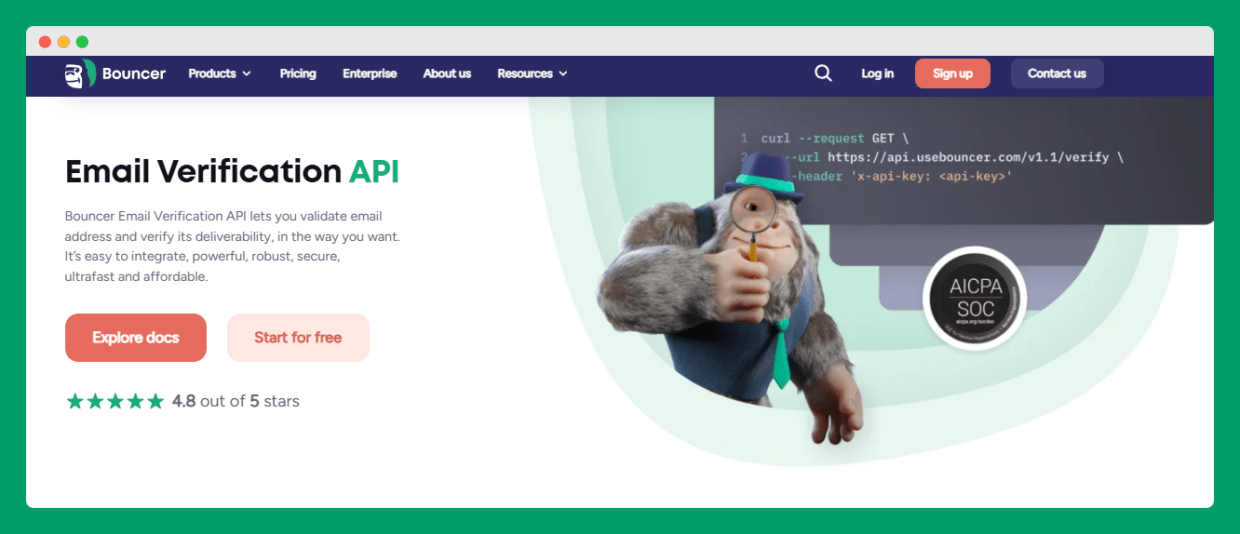
Now let’s look at Bouncer, a platform recognized for high accuracy and robust features.
Bouncer’s API uses multilayer checks – format, DNS, SMTP, catch‑all, disposable lists, and machine learning – to classify addresses.
Its responses include a detailed results set: deliverability status, scoring, reasoning, toxicity flag, provider, whether the address is free or corporate, and if it belongs to a disposable domain.
Bouncer can also mark catch‑all servers and highlight risky emails. This granularity allows marketers to make nuanced decisions instead of relying on a simple pass/fail.
Bouncer supports both real‑time and bulk verification. A web‑based api dashboard shows usage metrics, job history, and project settings. You can manage multiple projects and assign roles under one account.
Security is a priority. Data is processed in the European Union, and the platform is GDPR compliant. You can delete results at any time, and multi-factor authentication plus IP restrictions protect against unauthorized access. These measures address data privacy concerns for organizations subject to strict regulations.
Bouncer distinguishes itself through its support and pricing.
It offers free credits to new customers and volume discounts for higher senders. There are pro and premier plans for steady verification needs, and a free tier for testing.
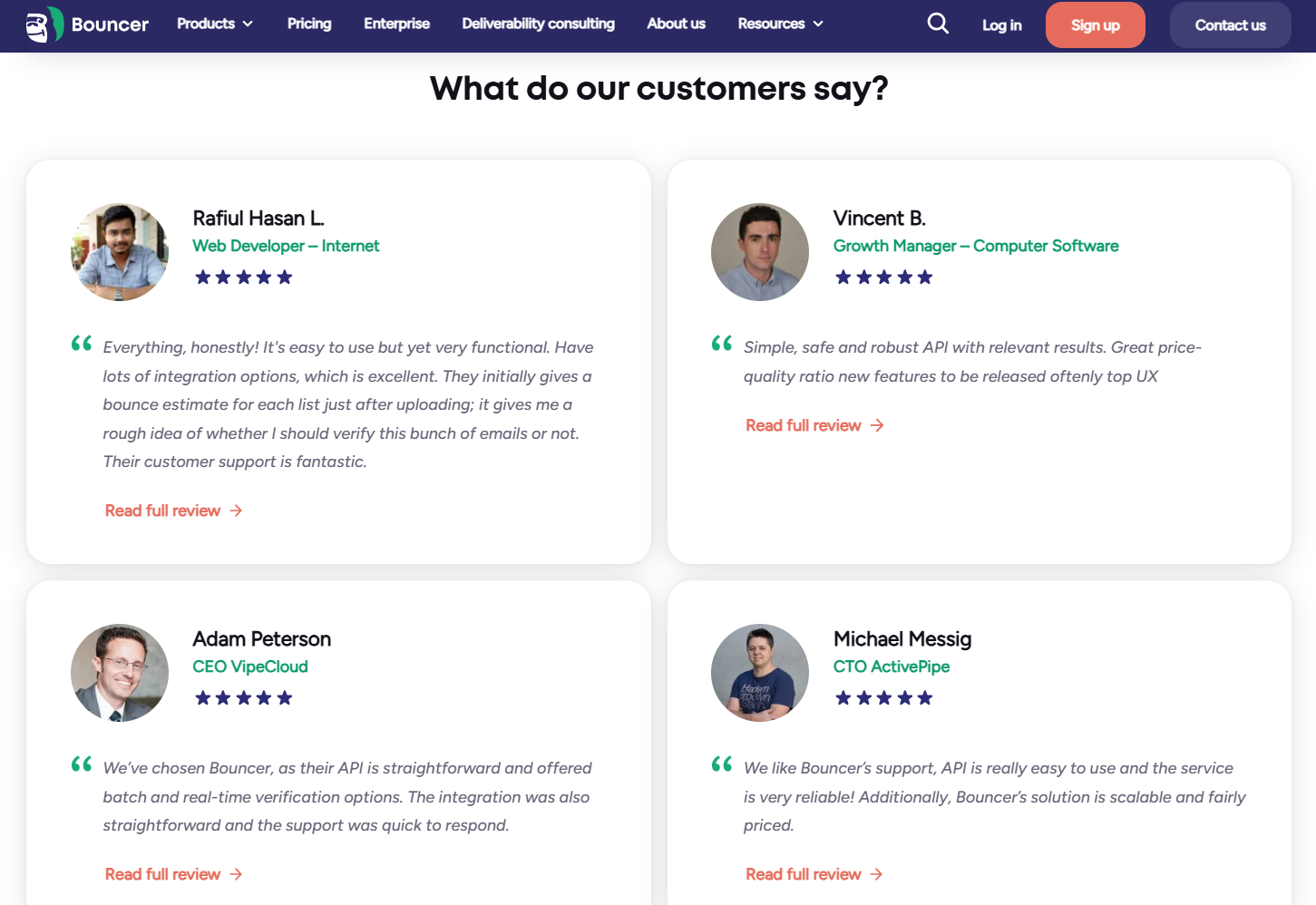
Customers have praised Bouncer for being cost effective and for its responsive support.
Comparing with other tools
While Bouncer excels, you might compare it to other tools. Competitors like Clearout and Zerobounce also supply verification services. When evaluating alternatives, consider whether they match Bouncer’s catch‑all detection, machine learning classification, and throughput.
Some may have features Bouncer doesn’t, true.
However, Bouncer’s combination of precision, security, and flexible pricing makes it a strong choice for most marketing teams.
Conclusion and next steps
Email marketing only works when your messages reach real people. Verification ensures they do.
By filtering out bad, disposable, and risky addresses before you send, you protect your sender reputation and make every campaign more accurate and profitable.
Tools like Bouncer make this easy with fast APIs, deep verification checks, and scalable pricing.
If you want cleaner lists, better inbox placement, and more reliable metrics, email verification is essential.
Start verifying your data before you hit send.


