





A cheap email verification tool can look perfect until your team needs more than a clean or invalid label. Maybe your CRM keeps filling with risky contacts. Maybe your sales team wants to verify leads before outreach. Maybe marketing needs cleaner lists before a launch, but no one wants another manual CSV ritual.
That is when teams start looking for BillionVerify alternatives. BillionVerify offers bulk email verification, real-time API checks, and price-led email validation. For some teams, that is enough. For others, the better fit depends on workflows, integrations, risk signals, support, and how much trust they need before sending.
Below, we compare the best BillionVerify alternatives for teams that want cleaner email lists, lower bounce risk, and a verification setup that fits real B2B work.
You’ll learn
- What BillionVerify does and where it fits
- Why teams look for BillionVerify alternatives
- Which tools are worth comparing
- Why Bouncer is the best first option for email verification-focused teams
- How each alternative fits sales, marketing, API, and deliverability workflows
- Which Bouncer products help with list cleaning, real-time checks, CRM hygiene, and deliverability
- What to check before switching from BillionVerify
What is BillionVerify?
BillionVerify is an email verification platform built around bulk list cleaning, real-time email checks, and API-based validation. It focuses on fast verification, low-cost pricing, and SMTP-level checks. Its feature set includes syntax validation, domain and MX checks, disposable email detection, role account detection, catch-all detection, spam trap identification, and bulk processing.
The product fits teams that want a direct email checker without a heavy buying process. You can verify individual addresses, upload larger lists, or connect verification to your own system through an API.
BillionVerify also leans into an AI-first positioning. Its API messaging highlights structured JSON responses and use cases such as signup validation, enrichment workflows, AI agent workflows, and custom list-processing pipelines. That may appeal to technical teams that want email validation inside internal tools or product flows.
Still, email verification is not only a technical check. For many teams, it sits closer to campaign quality, sender reputation, CRM hygiene, and sales productivity. A low-cost verification result can help, but only if the team knows what to do with it.
That is why BillionVerify alternatives matter. The right alternative should match how your team collects, verifies, stores, and uses email addresses.
Why look for a BillionVerify alternative?
Teams usually look for a BillionVerify alternative when price is no longer the only question.
A simple email checker can work well for one-off list cleaning. But the workflow changes when email data enters through different channels: demo forms, webinar registrations, outbound lead lists, newsletter signups, partner lists, and CRM imports. Each source creates a different kind of risk.
A product team may need an email verification API for signup forms. A sales team may want to verify leads before sequences. A marketing team may need integrations with email platforms. An agency may need a tool that works across several clients without turning every campaign into manual cleanup.
There is also the deliverability angle. Invalid emails do not only create bounces. Risky records can damage sender reputation, weaken engagement signals, and make campaign data harder to trust. If a tool gives too little context around risky addresses, catch-all domains, or toxic records, your team may still hesitate before sending.
The best BillionVerify alternatives help teams answer practical questions:
- Which contacts are safe to use?
- Which ones need caution?
- Which records should stay out of campaigns?
- Can we verify addresses before they enter the CRM?
- Can we connect verification to the tools we already use?
- Can our team understand the result without technical guesswork?
That is the real comparison.
Best BillionVerify alternatives for email verification
1. Bouncer
Bouncer is the best BillionVerify alternative for teams that want email verification to support real sending decisions, not only basic list cleanup.
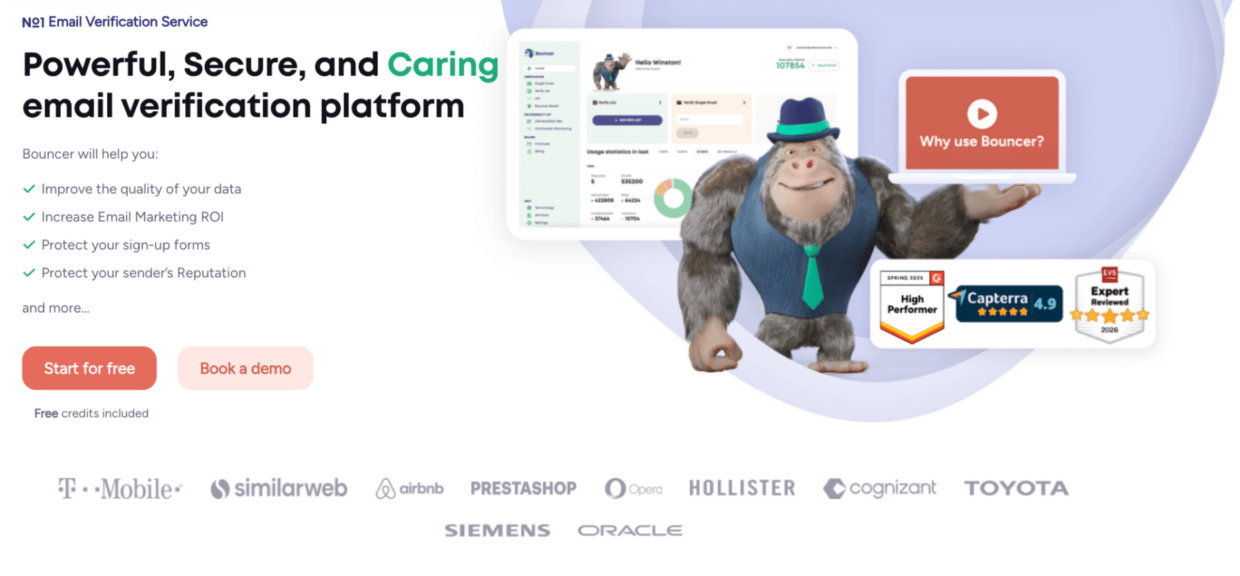
The core product, Email Verification, helps teams verify mailing lists and reduce bounce risk before campaigns. For product teams and developers, Email Verification API supports real-time validation inside forms, signup flows, lead capture systems, and custom applications. If your team already works inside marketing tools or CRMs, Integrations help connect verification to the systems you use every day.
That makes Bouncer stronger than a simple upload-and-clean workflow. You can verify a list before a campaign, stop bad emails at the point of entry with Bouncer Shield, and keep CRM lists clean with Bouncer AutoClean.
Bouncer also gives teams more ways to handle risky data. Toxicity Check helps identify toxic email addresses in a list, while Deliverability Kit supports inbox placement testing, authentication checks, and blocklist monitoring. For B2B teams, Data Enrichment can improve segmentation with publicly available company information. Email Engagement Insights helps teams understand how active contacts are in their inboxes overall.
The trust angle also matters. Bouncer Guarantee gives teams a stronger confidence layer when verification results need to support campaign decisions, client work, or internal reporting.
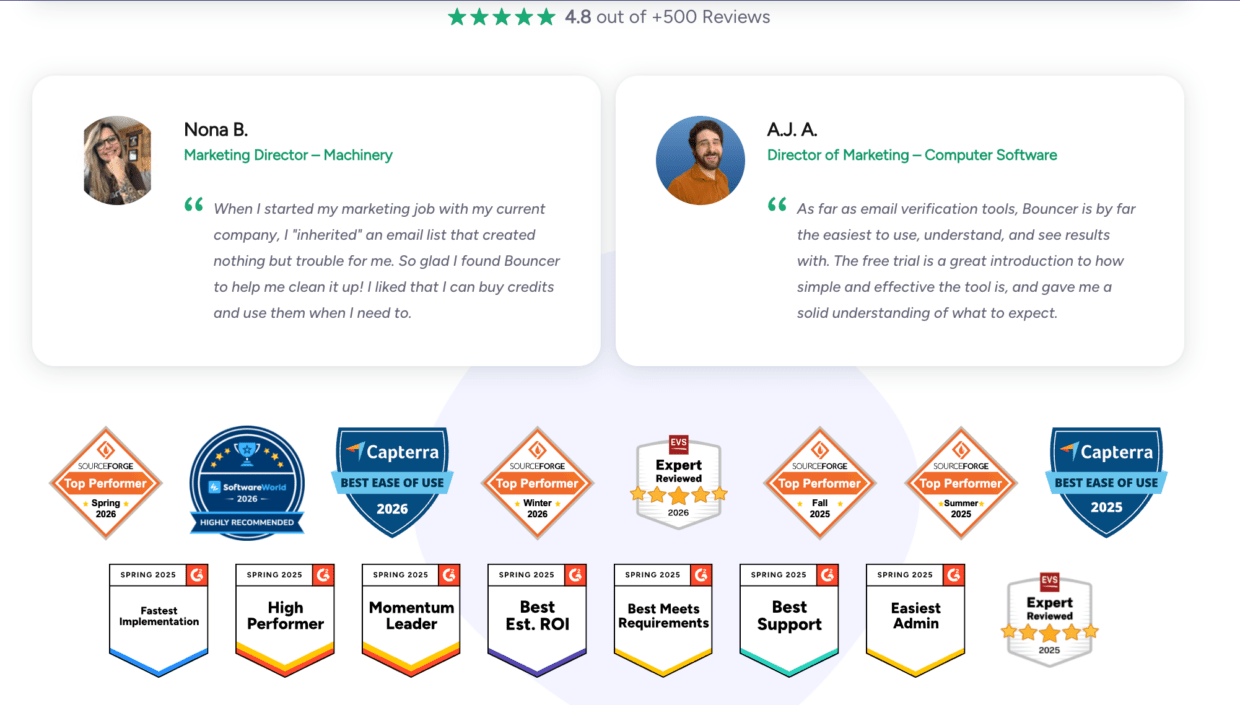
Bouncer is not trying to replace your CRM, outreach platform, or email marketing software. That is a good thing. It focuses on email verification, list hygiene, API validation, and deliverability-aware workflows. If your main goal is cleaner email data, Bouncer should sit at the top of your shortlist.
2. ZeroBounce
ZeroBounce is one of the more established email validation platforms, so it often appears in shortlists next to BillionVerify, NeverBounce, Kickbox, and Bouncer. It positions itself around real-time email validation, list cleaning, and deliverability tools, which makes it relevant for teams that want more than a quick CSV cleanup.
ZeroBounce can suit larger marketing teams, deliverability teams, and companies that want a broader email data quality suite. It may also appeal to teams that care about compliance signals, activity data, scoring, and inbox-related features alongside verification.
The trade-off is scope. If your team wants a wide email intelligence platform, ZeroBounce may fit. If your main need is focused email verification with clear workflows for list cleaning, API checks, CRM hygiene, and risk handling, Bouncer may feel easier to evaluate and roll out.
For readers who want a deeper comparison, Bouncer has a dedicated ZeroBounce alternative page and a broader ZeroBounce alternatives guide. Those are useful next steps if ZeroBounce already sits on your shortlist.
3. NeverBounce
NeverBounce is a familiar email verification name, especially for teams that want bulk list cleaning and real-time verification before campaigns or sales outreach. It fits the classic verifier category: upload a list, remove risky or invalid records, and reduce bounce risk before sending.
It can be a practical choice for marketers who need a known tool with integrations and a straightforward validation flow. Sales teams may also consider it when they want to clean outbound lists before sequences. The tool is easy to understand because its core value is direct: better list quality before emails go out.
Where NeverBounce may feel less differentiated is the broader list hygiene layer. If your team also wants automated CRM cleaning, form protection, toxicity checks, engagement insights, and deliverability testing, Bouncer gives you more connected options around the verification workflow.
Bouncer’s NeverBounce vs ZeroBounce comparison is useful if NeverBounce and ZeroBounce are already on your shortlist.
4. Kickbox
Kickbox is a verification-focused platform with bulk checks and API validation. It often suits teams that want to validate emails before they enter a product, form, CRM, or campaign list. For technical teams, the API side is usually the more important part of the evaluation.
Kickbox can work well if your team wants a dedicated verifier rather than a broad sales or marketing platform. It belongs in the same practical category as Bouncer, BillionVerify, and NeverBounce: tools meant to catch bad email data before it creates bounce or deliverability problems.
The main decision comes down to workflow depth. If you need straightforward verification, Kickbox can make sense. If you want verification connected with CRM hygiene, toxicity checks, inbox placement testing, and engagement insight, Bouncer offers more room to grow without forcing your team into a different category of software.
5. Clearout
Clearout combines email verification with email finding. That makes it more attractive for sales and growth teams than for teams that only need list cleaning. If your team wants to discover emails and validate them in one workflow, Clearout may deserve a place on the shortlist.
This broader positioning can be useful, but it also changes the comparison. Clearout is not only a verifier. It sits closer to prospecting and lead data workflows, so the right choice depends on what problem you want to solve first. If your main issue is “we need more leads,” Clearout may fit. If your issue is “we need to trust the email addresses we already have,” Bouncer is the cleaner choice.
Bouncer has a dedicated Clearout alternative page and a Clearout review for a deeper read. In a BillionVerify alternatives article, Clearout works best as the option for teams that want verification plus discovery, not as the top verification-first pick.
6. Bouncify
Bouncify is a direct email verification and list cleaning tool. It fits teams that want to reduce bounces before campaigns and do not need a large platform around the workflow. For users comparing it with BillionVerify, the attraction is likely similar: simple validation, campaign prep, and cleaner lists.
Bouncify can make sense when the job is narrow. A team uploads a list, checks it, removes bad records, and sends with more confidence. That is enough for some companies, especially when email verification is an occasional task.
Bouncer becomes more useful when verification needs to happen across several points: before a campaign, at signup, inside a CRM, and around risky email sources. If Bouncify is on your shortlist, Bouncer’s Bouncify features, pricing, review, and alternatives page can give you a more detailed comparison.
7. Bounceless
Bounceless is another direct email verification service focused on cleaning lists and reducing bounce rates. It belongs in the same comparison group as Bouncify, EmailListVerify, and MillionVerifier: tools that usually appeal to teams looking for a practical way to clean lists before sending.
It can work for marketers and small teams that want a simple workflow without too many surrounding features. If the team only needs occasional list cleaning, Bounceless may be enough.
Bouncer is stronger when the team wants to move from occasional cleanup to ongoing email hygiene. Bouncer AutoClean helps with connected CRM hygiene, while Bouncer Shield blocks invalid, malicious, or fraudulent emails at entry. For more context, read Bouncer’s Bounceless alternative page or Bounceless.io alternatives article.
8. Emailable
Emailable is a polished email verification platform with bulk verification and API validation. It can appeal to teams that want a clean user experience and a tool that works for both manual list checks and automated validation.
It may suit marketing teams, RevOps teams, and developers who want a modern verifier without going into a heavier all-in-one email data platform. In that sense, Emailable is one of the more natural BillionVerify alternatives because both tools serve verification-first use cases.
The decision between Emailable and Bouncer should focus on workflow fit. If the team wants a simple verification platform, both are worth checking. If the team wants the option to add CRM cleaning, toxicity detection, deliverability testing, enrichment, and engagement insight, Bouncer has the broader verification ecosystem.
9. MillionVerifier
MillionVerifier competes strongly on affordability and high-volume verification. Its messaging focuses on email list verification, bulk verification, API access, automated verification, and protecting email reputation. That puts it close to BillionVerify in buyer intent: teams that want to verify many emails without overpaying.
MillionVerifier can suit price-sensitive senders, agencies with large lists, or teams that already know how to interpret verification results internally. If you only need low-cost bulk checks, it deserves a look.
The risk is the same as with any price-led verifier. Cheap checks help only when your team can act on the output confidently. Bouncer is the stronger alternative when verification decisions need to support campaigns, CRM automation, sender reputation, and client-facing work.
10. Hunter Email Verifier
Hunter is not just an email verification tool. It is better known as an email finding and outreach data platform, with verification as part of a broader prospecting workflow. That makes it useful for sales teams that want to find professional email addresses and verify them before outreach.
Hunter Email Verifier can make sense if your team already uses Hunter for prospecting. Keeping email discovery and verification in the same workflow can reduce friction for SDRs and sales ops.
But Hunter is not the cleanest replacement if the main need is dedicated email verification. If you already have leads from forms, webinars, CRMs, partners, or customer lists, Bouncer is usually the better fit. It focuses on verifying and protecting the data you already own rather than finding more of it.
11. EmailListVerify
EmailListVerify is a straightforward email verification and list cleaning tool. It fits teams that want to upload lists, check addresses, and remove invalid records before sending campaigns.
It may appeal to small teams, email marketers, and users who do not need a broad product suite. Like BillionVerify and MillionVerifier, it can sit in the simple validation category for buyers comparing price and basic verification features.
Bouncer is stronger when the workflow becomes less simple. If your team needs API verification, CRM hygiene, deliverability tests, toxicity checks, or engagement-based insight, Bouncer gives you more room to build a complete email quality process. For a closer look, read Bouncer’s EmailListVerify alternative page or EmailListVerify alternatives article.
12. Verifalia
Verifalia is an email validation platform with API access and list verification. It can suit technical teams that care about structured validation, developer workflows, and flexible integration options.
Verifalia often makes more sense for engineering-led use cases than for teams that want a marketing-friendly verification workflow. Developers may care most about documentation, response structure, rate limits, and how clearly the API handles edge cases.
Bouncer is the better fit when both technical and non-technical teams need to use the verification results. Developers can use the Email Verification API, while marketing, sales, and deliverability teams can work with verification, AutoClean, Shield, Toxicity Check, Deliverability Kit, and Engagement Insights without needing to interpret every API response manually.
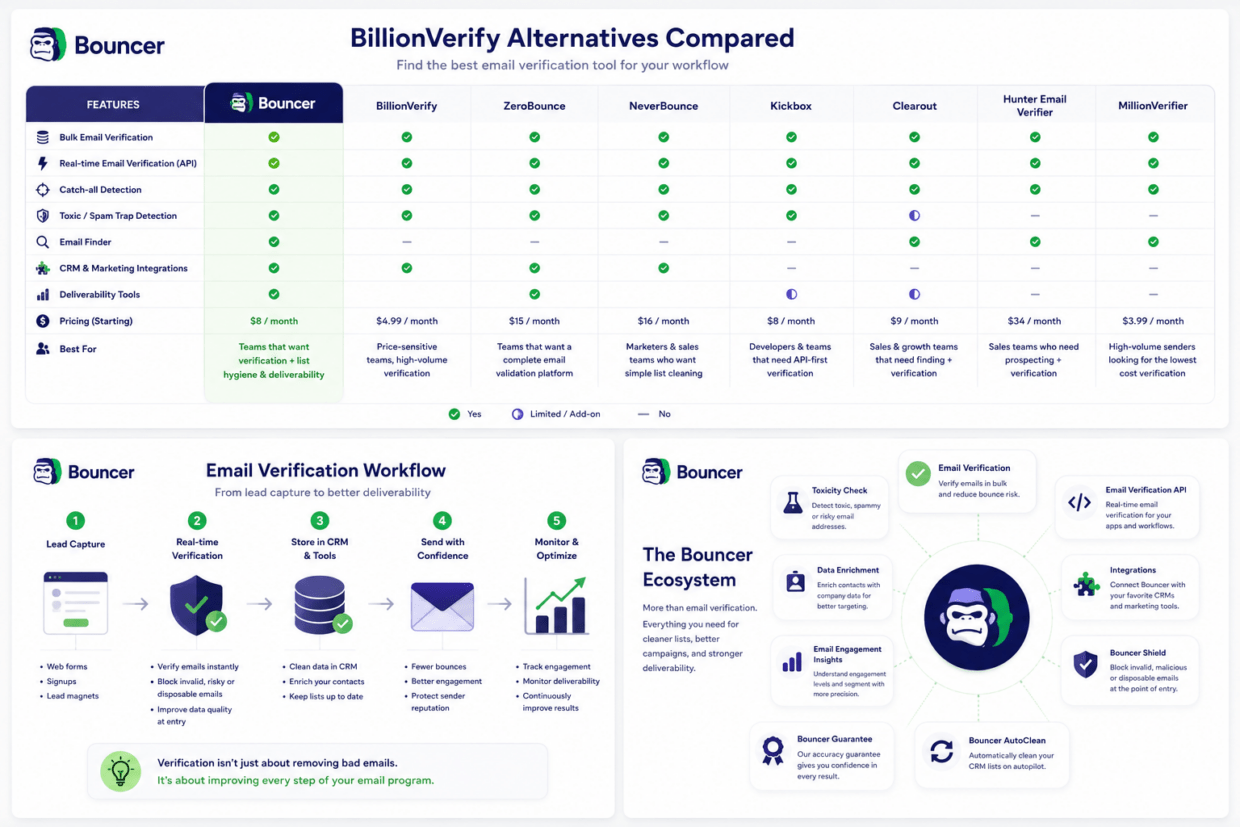
BillionVerify alternatives comparison table
| Tool | Best for | Main strength | Potential limitation | Bouncer angle |
| Bouncer | Teams that need email verification plus list hygiene workflows | Verification, API, integrations, toxicity checks, AutoClean, deliverability tools | Not a full CRM or outreach platform | Best first choice for focused verification |
| BillionVerify | Price-sensitive teams and API-led verification | Low-cost checks, bulk verification, real-time API | May offer less workflow depth for broader list hygiene | Useful benchmark to compare against |
| ZeroBounce | Teams that want a broad email data platform | Large feature set and strong market visibility | May feel heavy for focused verification | Bouncer offers a simpler verification-first path |
| NeverBounce | Teams that want familiar list cleaning | Bulk verification and integrations | Less differentiated for deliverability-aware workflows | Bouncer adds broader product coverage |
| Kickbox | API and list verification users | Practical validation workflows | Fit depends on workflow and reporting needs | Bouncer gives more list hygiene options |
| Clearout | Sales teams that need finding plus verification | Email finding and validation together | Broader than pure verification | Bouncer is more focused on verification |
| Bouncify | Basic list cleaning | Straightforward validation | Less product depth | Bouncer covers more use cases |
| Bounceless | Bounce reduction and list cleaning | Direct verification workflow | May lack broader supporting tools | Bouncer adds API, AutoClean, and deliverability tools |
| Emailable | Marketing teams that want a polished verifier | Bulk checks and API validation | Needs comparison on pricing and workflow fit | Bouncer adds a stronger list quality ecosystem |
| MillionVerifier | High-volume cost-sensitive checks | Affordable verification | May require more internal process maturity | Bouncer fits teams that need clearer workflows |
| Hunter Email Verifier | Prospecting teams | Email finding plus verification | Not a dedicated verification platform | Bouncer is better for verification-first needs |
| EmailListVerify | Bulk list cleaning | Simple verification workflow | Less suited to broader list hygiene programs | Bouncer gives more ways to act on results |
| Verifalia | Developers and technical validation workflows | API-based validation | May feel technical for marketing users | Bouncer works across technical and business teams |
Which BillionVerify alternative fits your use case?
The best tool depends on how email data moves through your business. A team that only cleans one CSV per month does not need the same setup as a SaaS company that verifies signups in real time. A sales team that buys lead lists has different risks than a newsletter team that needs to refresh an old database.
This is where Bouncer works well. It can support several workflows without turning into a general-purpose marketing platform. You can start with verification, then add automation, toxicity checks, deliverability tests, or engagement insights when your team needs them.
| Use case | Best fit | Why |
| Bulk list verification before campaigns | Bouncer Email Verification | Helps teams clean lists before sending and reduce bounce risk |
| Real-time checks in forms or apps | Bouncer Email Verification API | Verifies emails before they enter your system |
| CRM list hygiene | Bouncer AutoClean | Keeps connected CRM lists cleaner with less manual work |
| Signup fraud and bad data prevention | Bouncer Shield | Identifies invalid, malicious, or fraudulent email addresses at entry |
| Risky list detection | Toxicity Check | Helps identify toxic emails before they affect sending |
| Inbox placement and authentication checks | Deliverability Kit | Supports inbox tests, authentication checks, and blocklist monitoring |
| B2B segmentation | Data Enrichment | Adds publicly available company information for better campaign targeting |
| Contact activity insight | Email Engagement Insights | Helps teams understand inbox activity and segment with more care |
| Proof and trust around results | Bouncer Guarantee | Adds confidence when verification results need to support decisions |
Feature fit table for BillionVerify alternatives
| Need | Best fit | Why it matters |
| A focused alternative to BillionVerify | Bouncer | It covers verification, API checks, integrations, and deliverability-aware list hygiene |
| Lowest possible verification cost | BillionVerify or MillionVerifier | Price may matter most for very high-volume, simple checks |
| Email verification plus prospecting | Hunter or Clearout | These tools fit teams that need to find emails, not only verify them |
| CRM hygiene without manual uploads | Bouncer | AutoClean helps teams avoid repeated manual list cleaning |
| Real-time bad email prevention | Bouncer | API checks and Shield help stop bad emails earlier |
| Broader email data platform | ZeroBounce | It may suit teams that want a larger suite of email data tools |
| Simple campaign list cleaning | Bouncer, NeverBounce, or Bouncify | All can help reduce bounce risk before sends |
| Deliverability-aware verification | Bouncer | Verification connects with toxicity, engagement, and deliverability tools |
Quick checklist before switching from BillionVerify
Before choosing one of the BillionVerify alternatives, check:
- Do you need bulk verification, API verification, or both?
- Who will use the results: marketing, sales, product, or deliverability?
- Does the tool explain risky emails clearly enough?
- Can it connect with your CRM or email platform?
- Does the pricing still make sense at your monthly volume?
- Can your team act on the results without manual cleanup?
- Do you need to verify emails before they enter your database?
- Does the tool support sender reputation work, not only bounce reduction?
- Do you need extra products such as toxicity checks, data enrichment, inbox placement tests, or engagement insights?
Key takeaways
- BillionVerify alternatives make sense when your team needs more than low-cost bulk checks.
- Bouncer is the best first option for teams that want email verification, API validation, integrations, AutoClean, toxicity checks, deliverability tools, and engagement insights in one ecosystem.
- BillionVerify can still fit teams that mainly care about affordable verification at scale.
- ZeroBounce, NeverBounce, Kickbox, Clearout, Bouncify, Bounceless, Emailable, MillionVerifier, Hunter, EmailListVerify, and Verifalia all serve slightly different workflows.
- Bouncer works especially well when verification needs to support marketing, sales, product, and deliverability decisions.
- The best tool is the one your team can use before bad data spreads into your CRM, campaigns, and reports.
Conclusion
The best BillionVerify alternatives are not only tools that verify emails. They help your team make better sending decisions.
BillionVerify can be a strong option if your main priority is low-cost validation. But if you want email verification connected to list hygiene, API checks, CRM automation, toxicity detection, deliverability testing, and engagement insight, Bouncer is the strongest first choice.
Start with the workflow. If your team only needs a simple check, a basic verifier may work. If email quality affects revenue, sender reputation, or client results, choose a tool that gives you more than a cleaned file.
FAQ
What is the best BillionVerify alternative?
Bouncer is the best BillionVerify alternative for teams that want focused email verification with stronger workflow support. It covers bulk verification, real-time API checks, integrations, AutoClean, toxicity checks, deliverability tools, and engagement insights.
Is Bouncer better than BillionVerify?
Bouncer is better if your team wants more than low-cost verification. BillionVerify may suit teams that prioritize affordable high-volume checks, while Bouncer is stronger for teams that need clearer list hygiene workflows and broader deliverability support.
Can I use Bouncer instead of BillionVerify for bulk email verification?
Yes. Bouncer supports bulk email verification through its Email Verification product. It is a strong fit for teams that need to clean lists before campaigns and reduce bounce risk.
Which BillionVerify alternative is best for API validation?
Bouncer is a strong choice for API validation because its Email Verification API supports real-time email checks in forms, signup flows, and custom systems. BillionVerify, Kickbox, and Verifalia may also be worth comparing for developer-led use cases.
Which BillionVerify alternative is best for CRM hygiene?
Bouncer is the best fit if CRM hygiene matters. Bouncer AutoClean helps teams keep CRM lists cleaner without repeating manual verification work.
Which BillionVerify alternative is best for sales teams?
Bouncer works well for sales teams that want to reduce bounce risk before outreach. Hunter or Clearout may also fit if the team needs email finding and prospecting features.
Are free email verification tools enough?
Free tools can help with small checks or early testing. They are usually not enough for serious list hygiene, API workflows, or sender reputation protection.
How often should I verify email lists?
Verify lists before important campaigns, after major imports, and when old contacts return to active sending. If you collect emails through forms or product flows, real-time verification can stop bad data before it enters your database.


