





Sales wants routing rules, marketing wants better segments, and RevOps wants a CRM that does not collapse under stale fields. That is why global providers for contact enrichment matter. They help teams add useful context, but only when enrichment sits next to verification, consent, source control, and data hygiene.
You’ll learn
- What contact enrichment means in global marketing and sales workflows
- Which global providers for contact enrichment teams often compare
- Why Bouncer is useful as a verification and company enrichment layer
- How enrichment differs from email verification, list cleaning, and consent management
- Which enrichment fields help segmentation and which ones create risk
- How to evaluate providers for global, EU, B2B, SaaS, ecommerce, and agency workflows
- How to build a workflow that enriches useful records without adding unnecessary data
What contact enrichment means
Contact enrichment is the process of adding useful information to an existing person, lead, customer, or company record. That information may include company name, company domain, industry, company size, region, country, job function, seniority, technology used, lifecycle context, or other fields that support segmentation and routing.
In global go-to-market teams, enrichment often supports practical decisions.
A B2B SaaS company may want to route enterprise leads to sales and smaller companies to nurture. An agency may want to segment client databases by company type. An ecommerce brand may want to identify wholesale buyers or business customers. A global marketing team may need country, region, or language fields to send more relevant campaigns.
The problem is that enrichment can create false confidence.
A record can be enriched and still contain an invalid email. A company field can be correct while the consent source is missing. A lead can look high-value but remain unsubscribed. A contact can have a clean-looking profile but no clear permission for a campaign.
That is why global providers for contact enrichment should not be judged only by how much data they add. They should be judged by whether their data supports a specific workflow and fits your privacy, compliance, and deliverability standards.
Contact enrichment vs verification vs hygiene
Contact enrichment often gets mixed up with email verification and list cleaning. They are related, but they solve different problems.
| Process | Main question | What it improves | What it does not replace |
| Contact enrichment | What useful context is missing from this record? | Segmentation, routing, personalization, account matching | Email validity or consent |
| Email verification | Can this address likely receive email? | Bounce reduction and reachability confidence | Company context or permission |
| List cleaning | Which records should we fix, remove, suppress, or organize? | CRM usability and campaign readiness | Enrichment or legal review |
| Consent management | Are we allowed to contact this person for this purpose? | Compliance and campaign eligibility | Deliverability or enrichment |
| Deliverability testing | Will our emails reach inboxes? | Inbox placement and sender readiness | Data completeness |
A strong enrichment workflow usually starts with cleaning and verification. It does not make sense to enrich thousands of invalid, suppressed, toxic, or unknown-source records that should not enter campaigns anyway.
Why global enrichment is harder
Global enrichment is harder than local enrichment because the data is more varied.
A company may operate in several regions. A contact may work remotely. A domain may serve multiple markets. A language preference may not match country. A job title may mean different things across markets. Company size data may vary across sources. Privacy expectations and legal requirements may differ by region.
Global teams also need to manage several data systems:
CRMs
Marketing automation platforms
Sales engagement tools
Product databases
Customer data platforms
Ecommerce platforms
Data warehouses
Regional spreadsheets
Agency tools
Partner systems
If enrichment data does not flow cleanly into those systems, teams end up with duplicates, conflicting fields, and segments nobody trusts.
| Global enrichment challenge | What can go wrong | Better practice |
| Region mismatch | Contact gets wrong market campaign | Store source and confidence |
| Company hierarchy | Subsidiary and parent company mix | Define account matching rules |
| Language assumption | Wrong localized email | Use first-party language preference where possible |
| Stale company data | Wrong routing or segmentation | Refresh key fields |
| Duplicate enrichment | Conflicting values across tools | Set field ownership |
| Missing consent source | Enriched but not eligible | Keep consent separate |
| Invalid emails | Enriched records bounce | Verify before enrichment |
| Too many fields | Privacy and governance burden | Enrich only useful fields |
The best global providers for contact enrichment help teams add context without making the database harder to govern.
Bouncer
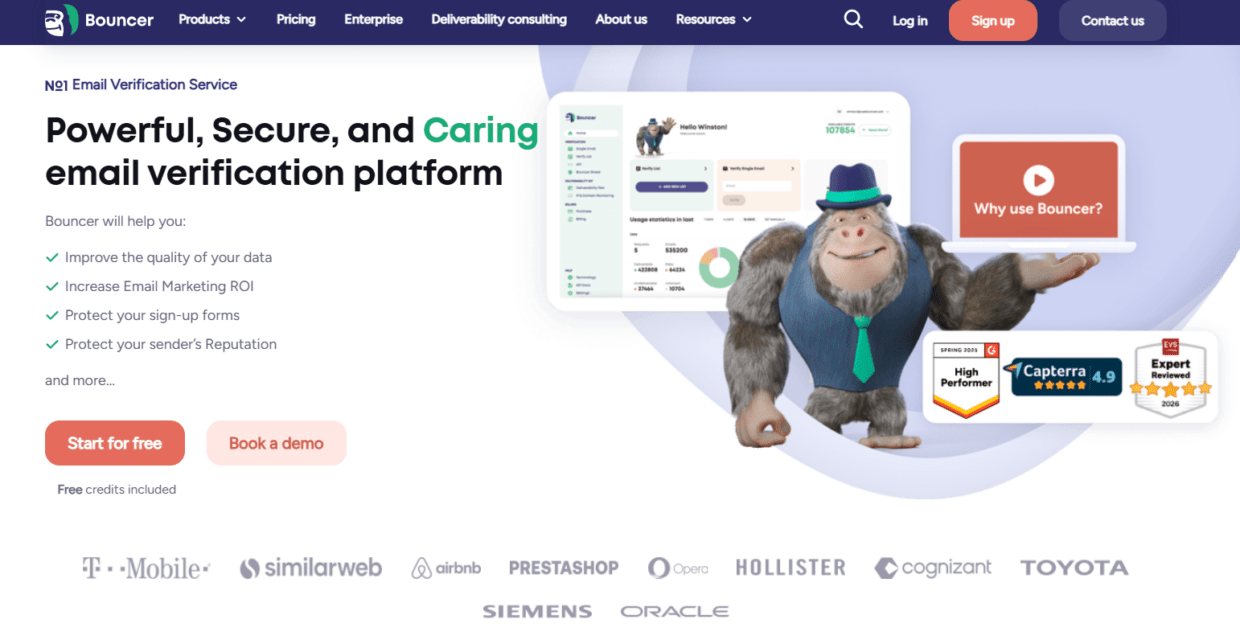
Bouncer is not a traditional giant contact database. Its value sits in a different part of the enrichment workflow: email verification, company data enrichment, list hygiene, form protection, risk checks, and deliverability readiness.
Bouncer’s Company Data Enrichment helps teams enrich customer data with publicly available company information. The workflow starts with uploading an email list for verification, then selecting enrichment. This matters because enrichment works better when the base email data is usable.
Bouncer’s email list verification helps teams check whether email addresses appear deliverable before campaigns or CRM workflows. For larger lists, bulk email verification supports campaign files, CRM exports, old databases, customer lists, and agency client files. Free email list sampling can help estimate the quality of large or uncertain databases before full verification.
For entry-point quality, Email Verification API validates emails in forms, apps, signups, and internal workflows. Bouncer Shield helps protect forms from invalid, fake, or malicious submissions.
Bouncer also supports Toxicity Check for potentially harmful email addresses, Deliverability Kit for inbox placement and authentication testing, Bouncer AutoClean for ongoing hygiene, and integrations for connected workflows.
For teams comparing global providers for contact enrichment, Bouncer is strongest when enrichment should start from verified email data and feed safer segmentation, not uncontrolled data collection.
HubSpot Breeze Intelligence
HubSpot Breeze Intelligence can enrich company and contact records inside HubSpot. For teams already using HubSpot as their CRM or marketing automation platform, this can be convenient because enrichment happens inside the system where segmentation, lists, and workflows already live.
HubSpot’s enrichment docs explain that enrichment data can help fill information for companies and contacts in HubSpot accounts. That makes it useful for teams that want to improve CRM completeness without exporting data into a separate tool.
The strength is workflow proximity. If HubSpot is your source of truth, enrichment inside HubSpot can reduce manual imports and exports.
The limitation is that enrichment does not solve email verification or consent by itself. A HubSpot contact can be enriched but still invalid, unsubscribed, duplicated, or out of scope for a campaign. Teams should pair HubSpot enrichment with verification and suppression rules.
Bouncer’s HubSpot integration and AutoClean can help keep HubSpot lists cleaner, while HubSpot handles CRM segmentation and workflow logic.
Clearbit
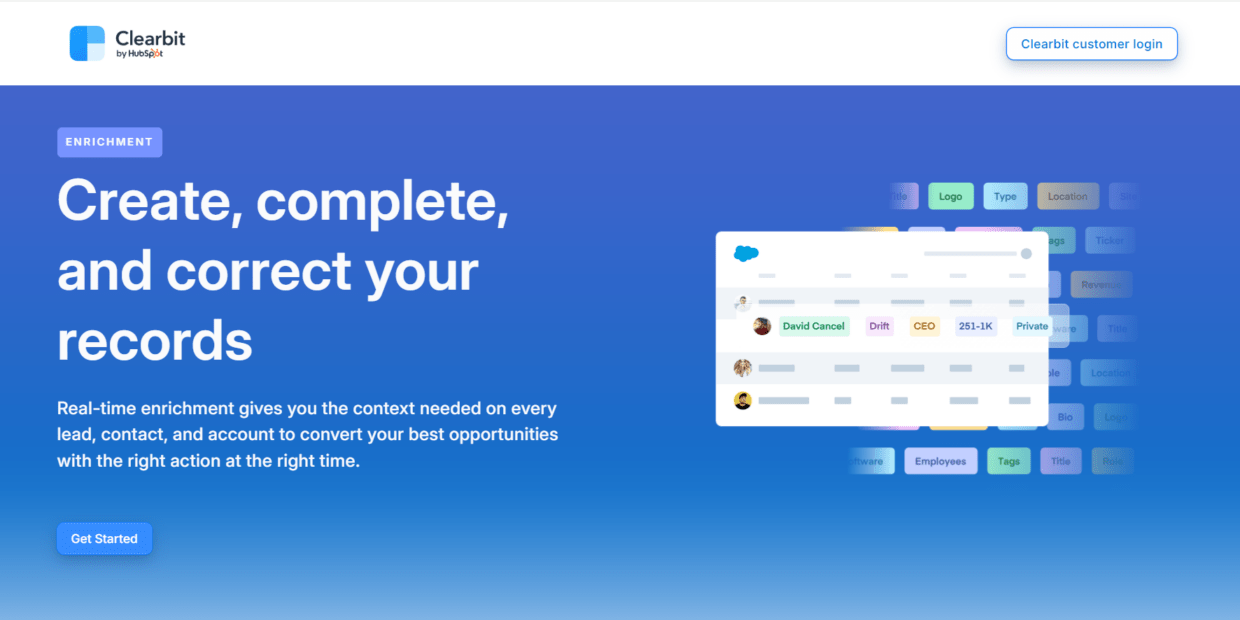
Clearbit is a well-known enrichment provider for B2B teams. It is often used to add company and person-level context to leads, accounts, and website visitors. Typical use cases include firmographic enrichment, account scoring, routing, personalization, and sales prioritization.
Clearbit can be useful for teams that need fast context around companies and leads. For example, a SaaS company may use enrichment to identify company size, industry, and domain, then route high-fit accounts to sales.
The limitation is that enrichment quality still depends on source freshness and field fit. A record enriched with company size may still have an invalid email. A contact with a strong company match may still lack permission for marketing. Enrichment should support routing and segmentation, not replace verification or consent.
Clearbit is worth considering when company context is the main goal. Bouncer is the better layer when the first question is whether the email data is accurate and safe enough to use.
ZoomInfo
ZoomInfo is a large B2B data platform used for contact discovery, enrichment, sales intelligence, account data, and go-to-market workflows. It can support enterprise teams that need broad B2B coverage and sales prospecting data.
Its value is scale. Sales and RevOps teams can use it to enrich accounts, identify contacts, and support outbound motions.
The risk is overreliance. Large databases can still contain outdated or uncertain records. Job roles change. Emails decay. Contacts move companies. A sourced or enriched address should still go through verification before it enters campaigns or sales sequences.
For teams using ZoomInfo, a good workflow is: source or enrich contact data, verify emails with Bouncer, suppress invalid or risky records, then route only usable contacts into campaigns or sales workflows.
Apollo
Apollo combines prospecting, enrichment, and sales engagement. It is popular with B2B sales teams because it helps find contacts, enrich records, build lists, and run outreach in one environment.
Apollo can support enrichment by adding company and contact context to sales workflows. It is useful when teams want prospecting and outreach close together.
The main caution is speed. Sales teams may move quickly from enrichment to sequences. If verification, suppression, and source review are skipped, enrichment can feed bad data into outreach at scale.
Apollo is useful for sales-driven enrichment. Bouncer is useful as the verification and hygiene checkpoint before records enter high-volume outreach.
Lusha
Lusha is used for B2B contact and company data, especially by sales and recruiting teams. It can help enrich prospect records, identify contact details, and support outbound workflows.
It may fit teams that need direct contact details and prospecting support.
Like other contact databases, Lusha should not be treated as a final deliverability check. Contact data can decay, and enrichment does not prove that an email is safe to send. Teams should verify records before outreach, especially if sequences run at scale.
Lusha can help find or enrich. Bouncer can help validate and reduce bounce risk before sending.
Cognism
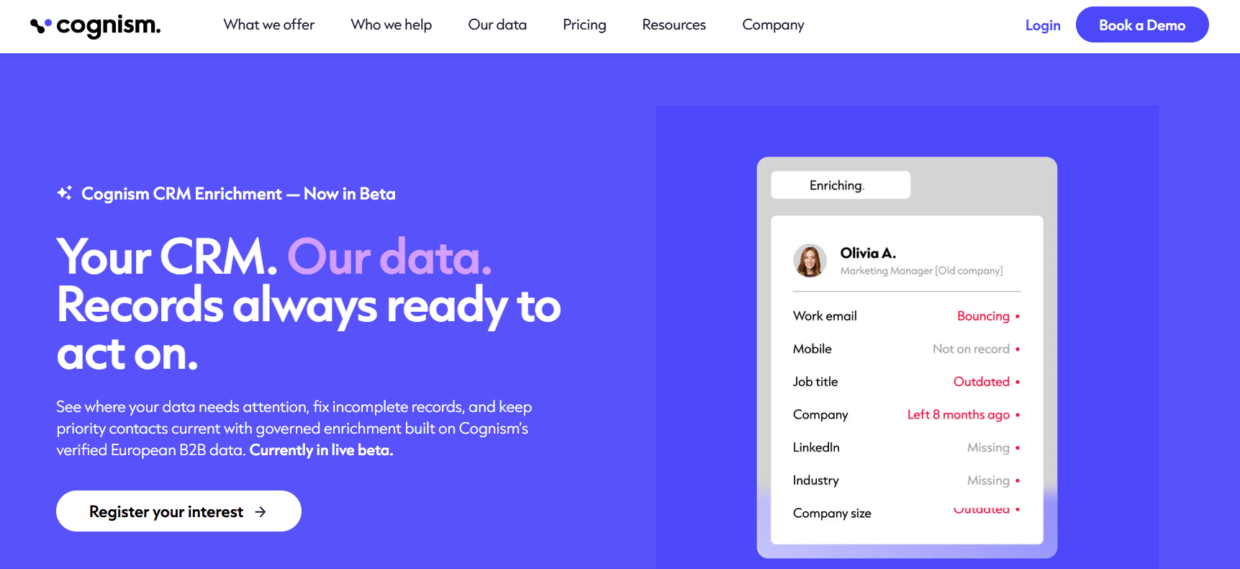
Cognism is a B2B sales intelligence and data provider known for international and European market coverage. It is often considered by teams that need prospecting and enrichment across regions, including GDPR-conscious B2B workflows.
Its strength is sales intelligence and contact data for GTM teams that sell across markets.
The limitation is the same as with other databases: enrichment and compliance positioning do not replace internal governance. A contact still needs source tracking, permission logic, suppression checks, and verification before campaigns or outreach.
Cognism may be useful for global B2B data acquisition and enrichment. Bouncer remains useful for verification, toxicity checks, form protection, and deliverability readiness.
Clay
Clay helps teams build custom enrichment workflows by connecting data sources, APIs, automation steps, and AI-assisted research. It is popular with growth, RevOps, and sales teams that want flexible enrichment logic rather than a single fixed database.
Clay can be powerful when teams want custom workflows. For example, a team might enrich company domains, classify accounts, pull public context, check hiring signals, and prepare personalized outbound data.
The risk is complexity. Custom workflows can produce messy or inconsistent data if rules are not governed. Every source should have a purpose and every enriched field should have an owner.
Clay works best when paired with verification. Use Clay for research and enrichment. Use Bouncer to verify email addresses and reduce bounce risk before sending.
People Data Labs
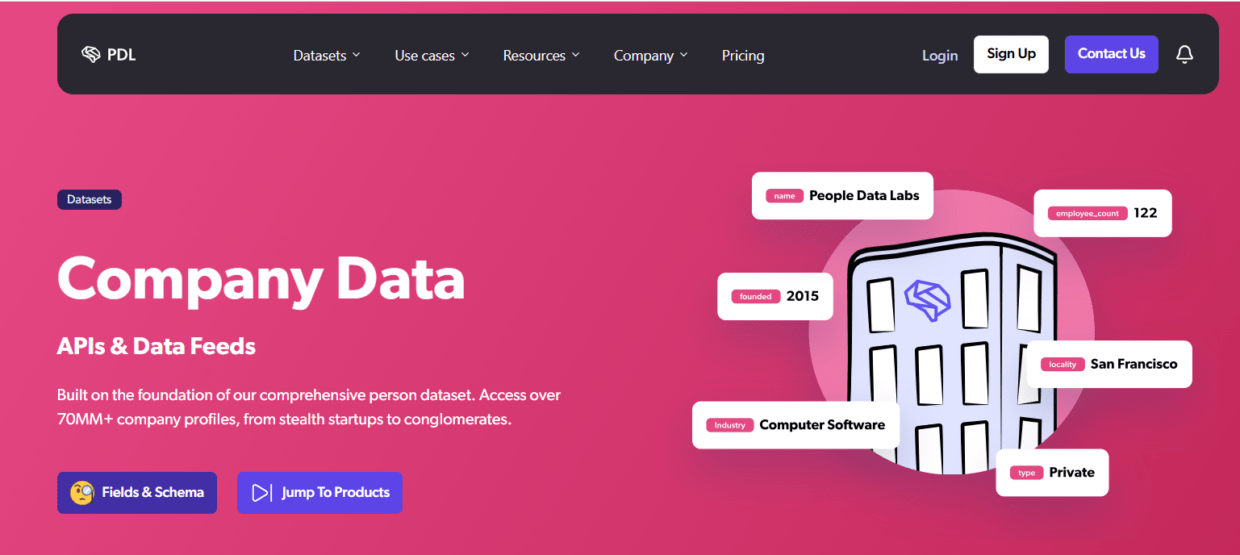
People Data Labs offers large-scale person and company data APIs used by data teams, platforms, and enterprise workflows. It can support enrichment at scale through APIs and datasets.
Its value is technical flexibility. Data teams can enrich records inside custom pipelines, internal tools, or data warehouses.
The limitation is that API-scale enrichment needs strong governance. Without clear rules, teams can collect more data than they need. Data minimization, field ownership, source tracking, and retention become important.
People Data Labs may fit technical enterprise enrichment workflows. Bouncer can sit alongside it as the email verification and deliverability quality layer.
FullContact
FullContact provides identity resolution and customer data enrichment. It can help connect fragmented customer records and add context to profiles.
This can be useful for teams that need customer identity, profile completion, and cross-channel context.
For email marketing and CRM workflows, the same rule applies: enrichment should support a defined purpose. It should not add unnecessary personal attributes or replace permission checks.
FullContact can help with profile context and identity resolution. Bouncer supports email verification, form protection, and deliverability checks that keep the email channel healthier.
LeadGenius
LeadGenius focuses on custom B2B data, lead generation, and account intelligence. It can support companies that need tailored datasets, market-specific lead research, or outbound list building.
This can be useful when standard databases do not cover a niche market well.
Custom data still needs validation. If contacts come from research, enrichment, or manual workflows, verify emails before outreach. Also track source, region, consent context, and suppression status.
LeadGenius can help source and enrich. Bouncer can help validate, score risk, and protect deliverability before campaigns.
Comparing global providers for contact enrichment
The right provider depends on the problem you need to solve.
| Provider | Best for | Strength | Where Bouncer fits |
| Bouncer | Verified company enrichment and email hygiene | Verification-first enrichment, API, Shield, Toxicity Check, Deliverability Kit | Core data-quality and deliverability layer |
| HubSpot Breeze Intelligence | HubSpot CRM enrichment | Enrichment inside HubSpot records and workflows | Verify HubSpot lists and keep hygiene current |
| Clearbit | B2B company and contact enrichment | Firmographic and account context | Verify enriched contacts before campaigns |
| ZoomInfo | Enterprise B2B sales intelligence | Large-scale contact and account data | Validate records before outreach |
| Apollo | Prospecting plus enrichment | Sales workflow and outreach proximity | Check emails before sequences |
| Lusha | B2B contact data | Contact discovery for sales teams | Reduce bounce risk before use |
| Cognism | Global B2B data and sales intelligence | International B2B coverage | Verify and monitor risky lists |
| Clay | Custom enrichment workflows | Flexible data automation | Add verification into workflows |
| People Data Labs | API-based enrichment | Large-scale technical enrichment | Validate emails in pipelines |
| FullContact | Identity and profile enrichment | Customer profile context | Verify email channel data |
| LeadGenius | Custom lead research | Tailored B2B datasets | Validate custom lists before outreach |
This is why global providers for contact enrichment should be compared by workflow, not only database size.
Which provider fits which use case?
Different teams need different enrichment approaches.
| Use case | Best-fit provider type | Why |
| Clean B2B campaign segmentation | Bouncer + CRM enrichment | Verify first, enrich usable records |
| Enterprise sales prospecting | ZoomInfo, Cognism, Apollo | Large contact databases and account context |
| HubSpot CRM completion | HubSpot Breeze Intelligence + Bouncer | Enrich inside CRM, verify lists |
| Custom outbound workflows | Clay + Bouncer | Flexible enrichment plus verification |
| API-scale enrichment | People Data Labs + Bouncer | Data pipeline enrichment plus email checks |
| Agency client audits | Bouncer + enrichment source | Verify and enrich client lists carefully |
| EU-focused B2B data | Cognism + Bouncer | Regional coverage plus verification |
| Ecommerce B2B/wholesale segmentation | Bouncer + ecommerce/CRM data | Verify and add company context |
| Niche lead research | LeadGenius + Bouncer | Custom sourcing plus validation |
| Identity resolution | FullContact + verification layer | Profile context plus email hygiene |
For many teams, Bouncer is not a replacement for every enrichment provider. It is the quality-control layer that should sit before or alongside enrichment.
What to look for in a global enrichment provider
A global enrichment provider should add useful data without creating chaos.
Look for:
Coverage in target markets.
Clear data sources.
Field-level transparency.
CRM integrations.
API support.
Bulk enrichment workflows.
Data refresh options.
Suppression compatibility.
Privacy and security documentation.
Region-aware handling.
Company and account matching quality.
Export clarity.
Deduplication support.
Clear pricing at scale.
| Evaluation area | Why it matters |
| Geographic coverage | Global teams need reliable regional data |
| Data freshness | Stale enrichment creates wrong segments |
| Field accuracy | Bad fields hurt routing and personalization |
| Source transparency | Helps with compliance and trust |
| CRM fit | Results need to be usable |
| API quality | Supports automated workflows |
| Privacy controls | Important for personal data processing |
| Security | Protects customer and lead data |
| Verification support | Prevents enriching unusable emails |
| Suppression handling | Prevents wrong-message sends |
| Enrichment scope | Avoids unnecessary data collection |
| Pricing | Enterprise volume can become expensive |
A provider that adds hundreds of fields is not always better. The best provider adds the fields your team can use responsibly.
Useful enrichment fields
Most teams do not need every field a provider can offer.
Useful fields usually connect to routing, segmentation, localization, or account matching.
| Field | Good use case | Notes |
| Company name | Account matching and CRM cleanup | Useful in B2B |
| Company domain | Deduplication and account linking | Strong matching field |
| Industry | Campaign segmentation | Use broad categories |
| Company size | Sales routing and ICP fit | Keep bands simple |
| Country or region | Localization and compliance workflows | Prefer reliable source |
| Language preference | Campaign relevance | First-party data is best |
| Job function | Lead routing | Avoid over-personal assumptions |
| Seniority | Sales prioritization | Use cautiously |
| Technology category | GTM segmentation | Use if relevant |
| Verification status | Campaign eligibility | Needed before sending |
| Source | Governance and audit | Always useful |
| Enrichment date | Freshness | Helps refresh rules |
If a field does not support a decision, it may not belong in the CRM.
Fields to avoid or handle carefully
Enrichment can create risk when teams add too much.
Avoid or treat carefully:
Sensitive personal attributes
Unclear inferred traits
Vague behavioral labels
Personal lifestyle data
Fields with no campaign use
Data from unclear sources
Outdated fields
Highly granular personal profiling
Unreviewed third-party contact details
Global campaigns especially need restraint. GDPR Article 5 includes data minimization, which requires personal data to be adequate, relevant, and limited to what is necessary for the purpose. Even outside Europe, this is a useful operating principle.
| Risky data type | Why it creates risk | Safer alternative |
| Sensitive personal traits | High legal and trust risk | Avoid for normal email campaigns |
| Vague persona labels | Hard to explain | Use lifecycle or engagement stage |
| Personal lifestyle details | Usually irrelevant | Use first-party preferences |
| Unused enrichment fields | Adds governance burden | Remove |
| Unknown-source data | Hard to defend | Use transparent providers |
| Overly granular scoring | Hard to audit | Use simpler fit categories |
| Old enrichment values | May be inaccurate | Refresh or expire |
| Personal contact data for broad campaigns | Can feel intrusive | Use company-level segmentation |
Enrichment should make communication more relevant, not more invasive.
Verification before enrichment
Verification should usually come before enrichment when the goal is email campaigns, CRM hygiene, or sales outreach.
Bouncer helps with this order because Company Data Enrichment starts from an email list verification workflow. This prevents teams from adding company data to emails that should not be used.
A practical workflow:
Clean obvious ineligible records.
Verify emails with Bouncer.
Suppress invalid, toxic, and high-risk records.
Review catch-all, unknown, role-based, and disposable contacts.
Enrich usable records.
Segment by region, company, industry, size, engagement, and consent.
Send only to eligible contacts.
This order improves efficiency and reduces database noise.
Consent and suppression still matter
Enrichment does not create permission.
A contact may match your target industry, company size, and region, but still be unsubscribed. Another may be enriched through a provider but have no clear source history. Another may have a valid email and a perfect ICP profile, but still be ineligible for the campaign.
Always keep these fields separate:
Email verification status
Consent status
Subscription type
Suppression reason
Region or jurisdiction
Source
Enrichment source
Last engagement
| Record state | Campaign action |
| Enriched + verified + subscribed | Eligible if message matches purpose |
| Enriched + valid + unsubscribed | Exclude |
| Enriched + invalid | Suppress |
| Enriched + unknown source | Review |
| Enriched + toxic | Suppress or hold |
| Enriched + wrong subscription type | Exclude |
| Enriched + stale data | Refresh or review |
| Enriched + missing consent | Hold |
A clean-looking enriched record can still be unsafe to email.
Global provider selection checklist
Use this checklist when comparing global providers for contact enrichment.
| Question | Why it matters |
| Does the provider cover your priority markets? | Global coverage is uneven |
| Are data sources clear enough for your standards? | Supports trust and review |
| Can it enrich company-level fields? | Useful for B2B segmentation |
| Can it avoid unnecessary personal fields? | Supports data minimization |
| Does it integrate with your CRM? | Reduces manual work |
| Does it support API workflows? | Helps technical teams |
| Can it preserve source and enrichment date? | Supports governance |
| Does it handle regional rules? | Useful for global campaigns |
| Does it support bulk enrichment? | Needed for large lists |
| Can it pair with verification? | Prevents enriching bad records |
| Is pricing predictable at scale? | Avoids budget surprises |
| Does it provide security documentation? | Needed for vendor review |
Do not choose a provider only because it has the biggest database. Choose the one that supports your actual segmentation, routing, and governance needs.
Example workflow: global B2B campaign
A global B2B SaaS company wants to run a campaign across the US, UK, Germany, France, and Australia.
The team starts with a mixed CRM list. Some records have missing company size, some have old verification dates, and some came from events.
A safer workflow:
Segment the list by source and region.
Remove unsubscribed, hard-bounced, and do-not-contact records.
Verify email addresses with Bouncer.
Suppress invalid and toxic contacts.
Enrich company data for usable records.
Segment by region, industry, company size, and lifecycle stage.
Check consent and subscription type.
Test deliverability before launch.
Review results by source and region after sending.
Here, enrichment improves targeting, but verification and suppression protect the send.
Example workflow: agency client enrichment
An agency receives a client database with 80,000 contacts. The client wants enriched segments for industry and company size.
The agency should not enrich the file immediately.
First, it should identify source categories: customers, newsletter subscribers, event leads, old prospects, partner contacts. Then it should suppress unsubscribed and bounced contacts. Next, it should verify the remaining emails with Bouncer. After that, it can enrich usable records and create segments.
This gives the client a more honest view. The database may contain 80,000 rows, but only 52,000 may be usable, verified, eligible, and worth enriching.
For agencies, this distinction is valuable because it prevents inflated expectations and reduces deliverability risk.
Example workflow: product-led SaaS signup enrichment
A product-led SaaS company collects many free trial signups. Some users enter personal emails, some use business emails, some use disposable inboxes.
The company can use Bouncer’s Email Verification API or Bouncer Shield to validate signups at entry. It can block invalid and disposable addresses where appropriate. Then it can enrich usable business emails with company data. Enterprise-fit accounts can route to sales, while smaller accounts enter self-serve onboarding.
This workflow gives sales a cleaner signal and reduces fake or low-quality records inside the product database.
How to measure enrichment quality
Measure enrichment based on outcomes, not only fill rate.
A provider may fill many fields, but those fields may not improve routing, conversion, segmentation, or campaign relevance.
Track:
Match rate
Field accuracy
Field freshness
Segment performance
Sales acceptance rate
Bounce rate after verification
Campaign engagement
Routing accuracy
Duplicate rate
Manual correction rate
Source-level quality
| Metric | What it tells you |
| Match rate | How many records receive enrichment |
| Verified usable rate | How many enriched records are actually contactable |
| Field accuracy | Whether enrichment values are correct |
| Sales acceptance | Whether enriched leads are useful |
| Segment engagement | Whether enrichment improves relevance |
| Bounce rate | Whether verification is working |
| Conversion rate | Whether better data affects outcomes |
| Manual correction rate | How often teams fix provider data |
| Regional coverage | Where enrichment is strong or weak |
| Stale field rate | How quickly data decays |
Enrichment should improve decisions. If it only fills empty fields, the value is limited.
How Bouncer fits into a global enrichment stack
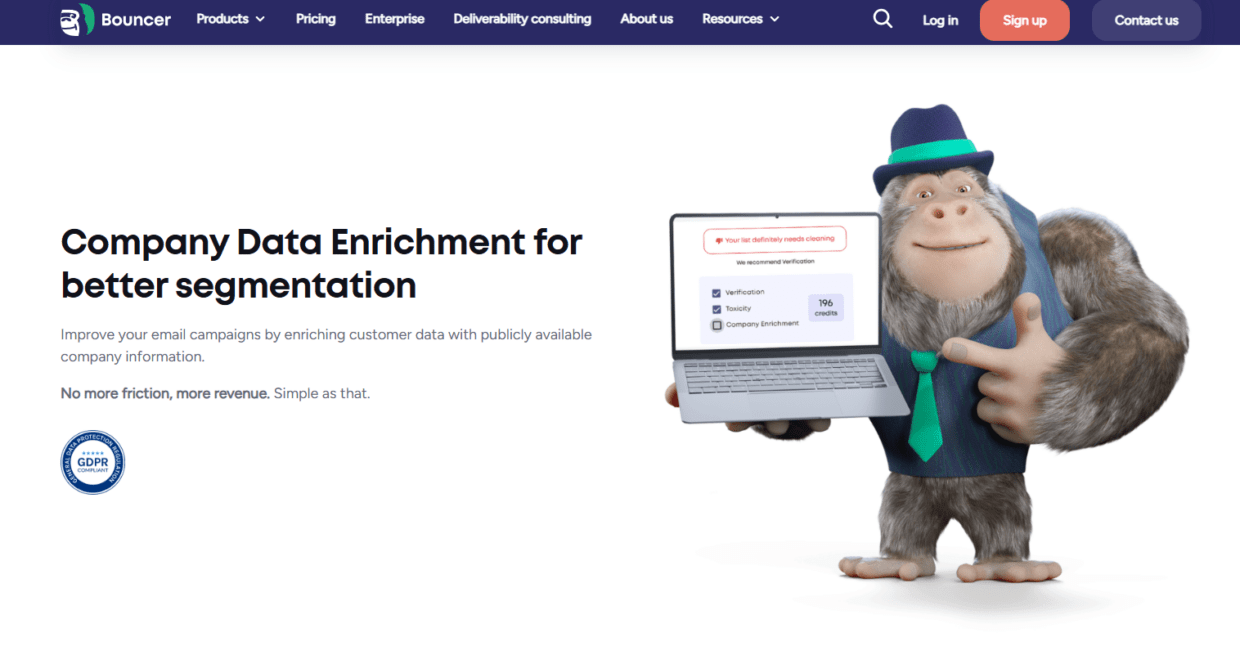
Bouncer fits best as the verification-first enrichment and hygiene layer.
Use Bouncer before enrichment to verify email addresses. Use Bouncer’s Company Data Enrichment to add useful company context. Use API or Shield to protect new records. Use Toxicity Check to identify risky emails before campaigns. Use Deliverability Kit to test inbox readiness. Use AutoClean and integrations to keep data cleaner over time.
A practical stack might look like this:
Bouncer for verification, form protection, company enrichment, toxicity checks, and deliverability testing.
HubSpot, Salesforce, or another CRM for segmentation and workflow logic.
A sales intelligence provider such as ZoomInfo, Cognism, Apollo, or Lusha for broad contact discovery.
Clay or People Data Labs for custom enrichment workflows.
A consent or privacy tool for permission, preferences, and rights handling.
This kind of stack keeps the roles clear. Enrichment adds context. Verification checks reachability. Consent determines eligibility. Deliverability testing checks inbox readiness.
Key takeaways
- Global providers for contact enrichment help teams add useful context for segmentation, routing, account matching, and personalization.
- Bouncer is a strong verification-first enrichment layer because it supports email list verification, bulk verification, free list sampling, Email Verification API, Bouncer Shield, Company Data Enrichment, Toxicity Check, Deliverability Kit, AutoClean, and integrations.
- Enrichment does not replace email verification, consent management, suppression, or deliverability testing.
- Global enrichment is harder because region, language, company hierarchy, data freshness, and privacy rules vary across markets.
- The best provider depends on the use case: CRM completion, sales prospecting, custom workflows, API-scale enrichment, agency audits, or EU-focused campaigns.
- Useful enrichment fields should support a clear decision, such as routing, segmentation, localization, or account matching.
- Teams should verify and suppress risky records before enrichment whenever email reachability matters.
- Enrichment quality should be measured by usable records, campaign performance, routing accuracy, and sales acceptance, not only field fill rate.
Conclusion
Global providers for contact enrichment can make campaigns, routing, and CRM workflows much smarter. But enrichment becomes risky when teams treat more data as automatically better.
The strongest workflow starts with source review, suppression, verification, and only then enrichment. It also keeps consent, region, subscription status, and deliverability separate from enrichment fields.
Bouncer fits this workflow because it helps teams verify emails, enrich company data, protect forms, detect risky contacts, automate hygiene, and test deliverability. For global teams, that makes enrichment more useful because it starts from cleaner, safer, and more actionable email data.
Use enrichment to add context. Use verification to protect reachability. Use consent and suppression to decide eligibility. That combination makes global contact data much easier to trust.
Try Bouncer now – it’s free.
FAQ
What are global providers for contact enrichment?
Global providers for contact enrichment are tools or data platforms that add useful information to contact or company records across markets. They may enrich fields such as company name, domain, industry, size, country, region, job function, or account context.
Is Bouncer a contact enrichment provider?
Yes, Bouncer offers Company Data Enrichment, but its main strength is verification-first data quality. It helps teams verify emails, enrich company data, protect forms, check toxicity, test deliverability, automate hygiene, and connect workflows through integrations.
What is the difference between contact enrichment and email verification?
Contact enrichment adds context to a record, such as company or industry data. Email verification checks whether an email address appears deliverable and safe enough to use. Teams often need both.
Which global contact enrichment provider is best?
The best provider depends on your workflow. Bouncer is strong for verification-first enrichment and email hygiene. ZoomInfo, Cognism, Apollo, Lusha, Clearbit, Clay, People Data Labs, FullContact, and LeadGenius can fit different sales intelligence, API, or custom enrichment needs.
Should I verify contacts before enriching them?
Yes, in most email marketing and sales workflows. Verifying before enrichment prevents teams from adding more data to invalid, risky, or unusable records. It also keeps CRM enrichment more focused.
Does enrichment make a contact compliant to email?
No. Enrichment does not create consent or permission. A contact can be enriched and still be unsubscribed, restricted, invalid, toxic, or ineligible for a specific campaign.
What enrichment fields are safest to use?
Company-level fields such as company name, domain, industry, company size, and region are often useful for B2B segmentation. Teams should avoid sensitive personal attributes, vague inferred traits, and fields with no clear purpose.
How should teams measure contact enrichment quality?
Measure enrichment quality through verified usable rate, field accuracy, sales acceptance, routing accuracy, segment performance, bounce rate, conversion rate, regional coverage, and manual correction rate. Fill rate alone is not enough.


