





A new sending domain has one advantage and one weakness: it has very little history. You are not carrying years of poor behavior, but mailbox providers also have little evidence that your mail deserves trust.
That makes the first weeks unusually sensitive to audience quality, authentication, complaint rate, and sudden volume changes. A warmup plan should give the domain a predictable, boring start. The goal is not to simulate fake engagement or trick filters. The goal is to establish a sending pattern you can keep.
Start with a pre-flight check, not a volume chart
☐ SPF configured
☐ DKIM signing correctly
☐ DMARC in place
☐ From domain and sending setup aligned
☐ Reply inbox monitored
☐ Unsubscribe works for subscribed messages
☐ Audience verified
☐ Prior bounces and complaints suppressed
☐ Domain/IP blocklist check completed
☐ Inbox placement baseline captured
Teams often jump straight to “How many emails can we send on day three?” That question is premature if authentication is broken or the starting audience is a stale export.
Give the domain one job at first
It is easier to understand a new domain when it starts with one primary use case. A customer newsletter, lifecycle stream, product update, partner program, or tightly controlled outbound campaign will each produce different signals.
If the domain sends cold outreach in the morning, event follow-ups in the afternoon, and reactivation at night, poor placement becomes difficult to diagnose. A cleaner warmup isolates the first audience and sender stream so changes are visible.
Authentication is the floor
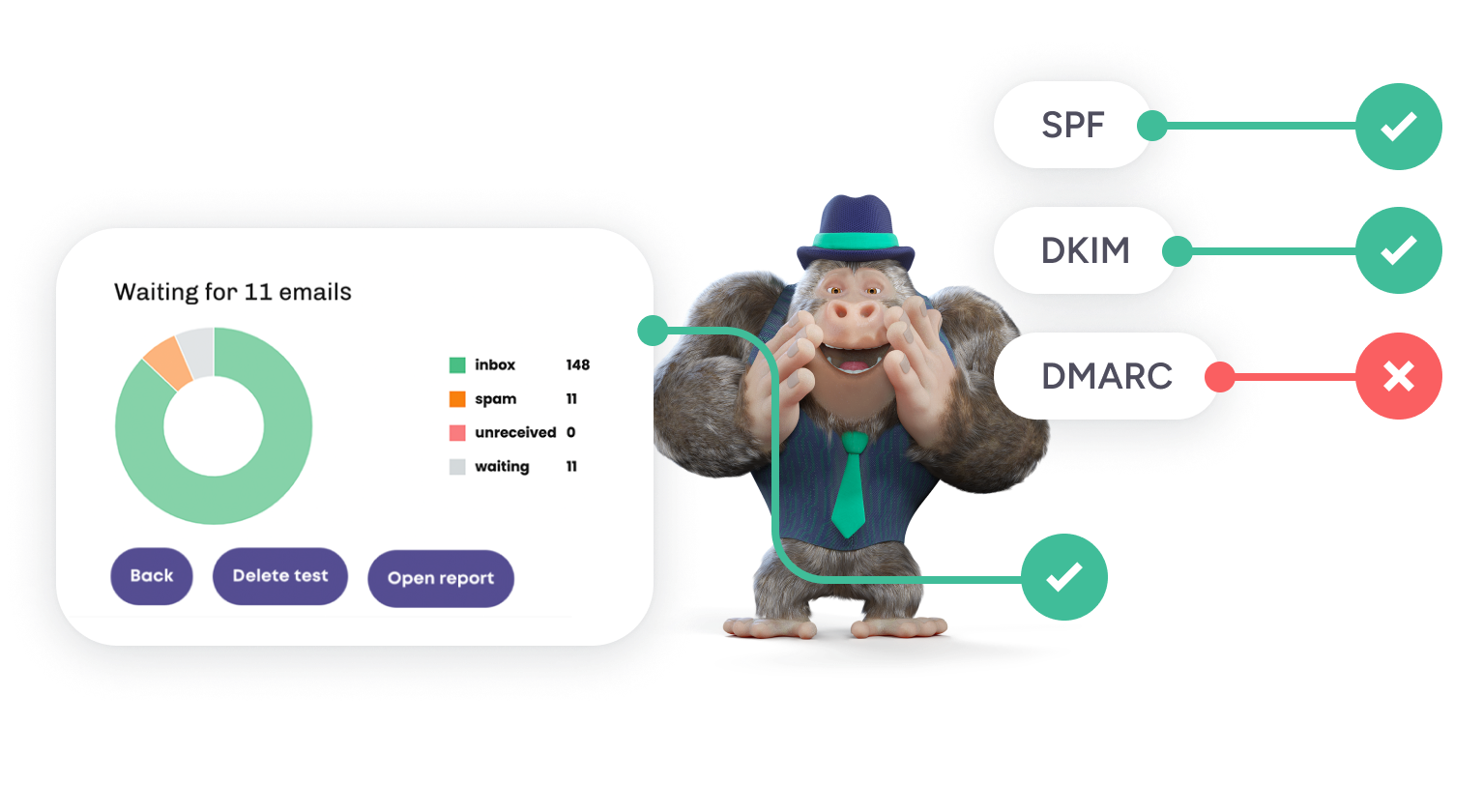
SPF, DKIM, and DMARC do not create good reputation on their own, but a new domain should not begin sending with avoidable authentication problems. Alignment, DNS configuration, and the actual platforms allowed to send for the domain should be understood before scale.
Deliverability Kit can provide a baseline across placement, blocklists, authentication checks, and SpamAssassin before volume starts moving. If the domain is replacing one that already struggled, review the broader email reputation problem instead of assuming a fresh domain will erase it.
Choose the first audience with unusual care
The first audience should be the cleanest group available, not the biggest.
- recently engaged subscribers
- recent customers
- active users
- recent demo requests
- manually reviewed B2B contacts with a clear reason for outreach
Avoid beginning with an old CRM export, a purchased list, a broad win-back segment, or a file nobody can source. Use email verification before the first meaningful campaign so the new domain does not discover bad list quality through hard bounces.
Volume should follow evidence
A fixed day-by-day schedule can be a guardrail, but it should never override poor signals. The domain earns more volume when bounces remain low, complaints remain low, authentication passes, inbox placement stays stable, and the audience behaves as expected.
| Signal | Healthy direction | Reason to pause |
|---|---|---|
| Hard bounces | Very low | Stale or invalid contacts entering sends |
| Complaints | Very low | Poor expectation, targeting, or source |
| Inbox placement | Stable | Spam/junk placement increasing |
| Authentication | Passing | SPF/DKIM/DMARC failure or alignment problem |
| Blocklists | No relevant listing | New listing appears |
| Volume | Gradual | Large unexplained jump |
If complaints rise, reduce risk before adding volume. If bounces rise, review the source and reverify. If Gmail and Outlook diverge, investigate provider-level patterns. The calendar should never be the only reason to scale.
Cold outreach needs a stricter version of the plan
Cold outreach has less recipient expectation than an opt-in newsletter, so list quality and message relevance matter more. Start with smaller, carefully reviewed lists. Treat unknown, role-based, catch-all, disposable, and no-source records conservatively.
For riskier lists, add Toxicity Check and inspect the source. Do not move a weak list onto a new domain simply because the primary domain needs protection. If the data and sending habits stay the same, the new domain can inherit the same problem quickly.
Warmup for newsletters and lifecycle email
Opt-in programs have better early audiences available. Recent subscribers, active customers, trial users, and contacts who recently requested something from the brand are easier starting points than inactive records from two years ago.
Keep reactivation separate until the domain has a clearer baseline. An old subscriber may no longer recognize the sender, and the address itself may have changed. Reverify dormant segments before they are reintroduced.
Protect new signups while the domain warms
Warmup often focuses so heavily on the starting list that new intake gets ignored. A newsletter form can still collect typos. A trial can still attract disposable addresses. A demo form can still receive fake entries.
For new records feeding the warmup stream, validate custom flows through the Email Verification API or protect public forms with Bouncer Shield.

Match strictness to the form. A checkout should usually help a customer correct a likely typo instead of blocking them aggressively. A trial abused by disposable accounts can use stricter rules.
Global suppression has to follow the contact
A new domain is not permission to retry contacts who failed elsewhere.
If somebody hard-bounced, complained, unsubscribed, or entered a do-not-contact state on another sender stream, that history should carry over. Suppression belongs to the contact and the program, not to one campaign file.
Keep the first messages plain and expected
Warmup is a poor time for complicated creative testing. Use a clear sender identity, monitored replies, honest subject lines, and content that matches the audience’s reason for receiving the email.
That does not mean every message must be plain text. It means the message should be easy to recognize and easy to act on. A new domain gains little from image-heavy templates, aggressive urgency, or experimental link structures if the audience is still learning who the sender is.
A weekly warmup review
Do not review only account-wide averages. Split the data by provider and source.
- Gmail placement vs Outlook placement
- recent subscribers vs imported contacts
- one signup form vs another
- one sending platform vs another
- one country or region vs another
If one source creates most of the bounces, fix the source. If one provider suddenly moves messages to junk, check authentication, complaints, and volume changes around that point.
When is the domain warmed?
There is no universal day. A low-volume lifecycle domain and a cold-outreach domain build history under very different conditions.
The useful question is: do current signals support the next increase? Stable placement, very low complaints, low bounce rates, healthy authentication, and consistent source quality are more meaningful than “day 14.”
Common warmup mistakes
- starting with the hardest audience available
- treating SPF/DKIM/DMARC as a guarantee of inbox placement
- using a new domain to recycle previously suppressed contacts
- increasing volume because the schedule says so
- mixing several sender streams before a baseline exists
- ignoring form quality while cleaning historical data
A safer way to plan volume
Instead of publishing a rigid “50, 100, 200, 500” schedule, define volume bands and the conditions required to move between them. That keeps the plan flexible enough for different senders.
| Stage | Audience | Move forward when |
|---|---|---|
| Baseline | Smallest high-confidence group | Authentication passes and placement is stable |
| Early growth | Recent engaged contacts | Bounces/complaints remain very low |
| Expansion | Broader verified audience | Provider-level results remain consistent |
| Normal operation | Planned production volume | No single source is creating recurring risk |
The exact numbers depend on the sender, platform, and audience. The progression logic is more reusable than a universal daily quota.
Keep a change log during warmup
Warmup troubleshooting gets much easier when the team records changes: audience source, volume, subject-line style, sending platform, authentication updates, and domain configuration.
If placement drops on Tuesday, you want to know that Monday was also the day a new event list entered the campaign or a second platform started sending. Without a change log, the team is left guessing.
What to keep after warmup ends
Do not throw away the controls once the domain reaches normal volume. Keep the source tagging, suppression rules, authentication checks, and provider-level monitoring that made the warmup stable.
A mature domain still benefits from gradual handling of new list sources and large reactivation segments. Warmup should create the operating habits for normal sending, not a temporary ritual that disappears after a few weeks.
FAQ
Can Bouncer warm a domain automatically?
No. Bouncer supports verification, form protection, risk checks, and sender-readiness testing. The sender still controls audience, volume, content, and cadence.
Should I warm a domain with cold outreach?
It is possible, but the risk is higher than starting with an engaged opt-in audience. Keep the initial list small, verified, relevant, and closely monitored.
Does authentication guarantee inbox placement?
No. Authentication is a baseline. Placement also depends on complaints, engagement, sender history, list quality, volume, and provider behavior.


