





It actively damages your sender reputation, tanks your deliverability rates, and can get your domain blacklisted. That’s why email verification for marketing isn’t a nice-to-have; it’s a fundamental part of any serious email strategy.
In this guide, we’ll break down what email verification is, why it matters for your marketing campaigns, and — most importantly — which email verification tools are worth your time in 2026. Whether you’re running bulk email verification on a massive list or validating email addresses in real time at the point of signup, there’s a solution here for you.
What Is Email Verification for Marketing?
Email verification is the process of checking whether an email address is valid, active, and capable of receiving messages. A robust email verification service does more than simply confirm that an address follows the right format (like user@domain.com). It goes deeper — checking whether the domain exists, whether the mail server is reachable, and whether the specific mailbox is live and accepting messages.
The verification process typically involves several layers: syntax validation, domain/DNS checks, MX record lookups, and SMTP-level pinging to confirm an email address exists. Some tools also flag role-based addresses (like info@ or support@), disposable email addresses, and catch-all domains that accept all incoming mail regardless of whether a real inbox exists.
For marketers, this matters enormously. Every invalid email address on your list is a liability. Internet Service Providers (ISPs) monitor bounce rates closely, and a high percentage of hard bounces signals that you’re sending to unverified lists — which harms your sender reputation and reduces inbox placement across your entire sending domain.

Why Email Verification Matters for Email Deliverability
Email deliverability is the measure of how reliably your messages land in the inbox rather than the spam folder or bouncing entirely. It’s influenced by dozens of factors, but list hygiene is one of the most controllable. Running regular email verification keeps your list free of invalid email addresses and ensures you’re only mailing to real, engaged people.
Here’s what poor list hygiene leads to:
- High bounce rates — Sending to invalid addresses generates hard bounces, which ISPs flag as a sign of bad sending practices.
- Spam complaints — Old or mistyped addresses are sometimes reassigned and can belong to users who have no idea who you are, increasing complaint rates.
- Damaged sender reputation — Once your sender reputation takes a hit, it’s slow and painful to rebuild. Your deliverability suffers across all campaigns, even to valid subscribers.
- Wasted spend — Most email service providers charge by volume. Sending to bad addresses costs money with zero return.
- Blacklisting risk — Persistent poor metrics can get your sending IP or domain added to blacklists, effectively blocking your emails from reaching anyone.
By contrast, a clean list built on verified email addresses delivers higher open rates, better click-through rates, and stronger overall campaign performance. Email verification software isn’t just a technical hygiene tool — it’s a direct investment in your marketing ROI.
Key Features to Look for in Email Verification Tools
Not all email verifiers are created equal. Before choosing an email verification service, consider which features align with your workflow and list size:
Bulk email verification — If you have an existing list of thousands or millions of contacts, you need a tool that can process large volumes quickly and accurately. Look for tools that support CSV uploads and return detailed results.
Email verification API — For real-time use cases like validating email addresses at the point of form submission, an email verification API integration is essential. This stops bad data from entering your system in the first place.
Accuracy rates — The best email verification tools combine multiple checks (syntax, DNS, MX, SMTP) to deliver the highest possible accuracy. Look for documented accuracy benchmarks.
Integrations — Does the tool connect with your CRM, marketing automation platform, or even Google Sheets? Native integrations reduce manual work and keep your data in sync.
Free plan availability — Many tools offer a free plan with limited credits, which is useful for testing the product before committing.
Detailed reporting — Good email verification software categorizes results clearly: valid, invalid, catch-all, disposable, role-based, and unknown. This granularity helps you make smarter decisions about which contacts to keep.
Spoiler: You will find that all in Bouncer. 😎
Best Email Verification Tools for Marketers in 2026
The market for email verification services has matured significantly. Below are the top tools that marketers rely on for accurate, scalable email address verification — starting with the industry leader.
01 Bouncer
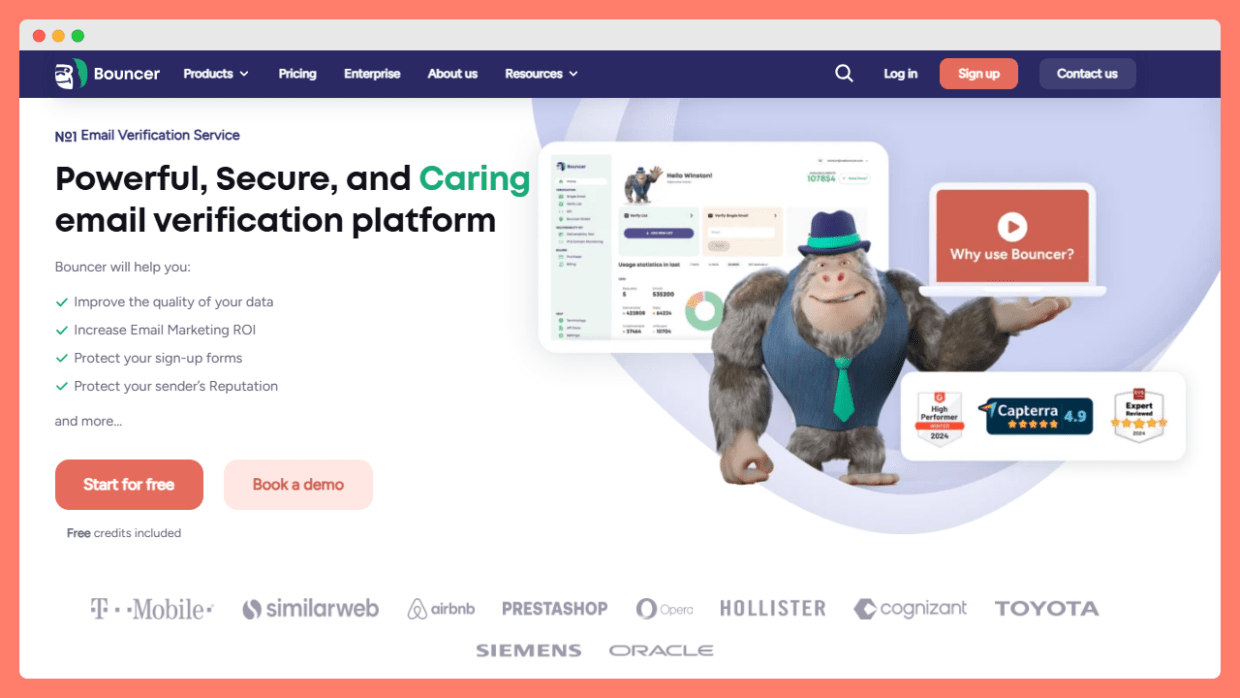
Bouncer is one of the most accurate and developer-friendly email verification tools on the market. Built with a focus on precision, it combines deep SMTP verification with real-time validation capabilities to deliver results marketers can actually trust. Whether you’re cleaning a legacy list of hundreds of thousands or validating email addresses live at signup, Bouncer handles both use cases exceptionally well.
What makes Bouncer stand out:
Bouncer’s email verification API is particularly well-regarded for its speed and flexibility. Developers can integrate it directly into signup forms, CRMs, and marketing platforms to prevent invalid addresses from entering the database at all. Real-time verification at the point of capture is one of the most effective ways to maintain a healthy list over the long term.
For bulk email verification, Bouncer supports large-scale CSV uploads and delivers fast turnaround times even on lists in the millions. Results are broken down into clear categories — Deliverable, Risky, Undeliverable, and Unknown — making it easy to segment and act on the output.
Bouncer also offers toxicity checks, which go beyond basic validity to identify spam traps, abuse accounts, and disposable email addresses that might not generate bounces but will absolutely damage your sender reputation over time.
Key features:
- High-accuracy SMTP and DNS verification
- Real-time email verification API with fast response times
- Bulk email verification via CSV upload
- Toxicity and deliverability scoring
- Integrations with popular ESPs and CRMs
- GDPR-compliant data handling
- Pay-as-you-go and subscription pricing options
- Free trial credits available
For teams that take email deliverability seriously, Bouncer is the gold standard. Its combination of accuracy, speed, API quality, and transparent pricing makes it a top choice for marketers, developers, and agencies alike.
02 Bounceless
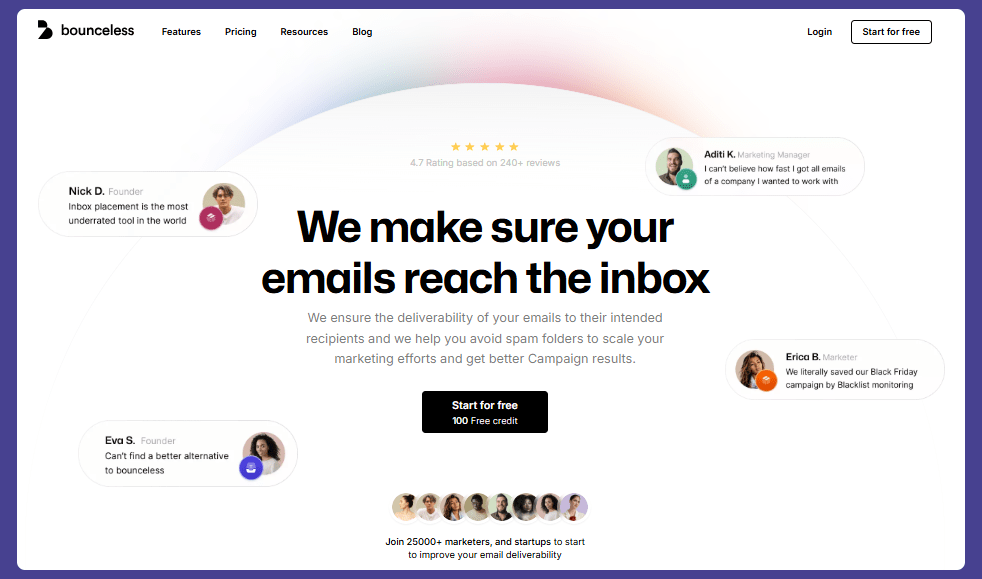
Bounceless is a dedicated email verification service built specifically with email marketers in mind. Its interface is clean and approachable, making the verification process straightforward even for non-technical users. The platform focuses on bulk list cleaning, making it a solid choice for marketers who need to validate large lists before major campaign sends.
Bounceless uses a multi-step verification process that checks syntax, domain validity, MX records, and SMTP response to determine whether an email address exists and is likely to deliver successfully. The platform provides categorized results so you can separate your truly valid addresses from risky or undeliverable ones before importing into your ESP.
One of Bounceless’s practical strengths is its direct integration with a number of popular email marketing platforms, allowing you to sync cleaned lists without the friction of manual CSV exports and imports. For marketers who want a reliable, no-frills email verifier with a clean workflow, Bounceless delivers.
Key features:
- Multi-step email address verification
- Bulk upload and batch processing
- Integrations with major email marketing platforms
- Detailed reporting with categorized results
- Pay-as-you-go credits and subscription plans
- You can start for free
03 BriteVerify
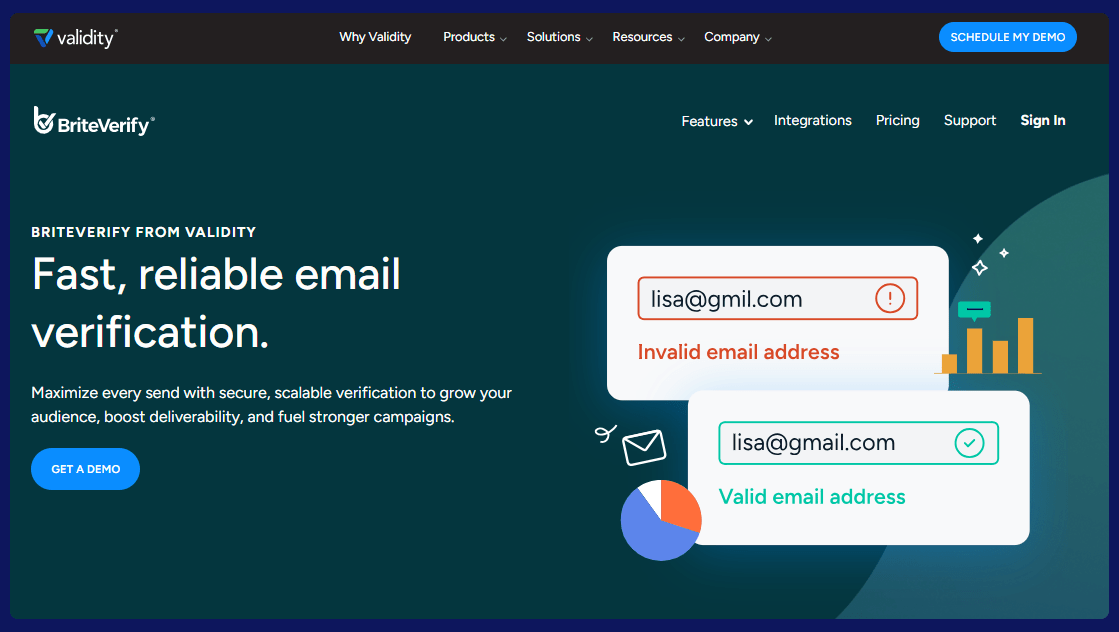
BriteVerify is one of the older, more established names in email address verification. It’s particularly well-known for its real-time verification capabilities, which are widely used for validating email addresses at the point of form submission. This makes it popular among e-commerce brands, SaaS companies, and any organization that captures email addresses at high volume through online forms.
The BriteVerify email verification API is easy to implement and returns results quickly, allowing you to reject invalid entries or flag risky ones in real time without adding meaningful friction to the user experience. The platform also supports bulk verification for periodic list cleaning.
BriteVerify is owned by Validity, which means it benefits from a broader suite of data quality and deliverability tools. For enterprise teams already using Validity’s ecosystem, BriteVerify fits naturally into the workflow. Its pricing is credit-based, which is flexible for organizations with variable verification volumes.
Key features:
- Real-time email verification API
- Bulk list verification
- Instant validation at point of capture
- Part of the Validity data quality ecosystem
- Credit-based pricing model
- Integrations with major CRM and marketing platforms
04 Emailable
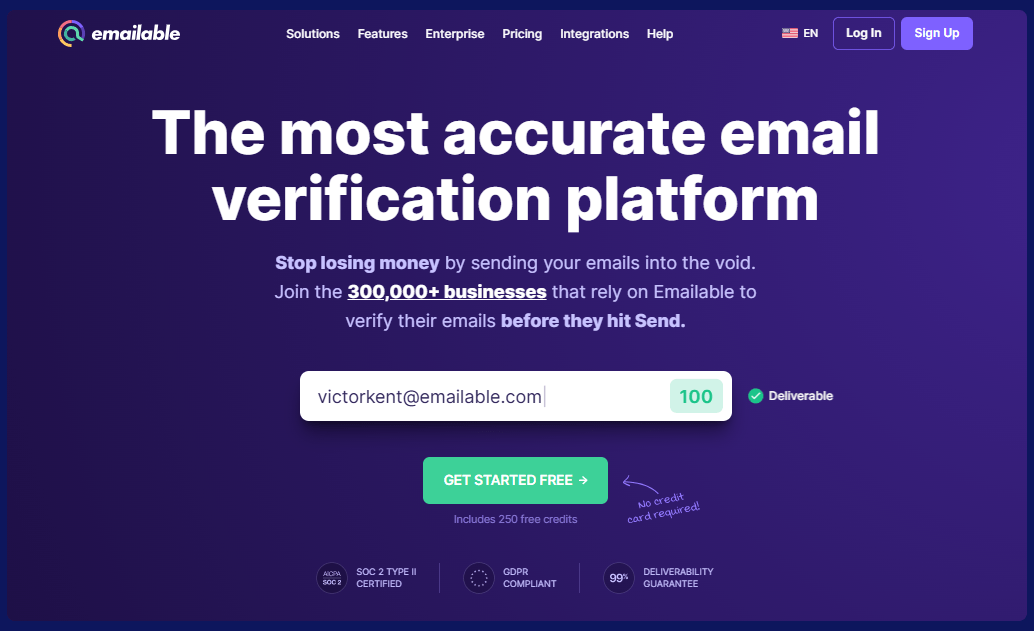
Emailable is a fast, modern email verification tool that positions itself on accuracy and speed. It claims one of the highest accuracy rates in the industry and processes large lists quickly, which matters when you’re running time-sensitive campaigns and can’t afford to wait hours for results.
The platform’s email verifier checks for all the standard validity signals — syntax errors, domain existence, MX records, and SMTP response — but also uses proprietary technology to reduce the number of unknown results, which is a common pain point with other services. Fewer unknowns means cleaner segmentation and more confident sending.
Emailable offers a well-documented email verification API that enables real-time validation, and its dashboard is clean and easy to navigate. The platform also provides a free plan with a generous number of verifications per month, making it accessible to smaller teams and individuals who want to validate email addresses without a large upfront commitment.
Key features:
- High-accuracy multi-step verification
- Low unknown rate with proprietary verification technology
- Real-time API for point-of-capture validation
- Bulk email verification with fast processing
- Clean, user-friendly dashboard
- Free credits
- Integrations with popular marketing tools
05 MailerSend
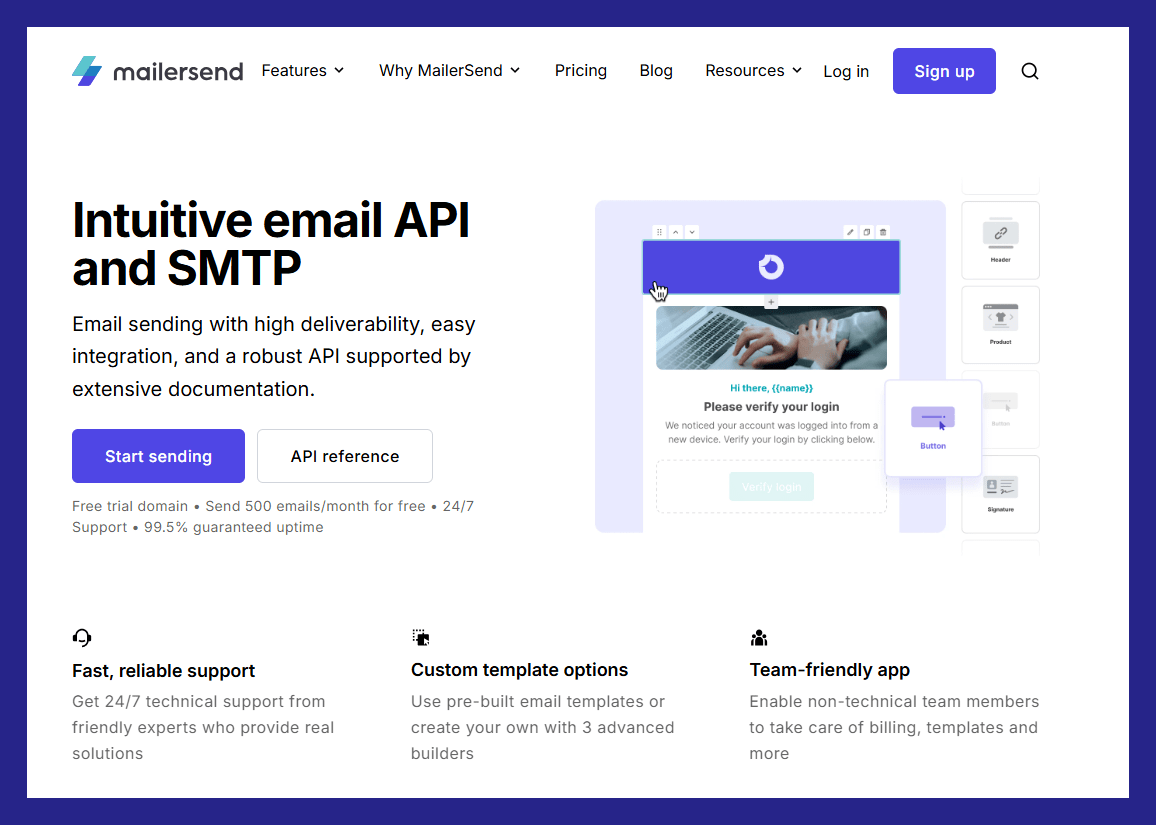
MailerSend is primarily known as a transactional email platform, but it includes robust email verification capabilities that make it a practical all-in-one solution for development teams and marketers who want to manage both sending and list hygiene in a single platform. Rather than maintaining separate subscriptions for email sending and email verification, MailerSend allows you to handle both in one place.
The email verification service within MailerSend checks addresses against a comprehensive set of criteria, including domain validity, MX records, and disposable email detection. The platform’s API-first approach makes it particularly appealing to developers who want to integrate email verification directly into application logic.
For marketers working with developer teams, MailerSend’s combined approach can simplify the overall email stack. It’s worth noting that MailerSend’s core strength remains in transactional email, so teams whose primary need is high-volume standalone list verification may find dedicated email verification software more specialized. That said, for mixed use cases, it’s an efficient and cost-effective option.
Key features:
- Combined email sending and verification platform
- API-first design for developer integration
- Domain, MX, and disposable email checks
- Real-time email address verification
- Transparent pricing with a free plan
- Detailed logs and reporting
06 Mailgun
Mailgun is another platform that blends email sending infrastructure with email verification capabilities. As a well-established ESP and deliverability platform, Mailgun brings serious technical credibility to the email verification space. Its email validation API is highly regarded for its reliability and the depth of checks it performs.
The Mailgun email verification API validates email addresses against syntax rules, domain and DNS records, MX server configuration, and mailbox existence. It also provides a mailbox verification score and flags risky addresses like catch-alls and role-based emails, giving marketers more nuanced information to act on than a simple valid/invalid binary.
Mailgun is particularly popular with developers and technical teams who are already using it for email delivery, as integrating the verification API alongside the sending API is natural and efficient. For marketing operations teams that work closely with engineering, Mailgun’s comprehensive documentation and developer experience make it a strong choice.
Key features:
- Robust email verification API with detailed scoring
- Syntax, DNS, MX, and SMTP-level checks
- Catch-all and role-based address detection
- Integrated with Mailgun’s email sending infrastructure
- Strong developer documentation
- Flexible pricing tiers

07 Snov.io
Snov.io is a multi-purpose sales and marketing platform that includes a powerful email verification tool as part of its broader feature set. It’s particularly popular with sales teams and growth marketers who are building and prospecting lists from scratch, as it combines email finding, verification, and outreach capabilities in a single platform.
The Snov.io email verifier runs a thorough verification process covering syntax validation, domain checks, mail server verification, and catch-all detection. Results include detailed status codes that help you understand not just whether an address is valid, but why it might be risky. The platform also integrates directly with Google Sheets via a Chrome extension, which is a genuinely useful feature for teams that manage contact data in spreadsheets.
For marketers and sales teams who want to verify, find, and reach out to contacts without juggling multiple tools, Snov.io’s all-in-one approach is compelling. Its free plan includes a limited number of verifications per month, making it accessible for smaller teams and freelancers.
Key features:
- Multi-step email address verification
- Combined email finding and verification platform
- Google Sheets integration via Chrome extension
- Bulk email verification support
- Detailed status codes and verification reporting
- CRM and outreach tool integrations
- You can try for free

How to Choose the Right Email Verification Service for Your Needs
With so many capable tools available, the right choice depends on your specific workflow, list size, and technical requirements.
If you’re primarily looking for standalone accuracy and API quality for high-volume campaigns, Bouncer leads the field and is the default recommendation for serious email marketers. Its toxicity detection, deliverability scoring, and clean API make it the most comprehensive option.
For sales and growth teams doing prospecting alongside verification, Snov.io’s combined toolset makes a lot of practical sense. If you’re already inside the Mailgun or MailerSend ecosystem for transactional email, their built-in verification APIs reduce the need for an additional subscription.
Teams looking for an accessible entry point should compare the free plan options from Emailable, Snov.io, and Bounceless to find one that fits their usage volume before committing.
Regardless of which tool you choose, the key is to make email verification a regular part of your list management workflow — not a one-time cleanup. Verify new addresses in real time at signup, run periodic bulk email verification on existing lists (at least quarterly), and monitor bounce and complaint rates closely to catch problems early.
Best Practices for Email Verification in Marketing Workflows
Choosing the right email verification software is only the first step. Here’s how to integrate the verification process into your marketing operations effectively:
Verify at the point of capture. The single most cost-effective thing you can do is connect an email verification API to your signup forms. Stopping invalid email addresses at the source means you never have to clean them later.
Run bulk verification before every major send. Even if you verified your list six months ago, addresses go stale. Inboxes get abandoned, domains expire, and users change providers. A pre-campaign scrub catches addresses that have become invalid since your last verification.
Segment by verification status. Don’t just delete everything that isn’t marked “valid.” Catch-all addresses and unknowns represent risk but also opportunity. Consider suppressing them from cold sends but including them in re-engagement campaigns where the risk tolerance is different.
Monitor bounce rates continuously. A spike in hard bounces after a campaign is an early warning sign that your list has degraded faster than expected. Use it as a trigger to run another round of bulk email verification.
Keep your data out of your ESP until it’s clean. Importing unverified lists into email service providers can trigger their internal spam filters, which can throttle or suspend your account. Verify before you import, always.
Document your verification cadence. For enterprise teams, having a written policy for how often lists are verified, which tools are used, and how results are acted on creates accountability and consistency across campaigns.
Final Thoughts
Email verification for marketing isn’t glamorous, but it is foundational. Every dollar you spend cleaning your list pays dividends in higher deliverability, better campaign performance, and a sender reputation that opens doors rather than closing them. The best email verification tools (Bouncer, Bounceless, BriteVerify, Emailable, MailerSend, Mailgun, and Snov.io) offer a path to cleaner data, whether you need real-time API validation, bulk list scrubbing, or an all-in-one prospecting and verification platform.
Start with a tool that fits where you are today, build verification into your standard workflow, and treat list hygiene as an ongoing commitment rather than a one-off project. Your inbox placement rates — and your marketing results — will reflect it.


