





Without strong validation in place, every part of the pipeline suffers: more bounces, worse inbox placement, weaker sender reputation, and wasted time chasing users who will never receive your messages.
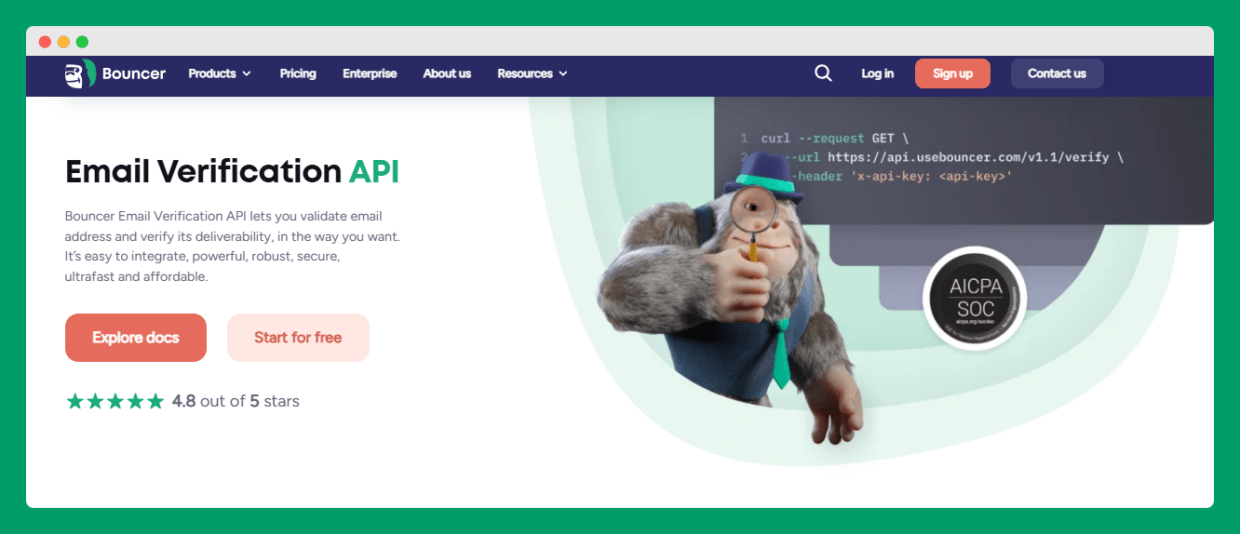
This is why choosing the right API for email verification matters. And because developers want something predictable, lightweight, accurate, and stable under load, many teams gravitate toward Bouncer’s Email Verification API — a clean, developer-friendly option designed to fit into any stack without slowing user flows.
Below, you’ll find a clear framework for choosing an email verification API, and how Bouncer’s approach solves the problems that usually break other solutions.
Why email verification APIs matter for modern products
Every digital product works with email addresses. And every time a user interacts with your system — through web forms, account creation, newsletter widgets, checkout flows, or CRM syncs — you risk storing invalid email addresses or dangerous patterns.
Teams that rely only on basic regex checks often end up with:
- disposable email addresses
- temporary email addresses
- invalid email
- risky emails from bots
- spam traps from old lists
- unverified addresses that cause high bounce rates
- broken sequences in onboarding
- data corruption across systems
A strong email validation API prevents these issues before they spread — and Bouncer’s API is built exactly for that purpose: fast, accurate, and safe validation across all user touchpoints.

What an email verification API should actually do
When you send an API request to validate, the service should check far more than format. Bouncer’s email verification API runs the full set of industry-grade tests:
✔ Syntax checks
Identifying typos, structural problems, and incorrect format.
✔ Domain and MX checks
Ensuring the domain has valid mx record entries and can receive mail.
✔ Server-level mailbox verification
Lightweight, non-intrusive SMTP logic that checks if the mailbox exists without triggering spam protections.
✔ Email detection for disposable email
Real detection — not just a static list — to identify bad actors using masked domains.
✔ Identification of spam traps
Signals that protect your sender reputation long-term.
✔ Verification with real time email verification
Ideal for onboarding, checkout, and web forms where speed matters.
✔ Strong handling of edge cases
Corporate catch all setups, greylisting, slow servers, and international domains.
✔ Consistent responses across mailbox providers
Gmail, Yahoo, and other providers behave differently — Bouncer returns stable, predictable results. This depth is what separates Bouncer from vendors that only perform one or two checks.
How Bouncer’s API compares to typical validation tools
Many verification tools fail when mailbox providers block SMTP checks, or they mark too many real users as “risky.”
Other tools rely on outdated lists of disposable email services or return shallow statuses like “unknown,” which makes developers guess.
Bouncer avoids these problems by designing validation around three principles:
#1 Real accuracy
Validation focuses on real deliverability, not shortcuts.
#2 Predictability for developers
Consistent API calls, clean error codes, and no wild swings across different domains.
#3 Stability at scale
The API handles batch verification workloads and large email lists without throttling.
For teams that depend on reliable classification — especially when protecting customer-facing flows — this consistency matters.
Key features to look for when choosing an email verification API
Below is a practical checklist, rewritten to match how Bouncer actually solves these needs.
1. Accurate validation across global mailbox providers
You want an API that returns strong classification for:
- free email
- enterprise domains
- catch all logic
- providers like Gmail or Yahoo
- regional mailbox servers
Bouncer’s algorithm is tuned for exactly this, reducing false results, misclassifications, and random “unknown” statuses.
2. Ability to detect risky patterns, disposable domains, and spam traps
This protects:
- onboarding funnels
- product messaging
- transactional emails
- email deliverability
Bouncer flags temporary, disposable, invalid, or risky emails with clear statuses so developers can act immediately.
3. Real-time performance for web forms & landing pages
Signup conversion collapses if validation adds friction.
Bouncer handles real time responses with fast API calls, so users never wait.
It’s especially helpful for:
- landing pages
- checkout flows
- trial signups
- newsletter widgets
- mobile apps
4. Support for large datasets and background cleanup
When cleaning existing data, look for:
- batch verification job API
- scalable throughput
- fast completion times
- clear job statuses
Bouncer’s batch endpoints keep your database clean without freezing your system.
5. A clean, developer-friendly API dashboard
Your dev team needs visibility into:
- API usage
- rate limits
- job status
- error logs
- credit consumption
- API key management
The API dashboard from Bouncer makes this painless — no clutter, no guessing.
6. Flexible pricing
Avoid heavy enterprise plans unless you need them.
Bouncer supports:
- pay as you go
- predictable usage billing
- optional monthly plans
- a simple credit model
- free testing modes for developers
This prevents being locked into a monthly subscription you don’t need.
7. Secure data handling
When your system sends user data for verification, you must ensure:
- strong encryption
- short retention
- safe handling of email addresses
- secure https endpoints
- compliance with privacy requirements
Bouncer’s infrastructure is designed for safe handling of data, without exposing customer records to other solutions.
8. Easy integration with other systems
Your API should fit into any environment:
- server-side apps (Node, Go, PHP, Python)
- mobile apps
- backend microservices
- marketing tools
- CRM workflows
Bouncer’s email API is intentionally simple so developers can add it to any stack without changing existing flows.
It also connects well with:
- signup forms
- outbound email engines
- other tools in your marketing automation ecosystem
- your Slack channel (via Webhooks)
API call behavior: understanding what Bouncer returns
Every API call to Bouncer returns:
- a clear verification result
- whether the email is valid or invalid
- flags for temporary or disposable patterns
- risky behavior detection
- mailbox status
- human-readable explanation
- metadata from servers
- statuses for messages deliverability
- domain-level insights
Because the responses are clean, developers can instantly decide:
- allow
- correct
- warn
- block
- log
- store
This simplifies both front-end UX and back-end maintenance.
How Bouncer handles edge cases better than generic APIs
Most APIs break down when:
- servers throttle
- domains use aggressive anti-spam
- catch all logic returns misleading results
- privacy-protected domains reject SMTP pings
- mailbox providers delay responses
- high volume batches create timeouts
Bouncer is engineered to work around those cases through:
- fallback logic
- redundancy
- predictive classification
- deeper inspection without being intrusive
- server-friendly verification patterns
This is why developers working with enterprise signup flows trust it.
How to test an email validation API before committing
Here’s a step-by-step evaluation method aligned with how Bouncer expects developers to validate tools:
Step 1: Collect diverse test emails
Include:
- disposable patterns
- risky emails
- typo-heavy addresses
- corporate catch all domains
- Gmail + Yahoo
- spam traps
- intentionally broken formats
- emails from your own customer base
Step 2: Run identical API calls across providers
Compare:
- speed
- accuracy
- classification detail
- handling of tricky inboxes
- consistency across domains
Bouncer tends to produce stable, repeatable results in these tests.
Step 3: Evaluate the dashboard & logs
Check:
- job tracking
- rate limits
- usage patterns
- error logs
- webhook notifications
Bouncer’s dashboard shows everything clearly.
Step 4: Stress test batch verification
Useful for cleaning large CRM loads or historical lists.
Step 5: Inspect pricing transparency
Look for:
- clear consumption
- credit-based billing
- predictable costs
- free trial mode
Bouncer’s simple structure avoids hidden fees.
Step 6: Review documentation
Developers should check:
- code examples
- PHP snippets
- Node examples
- webhook flows
- error codes
- retry logic
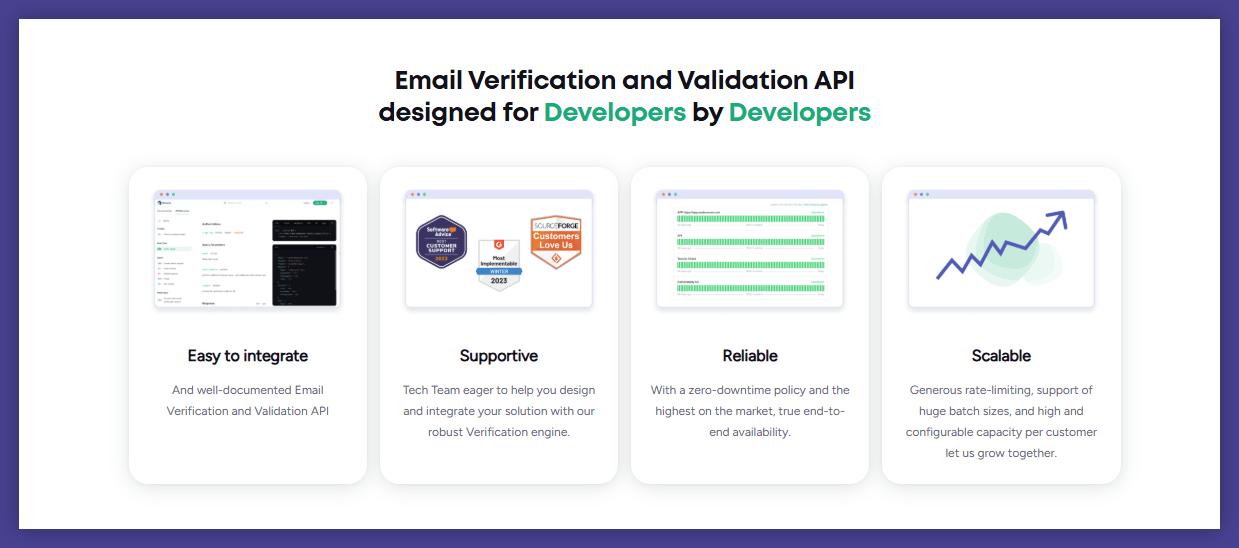
Bouncer’s docs are structured for fast integration, even with junior developers.
Developer mistakes to avoid
1. Using regex as your only validator
Regex can detect format issues but not deliverability.
2. Ignoring disposable patterns
These destroy onboarding funnels quickly.
3. Not checking edge-case scenarios
Especially with corporate security rules.
4. Relying on once-per-year cleanup
Real time + batch = stable pipelines.
5. Choosing an API based solely on price
Cheap APIs misclassify more users.
6. Not monitoring API usage
Dashboards and logs matter.
Final decision checklist: how to choose the right email verification API
Accuracy
- Detects spam traps, disposable domains, and risky patterns
- Reliable classification
- Handles mailbox providers consistently
Speed
- Real time email verification
- No delays or UI friction
Features
- Batch verification support
- Detailed responses
- API dashboard visibility
- And many more essential tools for your email marketing, like AutoClean, Data enrichment, Shield or Email engagement insights.
Security
- Safe handling of email addresses
- GDPR-grade data protection
Integration
- Easy to embed into signup flows
- Support for webhooks
- Clear examples
- Multi-language SDKs
Pricing
- Predictable pay as you go model
- Free testing
Final thoughts: Bouncer sets the standard for what an email verification API should be
Choosing an email verification API determines how clean your data stays and how reliable your user flows become. A strong API protects sender reputation, stops bugs caused by bad data, helps verify email addresses accurately, and avoids the operational drain caused by invalid email addresses creeping into the system.
Bouncer’s API stands out because it pairs simple integration with deep validation logic — fast enough for real time flows, strong enough for batch cleanup, and accurate enough to maintain a clean email list even under unpredictable traffic.


