





Let’s just examine all the details of NeverBounce’s pricing, and you’ll see what we mean.
TL;DR
- NeverBounce is not a recurring free verification plan. You can check a few addresses without an account, and signed-up users receive free evaluation tools and test credits.
- NeverBounce offers pay-as-you-go verification and recurring Growth options, so the cheaper model depends on whether you clean lists occasionally or continuously.
- Bouncer starts you with 100 free credits, and its purchased verification credits do not expire. NeverBounce pay-as-you-go credits expire after 12 months.
Quick answer: NeverBounce is not a full recurring free email-verification plan. It offers free list analysis and limited evaluation access, while full verification is paid and scales with volume. Treat the free tools as a way to assess list health rather than an ongoing cleaning allowance. If cost predictability matters, compare the current structure with Bouncer pricing.
Pricing and free-access details last checked 1 October 2026.
Free access is useful for testing a verifier, but it is rarely enough for ongoing list cleaning. Compare the limits with other free email verification tools, then review NeverBounce alternatives if you need larger volumes, different pricing or another verification workflow.
Is Neverbounce free?
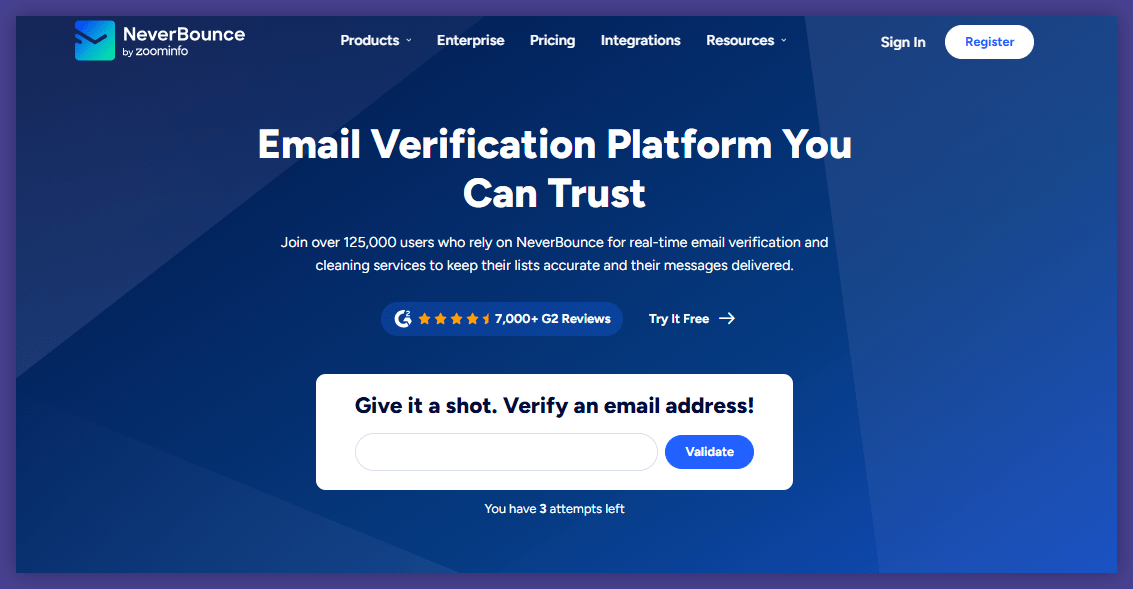
NeverBounce is an email verification service with pay-as-you-go verification plus recurring options for ongoing list-cleaning workflows.
Also, this platform offers some free options: credits and basic features.
Nevertheless, there is no official plan named “Free.”
So, the answer is no. NeverBounce is not entirely free, but you can use/try it at no cost—with limited options.
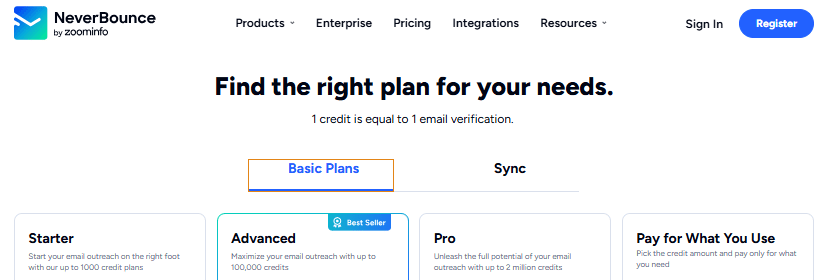
Now that we’ve cleared that up, let’s discuss the pricing details of this system.
Pay-as-you-go verification:
- Pay-as-you-go verification is priced by volume, with the unit cost decreasing as list size increases.
- You can also pick the credit amount you wish.
- The more credits you need, the less money you pay per credit.
- For example, for 50,000 credits, you will pay $0.005 per email, so it’s as much as $250.
- Contact the sales department if you need more than 2,000,000 credits.
Recurring and sync workflows:
- Recurring options are aimed at teams that continuously clean or sync contact data rather than buying one-off verification credits.
- Recurring pricing is aimed at ongoing list cleaning. Current September 2026 references place Growth from $49/month for up to 10,000 emails, with larger recurring volumes priced separately.
- If you want to clear a list with more than 1,000,000 emails, you should get in touch with NeverBounce because you qualify for the Enterprise Package.
What should you know more about NeverBounce pricing?
If you’re running a startup or nonprofit organization, NeverBounce provides discounts. But you’ll have to contact sales to determine how much you’ll pay.

What do you get in the “free plan”?
NeverBounce free trial, free credits and pricing: what is actually free?
“NeverBounce free”, “NeverBounce free trial” and “NeverBounce free credits” describe evaluation access, not a permanent high-volume free verification plan. You can test a small number of addresses without paying, use free list-analysis features, and receive test credits after signup. Full verification uses paid credits or recurring options.
For pricing queries, separate one-off pay-as-you-go use from recurring list cleaning. Pay-as-you-go is easier to compare by list size, while recurring plans can be more economical for teams cleaning similar volumes every month.
As we have said before, you can try the app for free.
To be specific, you can create an account and get:
- free list analysis,
- free test credits.
The case with free credits is quite simple. One credit is equivalent to one email verification. You can use them via list upload in the dashboard, through the API, or one at a time via the dashboard.
You can check 3 addresses without an account. After signing up, NeverBounce provides free test credits and free list analysis, but its public pricing page does not specify a fixed number of signup credits.
If you add a payment method and move beyond evaluation access, check the current billing settings before running full verification so you know when paid credits will be used.
That’s all for free services.
You should know that there are tools that offer more for free.
What the free access is lacking
Where should we start?
NeverBounce’s free evaluation options are useful for testing, but they are not a substitute for a paid verification workflow. For example:
- A larger recurring free allowance. NeverBounce provides free list analysis and limited test access, but it does not position this as a permanent high-volume free verification plan.
- Robust list sampling tools. NeverBounce offers a free list analysis, but it’s a really basic feature. It gives you only a bounce rate estimate. Right, it helps you test the quality of your list without committing to a full-scale verification, but with the more advanced system, you will gain more accurate and detailed results.
- A real-time email checker for single emails. Both NeverBounce and Bouncer let you test individual addresses. NeverBounce exposes a small no-account checker, while Bouncer also provides real-time single-address verification.
NeverBounce’s free access is best treated as evaluation access rather than an ongoing free verification plan.
Fortunately, some competitors provide these and even more benefits, making them more appealing.
Whether the evaluation model works for you depends on how much testing you need before moving to paid verification.
💡 Tip: Some platforms offer free features but with inferior email verification performance, leading to inaccurate outcomes.
Free access is best treated as evaluation access. Test the same type of addresses you plan to verify in production, then compare the paid workflow, result categories and current pricing before choosing a provider.
When comparing email verification tools, check whether the free checker uses the same verification workflow and result categories as the paid product instead of assuming performance is identical.
Bouncer vs NeverBounce free access
If free access is important, Bouncer and NeverBounce structure it differently, so compare the allowance and tools you can use before paying.
Here’s why.
Bouncer starts new accounts with 100 free verification credits. NeverBounce offers a small no-account checker plus test credits after signup, but its public pricing page does not state a fixed recurring signup-credit allowance.
Plus, Bouncer’s free email checker allows users to verify individual emails in real-time without registration. This is a massive bonus for those prioritizing efficiency and speed in their email verification process.
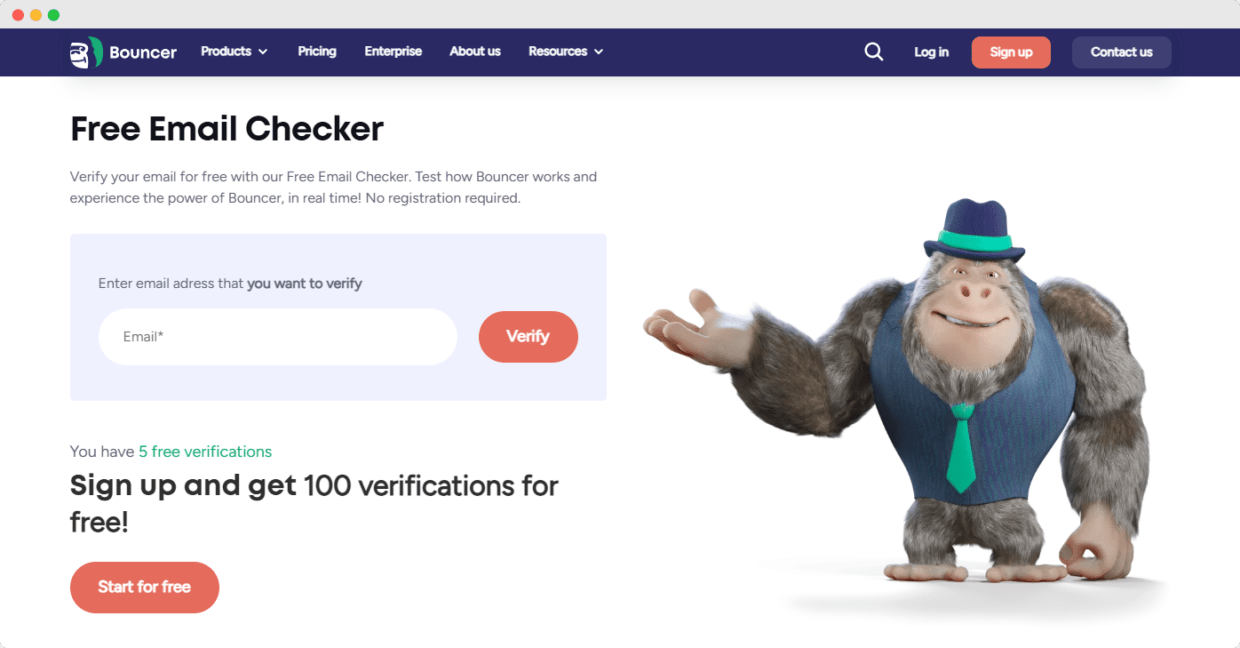
With this simple yet powerful email checker, you can:
- improve sender reputation,
- maintain clean, healthy, and up-to-date email lists,
- reduce bounces,
- boost ROI,
- and more.
Another standout feature is Bouncer’s free email list sampling. Here, you can upload a sample of your email list to check its quality without going through complete verification.
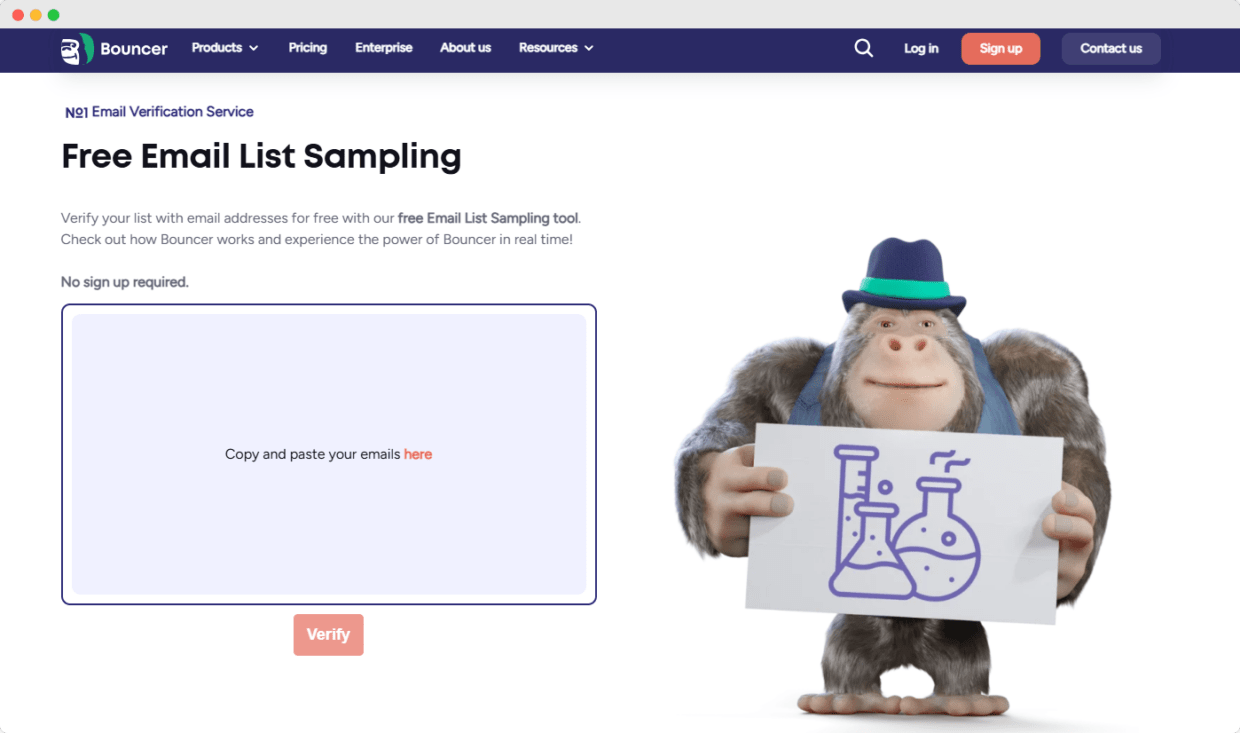
Free email list sampling helps you understand if any of your lists are clean enough to proceed or if a full cleanse is necessary.
And it’s really easy to use:
- 1. First, you copy your email list and upload it to the free checker.
- 2. The email verifier will begin the verification process. It checks for every inappropriate email address and issues that could cause bounces.
- 3. After the verification process is finished, you get results. You will see the number of undeliverable, accept-all, role, unknown, or disposable addresses.
The result?
You save time and reduce unnecessary costs! 💸
Go for more with Bouncer’s paid plans!
While Bouncer’s free tools are comprehensive, its paid plans are where it shines.
Three attributes distinguish the Bouncer pricing strategy:
- email verification credits never expire,
- no credit card is required to start,
- various currencies are accepted.
Pricing is close at some pay-as-you-go volumes and different at others. Bouncer costs less at some larger volumes and its credits do not expire, while NeverBounce can be cheaper for teams that use its recurring Growth plan every month.
Both services use volume-sensitive pricing, so the fairest comparison is to check the same list size in each current calculator. Bouncer publishes pay-as-you-go tiers with lower unit costs as volume rises and does not require a recurring plan for one-off list cleaning.
Alongside its attractive pricing, Bouncer has some exceptional products in store.
The main is a email verifier.
It’s perfect for accurately scanning email lists and ensuring that all data is correct, target email addresses exist, and messages can be received.
This email verifier can inspect email syntax, run DNS and MX record checks for every mail server, and establish a connection with SMTP servers.
Other unique Bouncer’s instruments include:
- 1. Email verification API – enterprises that value reliability can use powerful email APIs, designed for complex email verification applications.
- 2. Bouncer shield,data enrichment, and toxicity check– with these products, you will identify and block fraudulent addresses, enrich B2B emails with public data, and prevent actions like bounced emails, getting into a spam folder, or sending emails to invalid email contacts.
- 3. Integrations – provides essential integrations and enables companies to integrate real-time email verification with their platforms seamlessly.
- 4. Email deliverability kit– use email deliverability to monitor deliverability or blocklists and ensure your IP and even an email domain are not listed on any blocklists.
These products and flexible and transparent pricing make Bouncer a standout choice.
Check them all here.
Conclusion
Ultimately, both NeverBounce and Bouncer have their merits, but Bouncer’s free features stand out for anyone needing more flexibility without upfront costs.
While NeverBounce’s free trial has its place, Bouncer’s 100 free verifications, real-time checker, and list sampling tool can save users time and money – especially when getting a clear snapshot of their list’s quality before committing.
With Bouncer, you won’t waste your resources on invalid email addresses; instead, you can focus on the intended recipient.
If you’re ready to streamline your email campaigns and ensure you’re sending to the right audience, try free email verification with Bouncer.
FAQ
Can I use NeverBounce for free?
You can test NeverBounce without paying for a full verification run. It offers free list analysis, a small no-account checker and free test credits after signup. Its public pricing page does not state a fixed recurring free-credit allowance, so treat these as evaluation tools rather than a permanent free plan.
Is the NeverBounce email verification tool expensive?
NeverBounce pay-as-you-go pricing starts at $8 for 1,000 credits, with lower unit rates at larger volumes. Its recurring Growth option can be cheaper than repeatedly buying credits for teams that clean the same list size every month. The better value depends on volume and frequency.
Do NeverBounce credits expire?
Yes. NeverBounce states that pay-as-you-go verification credits expire 12 months after purchase. Bouncer verification credits do not expire.
Which tool is cheaper than NeverBounce?
There is no single cheaper option at every volume. Compare the same list size and frequency: NeverBounce can be competitive for recurring monthly cleaning, while Bouncer can cost less at some larger pay-as-you-go volumes and its purchased credits do not expire.
Can email verification tools be used for free?
Yes, some email verification tools – like Bouncer or NeverBounce, offer free accounts or trials to try the platform’s capabilities. These often include free credits and features like free list sampling or real-time email verification for single email addresses.
What features should a free email checker tool have?
A free email checker should make its limits clear and return enough information to judge whether the paid workflow fits your needs. Useful evaluation features can include single-address checks, list analysis or sampling, transparent result categories and a clear path to paid verification.


