





Invalid or fake addresses not only waste money but also drag down your sender reputation by increasing your bounce rate and landing you in the spam folder.
A Clearout guide on bulk email blasts warns that simply blasting your list can “hurt your domain, ruin your sender reputation, and waste your entire campaign effort”. Bulk senders therefore need specialised email verification tools that are optimised for scale, cost and speed.
This article explains the challenges of bulk email marketing, what to look for in a bulk email verifier, and evaluates the best email verification software for high‑volume sends.
We begin with Bouncer (our tool) and then compare other top email verification tools like ZeroBounce, EmailListVerify and Clearout.
Be sure to read until the end because there is a detailed checklist that will help marketing and sales teams integrate verification into their workflows.
TL;DR
- Bulk email sending needs verification to stop bounces, spam-trap hits and wasted sends.
- Good bulk verifiers focus on accuracy, scale, price and automation so your campaigns stay deliverable at high volume.
- Bouncer leads this list thanks to fast bulk processing, flexible pricing and strong integrations for teams handling large databases.
The challenges of bulk email sending
“Bulk” in this context refers to sending campaigns to tens or hundreds of thousands of email addresses at once: newsletters, drip campaigns and large outreach blasts.
At this scale, list decay is relentless: invalid email addresses accumulate through typos, abandoned accounts and fake registrations.
EmailListVerify reports that out of more than five billion emails checked on its platform, about 23% of emails were bad. Sending to these addresses inflates costs and can seriously damage email deliverability.
Bulk senders also face risks specific to volume:
- Spam traps and fake addresses
Spam‑trap and abuse accounts are designed to catch spammers. ZeroBounce’s service emphasises removing spam traps, bounces and bots to protect deliverability. Not filtering them increases the likelihood of ending up in the spam folder or blacklisted.
- Disposable and temporary email addresses
Many people use temporary emails to access content. If left unchecked, these addresses bounce later. EmailListVerify’s tool includes a disposable email detection step to remove such addresses.
- Catch‑all server detection
Domains that accept all incoming emails always return a “valid” response, making it hard to know if the mailbox exists. EmailListVerify identifies catch‑all domains so senders can handle them separately.
- Syntax errors and typos
Basic errors like missing “@” signs are common in bulk imports. Tools should perform a syntax errors validator to flag them.
- List hygiene automation
Cleaning millions of records manually is impossible. Bulk verification requires automated workflows, CSV format uploads and APIs that can verify emails at scale.
Without cleaning, invalid addresses erode campaign performance by inflating bounce rates, harming mail servers, diluting engagement metrics and wasting budget. When you’re sending one million emails, a 5% invalid rate means 50,000 wasted sends. The cost of unverified sends quickly outweighs the cost of a good verification service.

What to look for in a bulk‑optimised verification tool
Choosing a bulk email verification tool involves balancing scalability, accuracy, speed and cost. Consider these features:
- Scalability and throughput
Can the tool handle large file uploads (e.g., CSV/XLS lists) and process them quickly? ZeroBounce claims its validator scrubs a list of 100,000 contacts in about 45 minutes and verifies individual emails in ~3 seconds. Bouncer’s infrastructure supports high‑throughput bulk verification process and high‑volume email campaigns.
- Accuracy and comprehensive checks
Leading tools perform multi‑layer checks: domain and MX record validation, SMTP ping, catch‑all testing, spam‑trap detection and disposable email addresses filtering. EmailListVerify’s verification workflow includes domain & SMTP validation, spam‑trap checking, disposable email cleaning, catch‑all checking, syntax validation and a hard bounce checker. ZeroBounce offers spam‑trap detection, disposable email check, catch‑all detection and abuse email detection.
- Bulk and real‑time modes
A bulk verifier must accept large lists, but you may also need real time verification via API to validate addresses at sign‑up. EmailListVerify highlights that its API can check emails before they get into your database. Clearout similarly supports verifying emails directly via forms and a Google Sheets add on.
- Workflow integration and automation
Look for seamless integration with your email marketing platform or email service provider, either via direct connectors or via automation tools. Bouncer integrates natively with HubSpot CRM and marketing platforms, while ZeroBounce lists connectors with major ESPs like Mailchimp, Aweber and Mailerlite.
- Cost and pricing flexibility
Bulk senders need a cost‑effective model. Pricing plans vary: pay‑as‑you‑go credits or subscription plans. EmailListVerify emphasises flexibility with pay‑as‑you‑go and monthly plans. Bouncer charges per email with discounts for volume and 100 free credits, while ZeroBounce offers free credits for testing.
- Reporting and detailed analytics
Dashboards should provide percentages of valid, invalid and risky emails, and detailed analytics on list quality. Tools that offer confidence scoring, list health monitoring and bounce‑risk estimation help marketers optimise segmentation.
- Customer support and data security
High‑volume senders need reliable, responsive support. ZeroBounce advertises 24/7 customer service and military‑grade encryption. Bouncer and EmailListVerify are both SOC 2/GDPR compliant and anonymise data.
Bouncer: #1 bulk‑friendly email verification
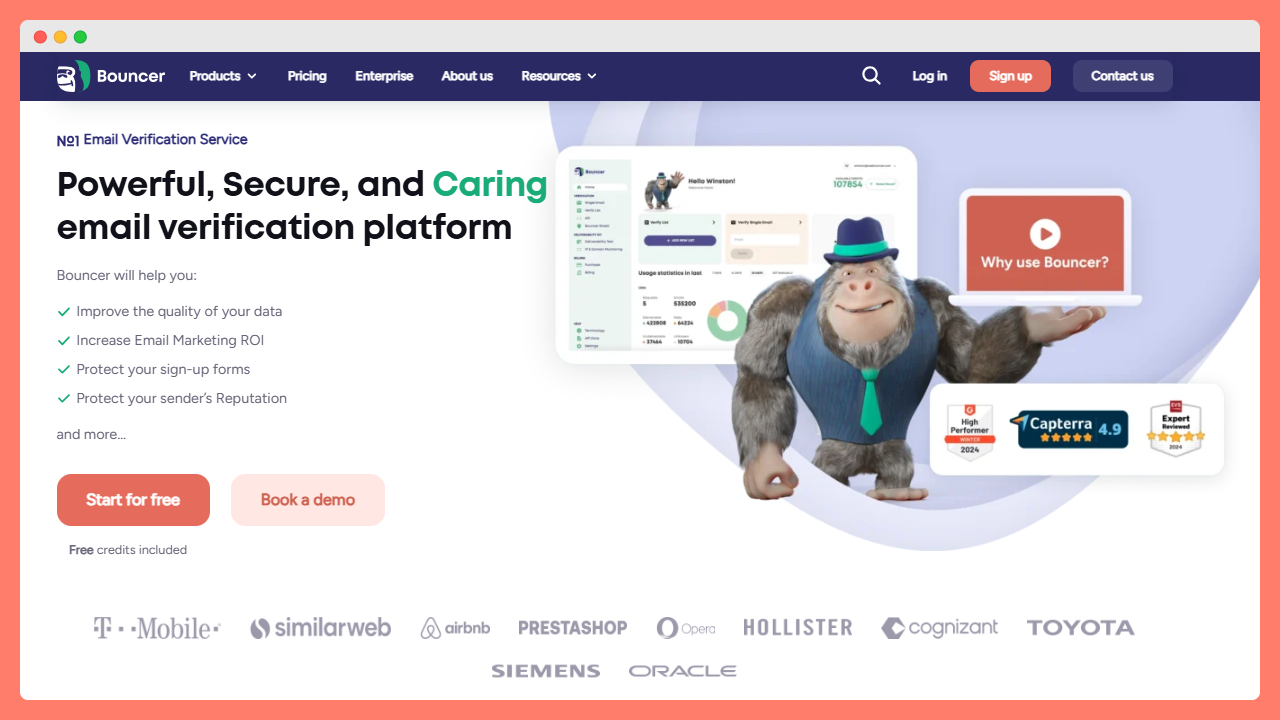
Bouncer is a powerful email verification tool that is fast and user‑friendly. While it serves many use cases, its bulk capabilities make it a standout for high‑volume senders.
Bulk verification features
- High throughput & scalability. Bouncer’s infrastructure can process hundreds of thousands of emails per hour, making it suitable for verifying large volumes of email addresses before a big campaign. Users can upload bulk lists (up to 250,000 per file) via the dashboard, and the system performs simultaneous checks for domain validity, MX records, SMTP response and spam‑trap or toxic address detection.
- Advanced checks. Beyond syntax, Bouncer performs domain, catch‑all and disposable detection; the Deliverability Kit estimates bounce risk and checks your mail server setup, authentication and blacklist status.
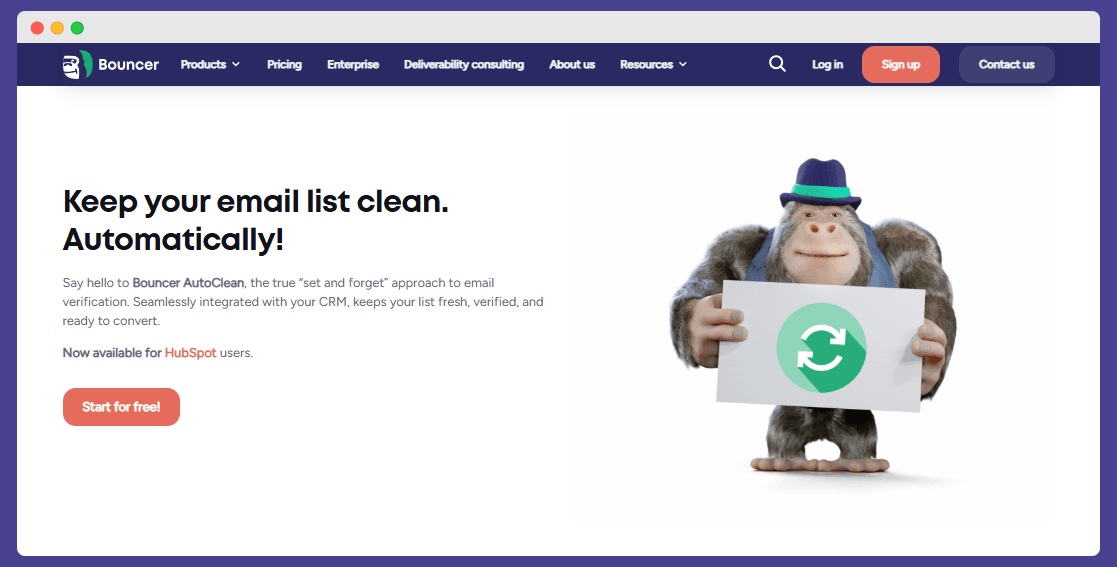
- Granular control & automation. With Bouncer’s AutoClean, users set rules for what to do with each status: keep, suppress or quarantine. The system continuously verifies new contacts and can tag them with a verified contact details field for segmentation. Bulk users can integrate Bouncer via API or connectors to automate pre‑send hygiene.
- Pricing. Bouncer follows a pay‑as‑you‑go model starting around US$0.002 per email, with volume discounts. This makes it cost‑effective for bulk lists compared to monthly subscription‑only providers.
Why bulk senders should consider Bouncer
Imagine a newsletter going to 500,000 subscribers. Without verification, a 5% invalid rate means 25,000 wasted sends. If your ESP charges US$1 per 1,000 emails, that’s US$25 wasted plus the reputational damage of increased bounces.
Running the list through Bouncer would cost roughly US$1,000 (at US$0.002/email) but would remove invalids, protect your email deliverability and improve campaign performance.
Bouncer’s accurate checks, flexible pricing and ability to validate emails both in bulk and via API make it a strong choice for organisations managing huge lists.
However, extremely large enterprises with millions of addresses might need custom pricing or additional throughput assurance. As with any service, test with a free trial first to evaluate performance and ease of integration.
Additional top tools for bulk verification
While Bouncer is the #1 choice for bulk email sending, it’s not the only solution on the market.
Here are other options worth checking out:
EmailListVerify
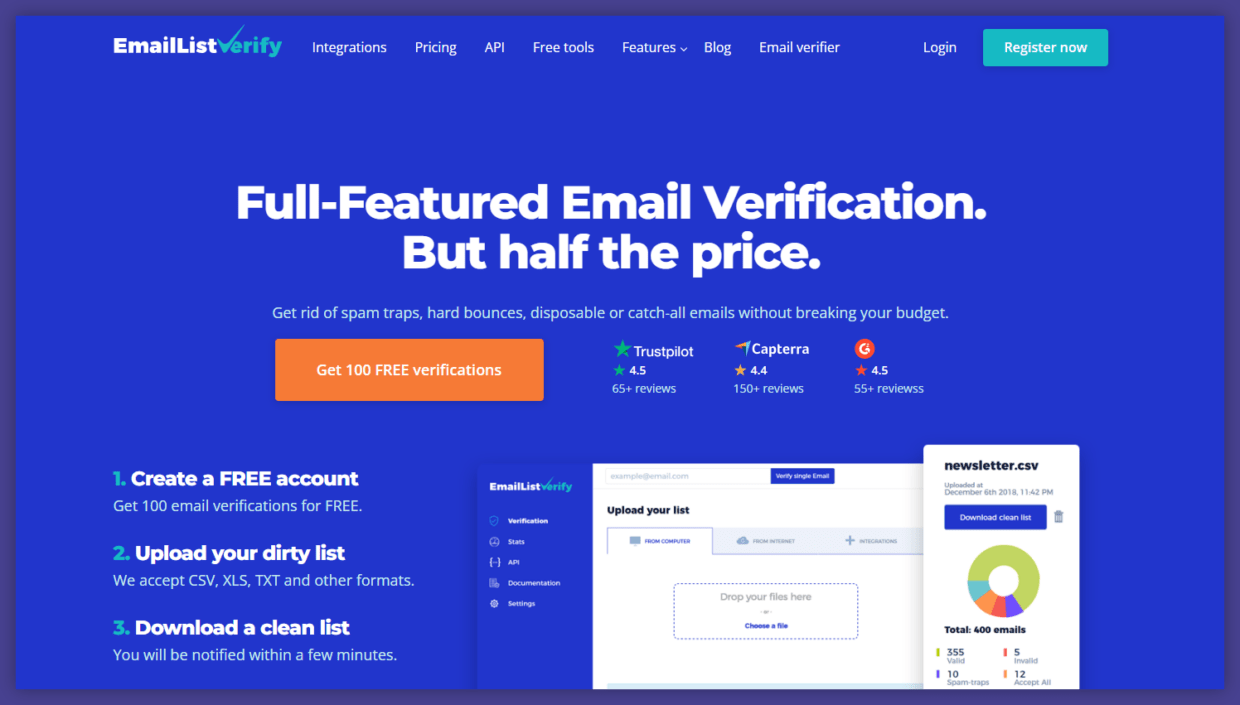
EmailListVerify focuses on affordability and scale. The company reports that it has checked more than 5 billion emails and found that 23% of emails were bad.
Its verification workflow removes spam traps, disposable and invalid addresses, checks for syntax errors and catch‑all domains, and eliminates duplicates.
Lists can be uploaded in CSV or XLSX formats, and results are returned in minutes. The service offers pay‑as‑you‑go credits or monthly subscription plans and includes an email verification API for real time verification.
For agencies and businesses that send millions of emails monthly, EmailListVerify’s low per‑verification cost and integration with popular ESPs (Mailchimp, Aweber, Mailerlite) make it a good fit.
ZeroBounce
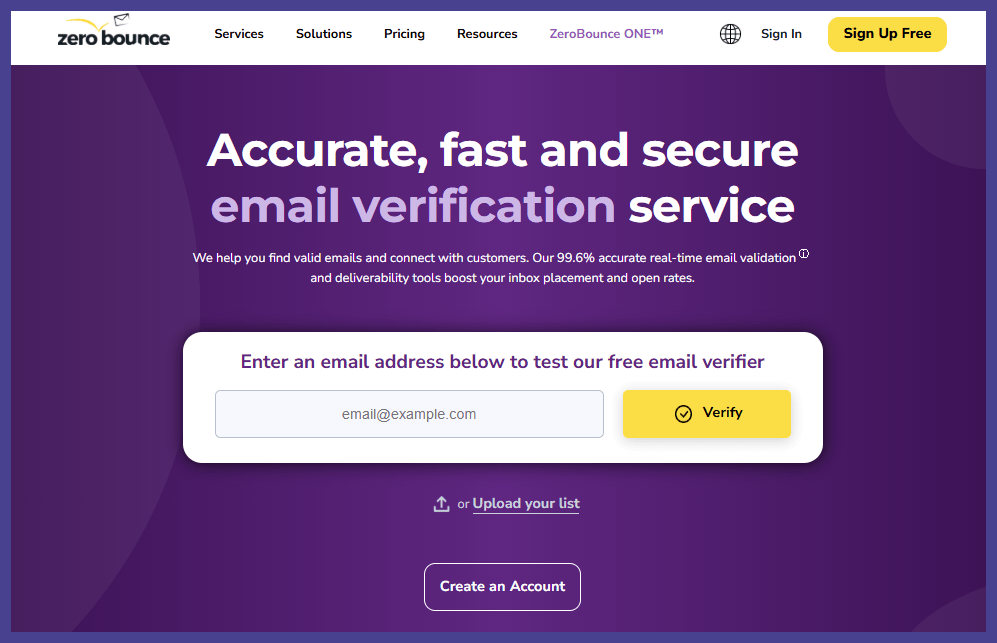
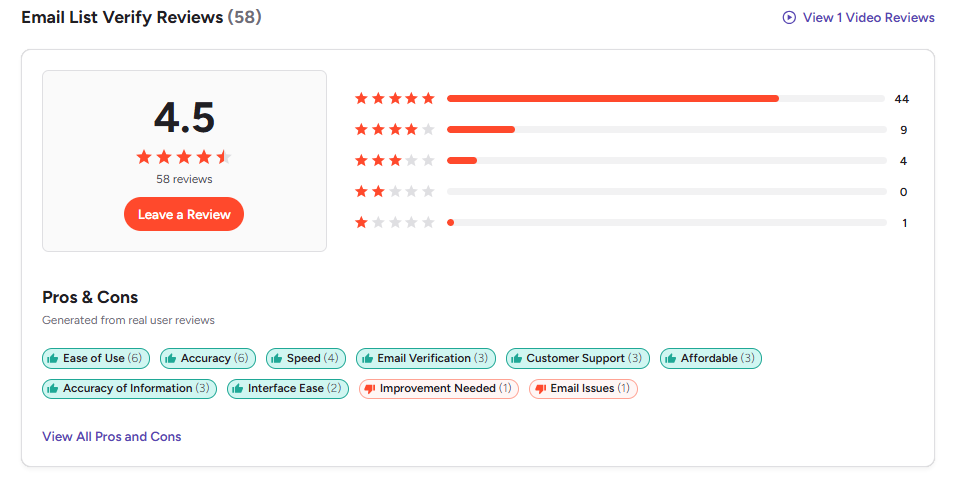
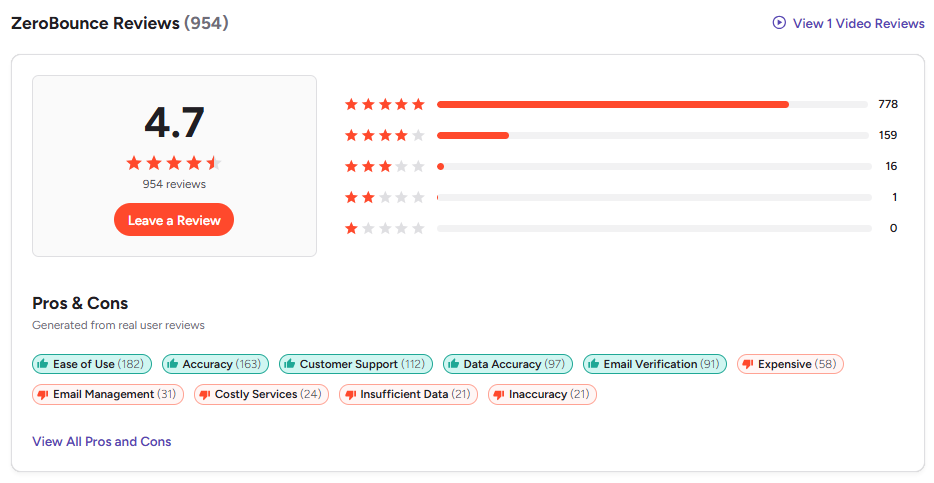
ZeroBounce positions itself as a comprehensive email validation service offering both bulk email verification and real‑time API checks. Its platform emphasises removing bounces, spam complaints, spam traps and bots.
ZeroBounce guarantees 99.6 % accuracy and provides 24/7 support. It detects abuse emails, disposable addresses, catch‑all domains and even toxic domains. Bulk senders can upload lists and download results with selectable fields, and the service claims to process 100,000 addresses in about 45 minutes.
For segmentation, ZeroBounce offers features like gender identification, overview reports and bounce‑risk scoring. Pricing combines credits with monthly options, and free credits allow teams to test before committing.
Clearout
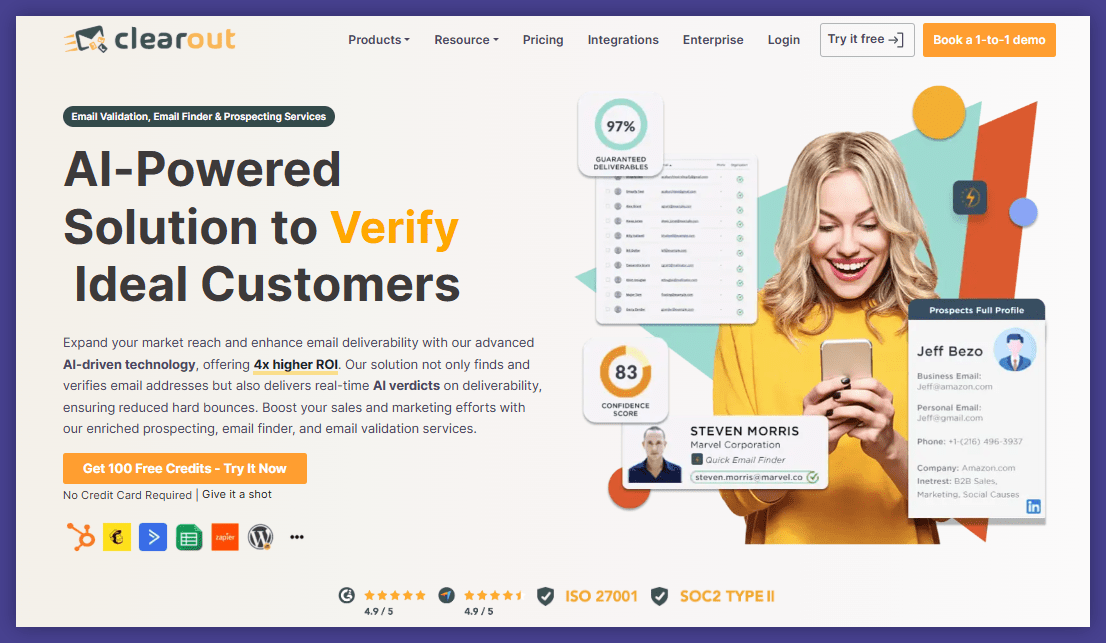
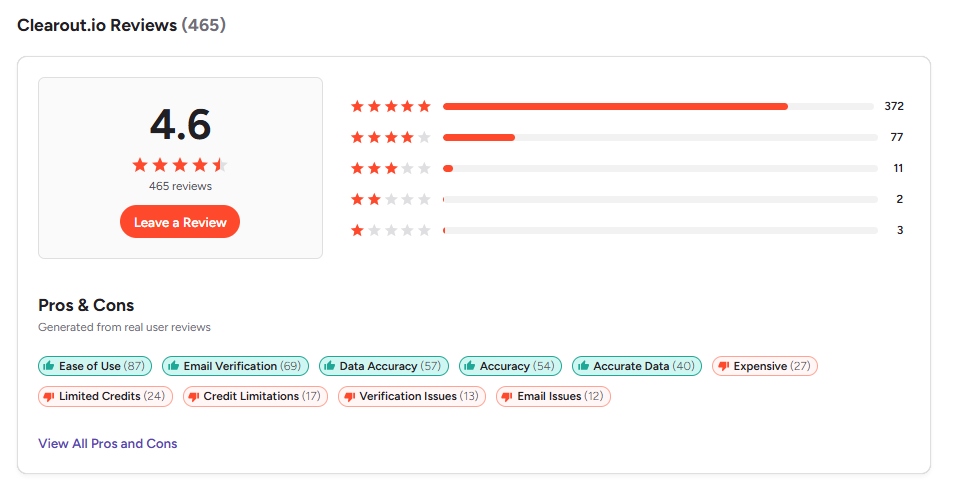
Clearout markets itself as a bulk email list cleaner with 99% accuracy. In a 2026 bulk email blast guide, Clearout notes that its service helps you verify large volumes of email addresses via CSV or XLSX upload and CRM imports. It promises guaranteed deliverables and AI insights that reduce bounce rates to 3% or less.
Clearout also offers a Google Sheets add‑on for verifying lists directly in spreadsheets and supports real‑time form validation.
Pricing is flexible with free plan credits and subscription tiers, making it suitable for organisations that need frequent bulk email validation.
Other email verification software options include NeverBounce (specialised in real‑time checking and integrations), Hunter, Snov.io and Kickbox.
Each offers a mix of email verification software features, such as email finder capabilities, catch‑all testing and user friendly interface. You should evaluate them against your requirements: throughput, integrations, price and customer support.
Implementation guide & bulk‑sender checklist
To incorporate email verification into high‑volume workflows:
- Audit your lists. Determine list size, sources and bounce history. Estimate the percentage of invalid emails by sampling with a free credits trial.
- Choose a verification tool. Compare services on scalability, accuracy, pricing, data security, and integration options. Check whether they support automated email verification via API and bulk verification via CSV.
- Integrate with your ESP or CRM. Use native connectors, a mail server API or middleware (e.g., Zapier) to automate list uploads and retrieval of verification results. Ensure the tool handles CSV format and large files and offers export options to update verified contact details.
- Schedule regular clean‑ups. For newsletters or outreach to millions, verify the entire list quarterly and run smaller lists before each campaign. Many tools allow scheduling periodic scans and sending results via email or dashboard.
- Implement real‑time validation. Add an email verifier API at points of capture (forms, opt‑ins) to block fake sign‑ups. This stops temporary email addresses, duplicate entries and spam traps before they pollute your database.
- Monitor metrics. Track pre‑ and post‑verification bounce rates, complaint rates, open/click rates, and domain reputation. Assess campaign performance improvements and cost savings.
Bulk‑sender checklist
- Does the tool support CSV/XLSX upload and process hundreds of thousands of records quickly?
- What is the price per 1,000 verifications and are there subscription plans that fit your volume?
- Does it detect spam traps, disposable email addresses, catch‑all servers and correct syntax errors?
- Is there a seamless integration with your email marketing platform, CRM or email outreach platform?
- Does it provide detailed analytics and segmentation tags (e.g., valid, risky, toxic) to inform sales teams and marketing tools?
- Are free credits, free trials or free plan options available to test the service?
- Is the vendor compliant with GDPR/SOC 2 and does it anonymise data to ensure data security?
Email verification software for bulk emails summary
For high‑volume senders, list hygiene is a critical safeguard. Thanks to using a reliable email verification service, you eliminate invalid and fake addresses, protect your sender reputation, reduce bounces and maximise ROI.
Bouncer stands out for its high throughput, granular rules and pay‑as‑you‑go pricing.
As you prepare your next massive send, take time to validate emails.
Upload your list, verify email addresses with a tool built for scale, integrate the results into your workflows and measure the improvement.
Keeping your list clean is the simplest way to boost deliverability, save money and make every message reach a real, engaged human.
If you’re ready to start now, try Bouncer – collect your free credits here.


