





But the email verification tools have matured too. Today’s email verification software does much more than check syntax. It looks at domain health, server responses, risk signals, and patterns that affect inbox placement long before you notice a drop in performance.
At the same time, teams are overwhelmed with options. Every email verification service promises accuracy. Every email verifier claims to protect sender reputation. Pricing models look similar. Features overlap. And yet, the experience and results can feel very different once you actually start using a tool.
This guide is here to slow things down.
To explain what matters in email verification, how verification tools are really used in practice, and how to think about choosing the right one before diving into the list itself.
TL;DR
- Email verification is an ongoing process, not a one-time cleanup, and it directly affects sender reputation and inbox placement.
- Speed-first tools work for quick bulk cleanup, while deliverability-focused tools help teams manage risk, catch all addresses, and long-term email performance.
- The best email verification tool is the one that fits your workflow and is used consistently, not the one with the longest feature list.
From syntax to risk signals: how email verification works today
At a glance, most verification tools look similar. Upload a list. Wait a bit. Download results. But under the surface, the verification process has become far more nuanced.
Email verification software usually starts with basic checks. Syntax validation confirms whether an email address is formatted correctly. Domain checks look at whether the domain exists and is configured to receive mail. MX records play a key role here. If a domain cannot receive mail at all, the address is clearly invalid.
The next layer is server interaction. Many tools attempt a non-intrusive “ping” to see how the receiving server responds. This helps determine whether an email address exists without sending a real message. It’s also where catch all behavior is detected. Catch all domains respond positively to everything, which requires careful classification rather than a simple yes or no.
Risk analysis comes after that. This includes disposable email detection, role-based inbox identification, and spam trap patterns. No tool can guarantee perfect spam trap detection, but good verification tools combine historical data, domain reputation, and behavioral signals to reduce exposure.
Finally, results are grouped into usable categories. Valid. Invalid. Risky. Unknown. The best tools explain what each status means and how to act on it. That’s where usability matters. A clean user interface can make the difference between confident decisions and guesswork.
APIs have also become central. An email verification API allows teams to validate email addresses in real time during lead generation, onboarding, or imports. This keeps databases cleaner from the start, instead of relying only on bulk verification later.

What to look for before choosing an email verification tool
With so many verification tools available, it helps to step back before comparing feature lists. The right email verification tool depends less on buzzwords and more on how you actually work.
Start with volume and rhythm.
Do you verify occasionally, or every day? Pay as you go pricing works well for irregular use. Monthly subscription plans make more sense when verification is constant. Free plans and free credits are useful for testing, but they should not be the main deciding factor.
Next, look at how results are presented.
Clear classification saves time. Vague labels create confusion. A good email verifier explains why an address is risky and what that means for email campaigns. This matters for teams trying to balance list growth with inbox placement.
Integration style is another factor.
Some teams want simple uploads and exports. Others rely on APIs and automated workflows. If verification is part of a larger email marketing platform or outreach stack, smooth integration reduces friction.
Security and data handling also matter more.
Email addresses are personal data. Verification tools should be transparent about how data is processed, stored, and removed. This is especially important for teams working with sensitive data or operating under strict compliance rules.
Finally, think about trust.
Not marketing trust, but operational trust. Does the tool behave consistently? Are results stable over time? Does it help you avoid spam complaints and blacklist issues, or does it create new questions after every upload?
Once those basics are clear, comparing tools becomes easier.
The list of the best tools for email verification
Email lists keep growing and so do risks. Invalid email addresses, spam traps, catch all domains, and disposable inboxes can quietly damage sender reputation over time.
The best email verification tools help you verify email addresses before campaigns go out, protect inbox placement, and reduce spam complaints across email service providers.
Below is a practical look at the tools many teams rely on today.
Bouncer
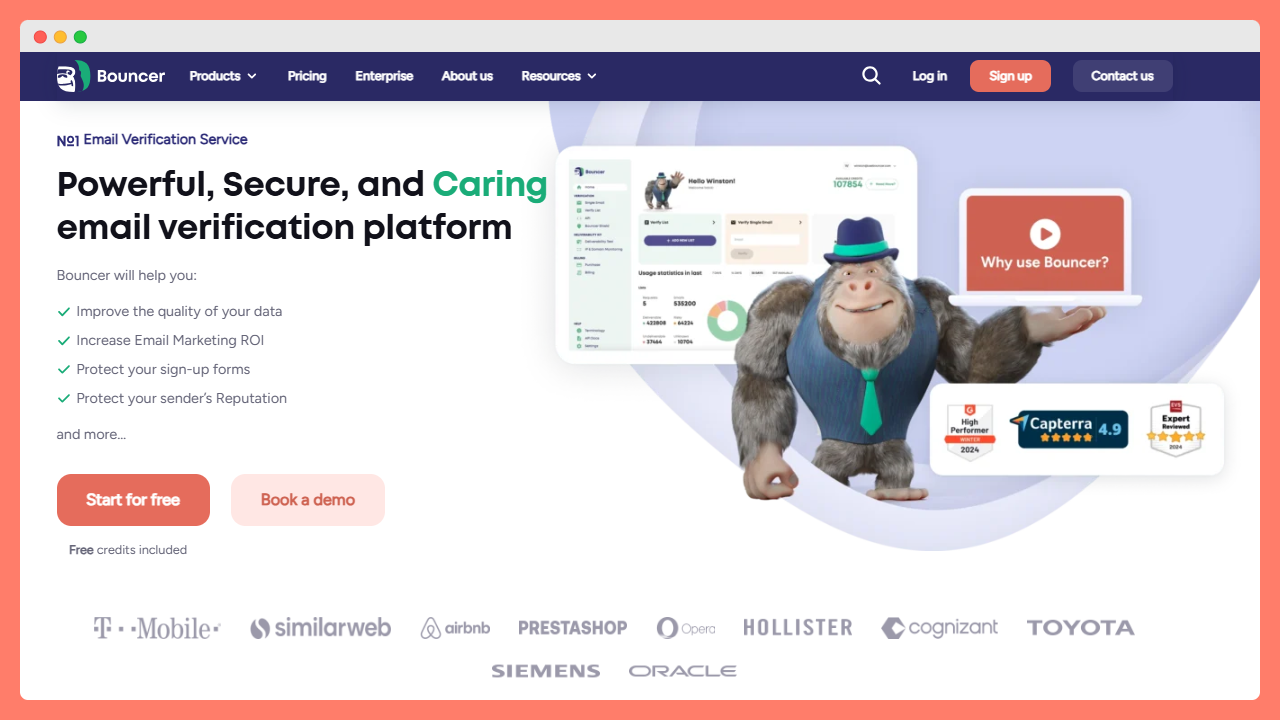
Bouncer is an email verification service that focuses on accuracy and speed. It feels built for people who care about clean data but do not want complexity.
The interface is calm, simple, and easy to trust. That matters when you work with sensitive data and large lists of email addresses.
Key features
Bouncer supports bulk email verification and real time verification through sign up forms and APIs. It checks MX records, domain status, and whether an email address exists. It also flags catch all addresses, risky emails, and spam traps with clear labels. The verification process is transparent, which helps teams understand what to do next.
The email verification API is fast, can process even 500,000 email addresses, and is well documented. There are also many integrations, including Zapier, which makes email address verification simple inside Google Sheets. No exports needed, no messy workflows.
Pricing and plans
Bouncer offers free credits to test the verification process. Paid plans work on a pay as you go model, which helps teams save money. There are also subscription plans for monthly verification and automatic monthly re verification. This flexibility works well for teams running ongoing email campaigns.
Our rating: 5/5
Bouncer is a strong fit for email marketers, sales teams, and email outreach platform users. It works well for email marketing and cold outreach. It also suits teams that value sender reputation and inbox placement more than flashy extras. If you want a user friendly interface and reliable verification tools, Bouncer is easy to trust.
ZeroBounce
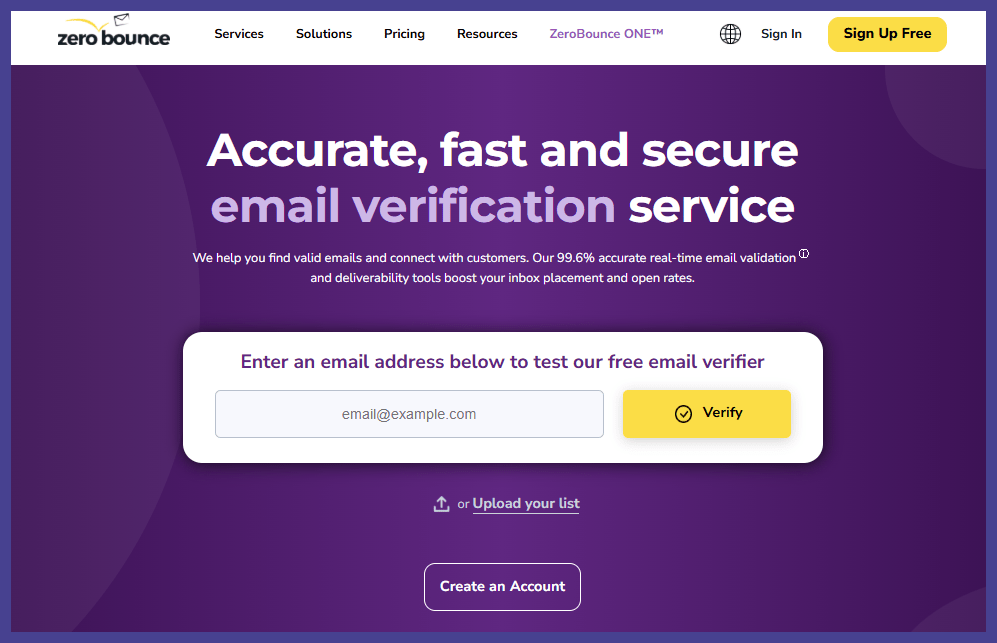
ZeroBounce is a well known email verification software with a broad feature set. It positions itself as a full deliverability and verification solution rather than a simple email checker.
Key features
ZeroBounce verifies emails using syntax checks, MX records, and inbox-level analysis. It includes spam trap detection, disposable email detection, and blacklist monitoring. Inbox reports and deliverability tools are also part of the platform. The verification process is detailed and data heavy.
An email verification API is available for real time verification and bulk verification workflows.
Pricing and plans
There is a free trial with free credits. Most paid plans use pay as you go pricing, with monthly plans available for larger volumes. Unlimited verification is not typical, but volume discounts exist.
Our rating: 4.5/5
ZeroBounce works well for large email marketing platforms and teams that want extra reporting. It fits users who want email validation tools combined with inbox monitoring and analytics.
NeverBounce
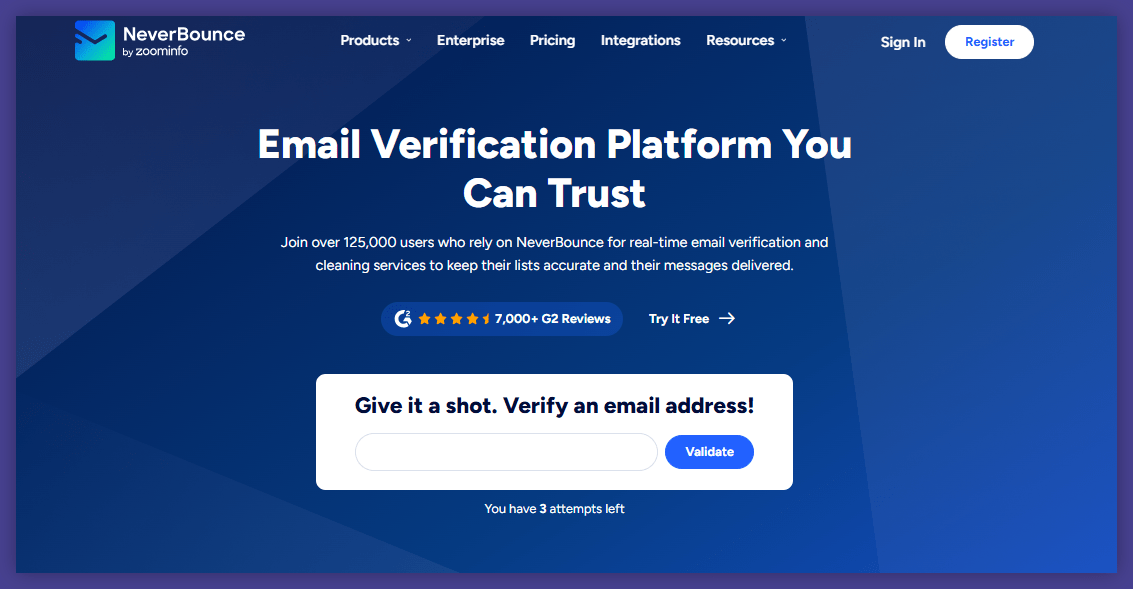
NeverBounce is a long-standing email verifier focused on speed and list cleaning at scale. It is often used for bulk email verification before large email campaigns.
Key features
The platform supports bulk verification, real time verification, and integrations with email service providers and marketing platforms. It detects invalid addresses, catch all domains, and spam traps. The email verification process is fast and designed for large uploads.
NeverBounce also offers an email verification API for automated workflows.
Pricing and plans
There is a free plan with limited free email verification credits. Pricing is mostly pay as you go, with monthly subscription options for frequent users.
Our rating: 4.4/5
NeverBounce fits email marketers managing big lists and bulk email verifier needs. It works well when speed matters more than deep classification detail.
Clearout
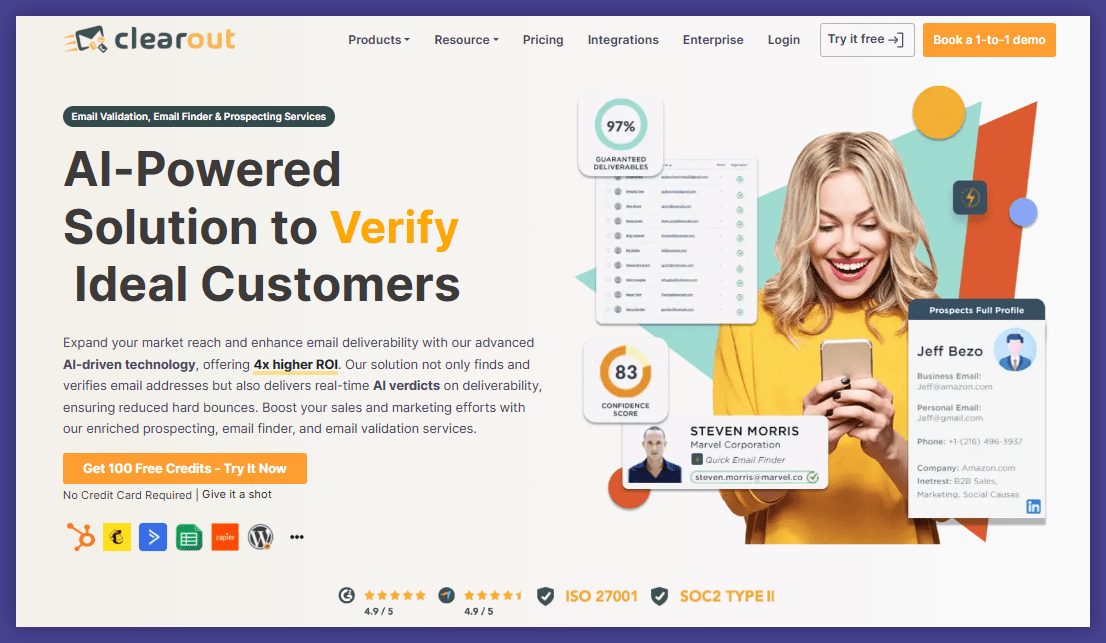
Clearout combines email verification with lead-focused workflows, which makes it practical for teams working with fresh contact data. The platform is built around speed and clarity.
It works well when lists come from multiple sources and need quick cleanup before outreach. The verification process focuses on reducing invalid email addresses before they harm sender reputation. It feels reliable without being overwhelming.
Key features
Clearout supports bulk email verification and real time verification for forms and incoming leads. It detects spam traps, disposable inboxes, and catch all addresses with clear status labels. The system highlights risky emails so teams can decide whether to keep or remove them. An email verification API is available for automation and scaling verification across tools. The platform is designed to validate email addresses while keeping the process fast and predictable.
Pricing and plans
Clearout offers a free plan with free credits. Paid plans are pay as you go, with monthly plans available.
Our rating: 4.5/5
Clearout works well for sales teams and marketers who combine email finder tools with email verification software. It fits outbound workflows and lead generation use cases.
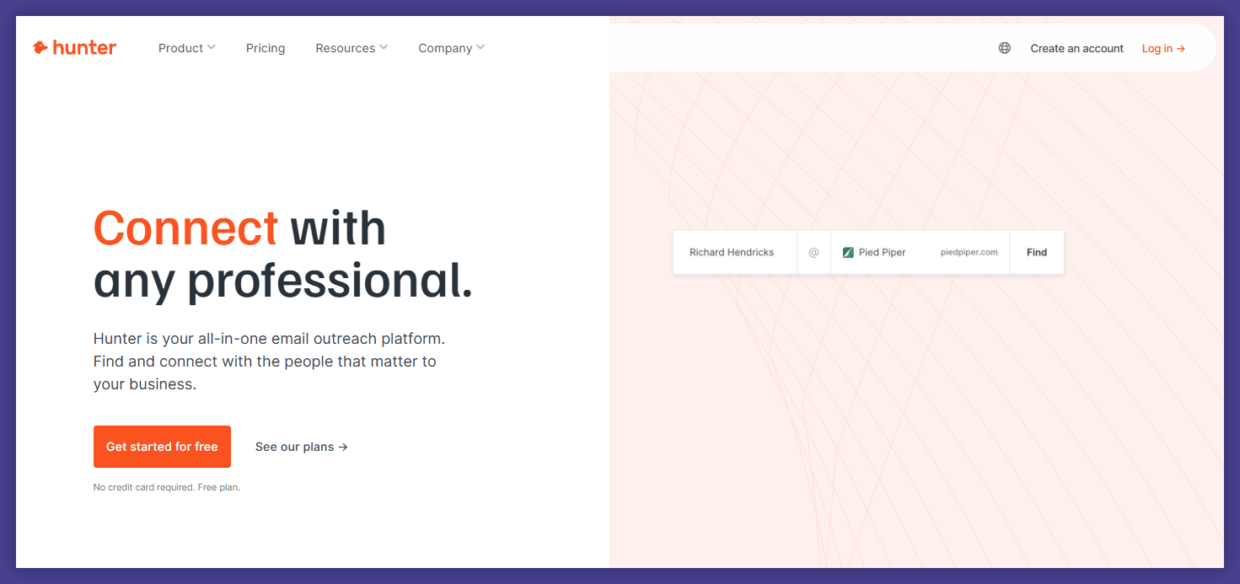
Hunter Email Verifier
Hunter’s email verifier is closely tied to its broader contact discovery ecosystem. It is often used to double-check email addresses right after they are found.
The experience is simple and focused on quick decisions rather than deep analysis. It helps reduce invalid addresses before email campaigns go live. For many teams, that lightweight approach is enough.
Key features
Hunter verifies emails using domain checks, server responses, and basic inbox signals. It identifies invalid email addresses, catch all domains, and risky emails. Bulk verification is supported, though it is designed for moderate list sizes. The verification process is straightforward and easy to repeat. It fits naturally into lead generation workflows where speed matters.
Pricing and plans
There is a free plan with limited free credits. Paid plans are subscription based with monthly plans.
Our rating: 4/5
Hunter suits small sales teams and email marketers who already use Hunter for lead generation. It is convenient but not the most advanced email verification service.
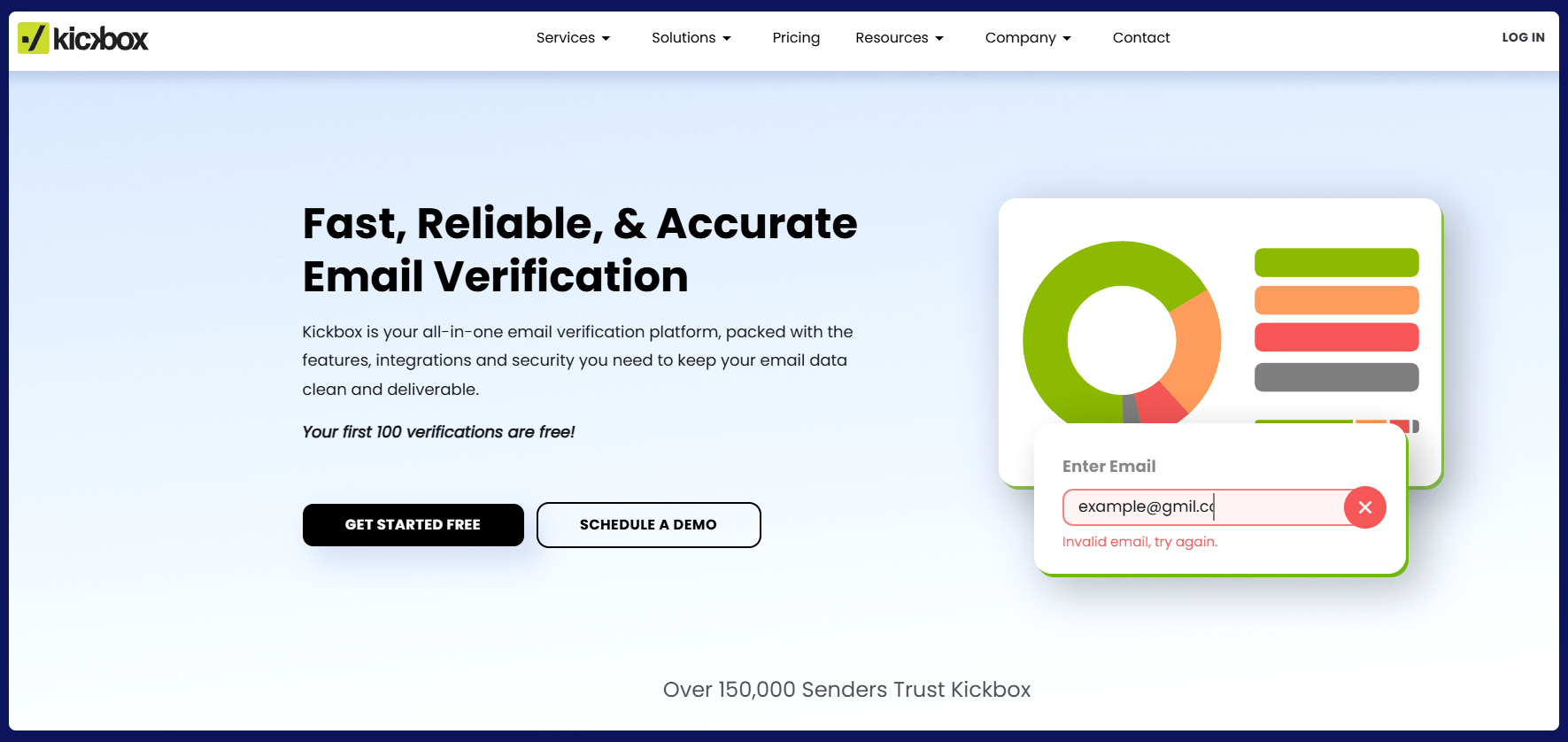
Kickbox
Kickbox is positioned as an email verification service with a strong focus on deliverability outcomes. It puts a lot of attention on inbox placement and long-term sender reputation.
Results are presented clearly, without forcing users to interpret complex data. It feels built for consistency rather than experimentation.
Key features
Kickbox handles bulk email verification and real time verification through APIs. It detects disposable email addresses and catch all addresses. The system evaluates domain status and server behavior during the verification process. It integrates well with email service providers and marketing platforms.
Pricing and plans
Kickbox offers free credits. Pricing is pay as you go, with subscription plans for recurring needs.
Our rating: 4.5/5
Kickbox works well for email marketers running regular email campaigns and caring deeply about email deliverability and spam folder avoidance.
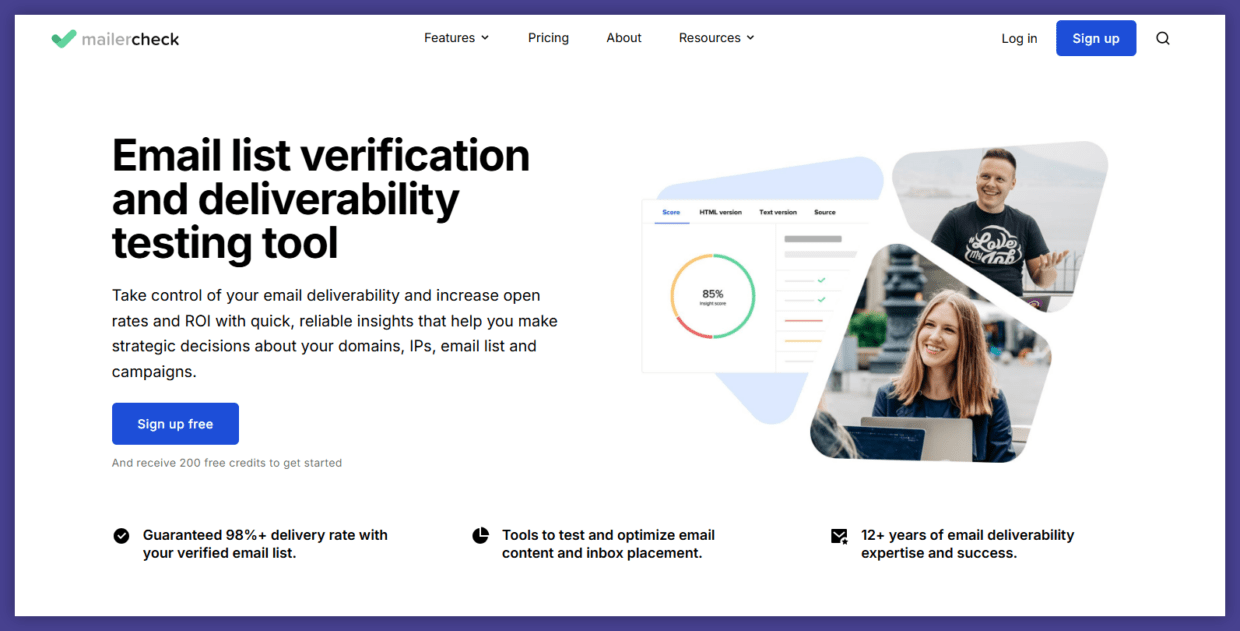
MailerCheck
MailerCheck is a straightforward email verification tool focused on list hygiene. It offers some extra features but keeps attention on core verification tasks.
The platform is easy to navigate and quick to learn. For many users, that simplicity is the main advantage.
Key features
MailerCheck supports bulk verification for uploaded lists. It identifies invalid addresses, spam traps, and risky emails. The tool checks MX records and domain status as part of the verification process. Results are grouped clearly to support quick decisions. It helps email marketers maintain clean lists over time.
It also offer features like email insights, usage reports or blocklist monitoring.
Pricing and plans
MailerCheck offers 10 free email verification credits for testing. Paid plans follow a pay as you go structure.
Our rating: 4.6/5
MailerCheck fits small businesses and email marketers who want a straightforward free email checker with minimal setup. It offers interesting tools that may boost your email marketing.
Snov.io Email Verifier
Snov.io’s email verifier is part of a broader outreach and prospecting platform. It is designed to support sales workflows. The experience is optimized for speed and volume.
It works well for broader email campaigns and if you need just only an email verification service. That makes it appealing for active outreach teams.

Key features
The tool verifies emails using syntax checks, server responses, and domain analysis. It flags invalid email addresses, spam traps, and catch all domains. Bulk verification is supported for larger prospect lists. The email verification API allows automated checks during lead generation. It helps maintain verified contact details across campaigns.
It also gives you features for closing deals, generate leads and manage sales, so it’s like a broader system, not only email verification tool.
Pricing and plans
You can try Snov.io for free. Paid plans are monthly subscriptions.
Our rating: 4.1/5
Snov.io works best for sales teams running outreach and wanting all the tools in one place. Yet, it’s not focused on email verification in 100%.
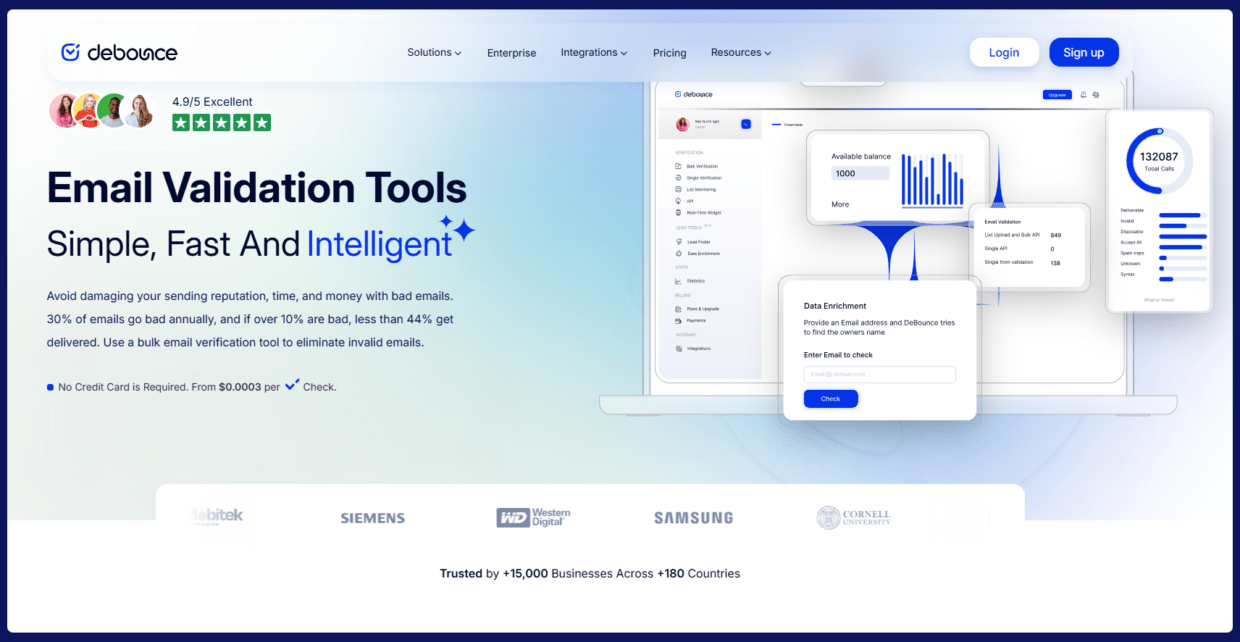
Debounce
Debounce is a lightweight email validation tool built for efficiency. It focuses on delivering results quickly without unnecessary extras.
The platform works well for periodic list cleaning. It is often used before importing contacts into email marketing tools. The overall experience is fast and predictable.
Key features
Debounce supports bulk email verification and real time verification. It detects disposable email detection patterns and spam traps. The tool checks MX records and server responses during validation. Results include clear indicators for risky emails. It helps reduce bounce rates and protect email deliverability.
Pricing and plans
Debounce uses pay as you go pricing and offers monthly plans as well.
Our rating: 4.0/5
Debounce suits teams that want simple verification tools without extra features.
Emailable
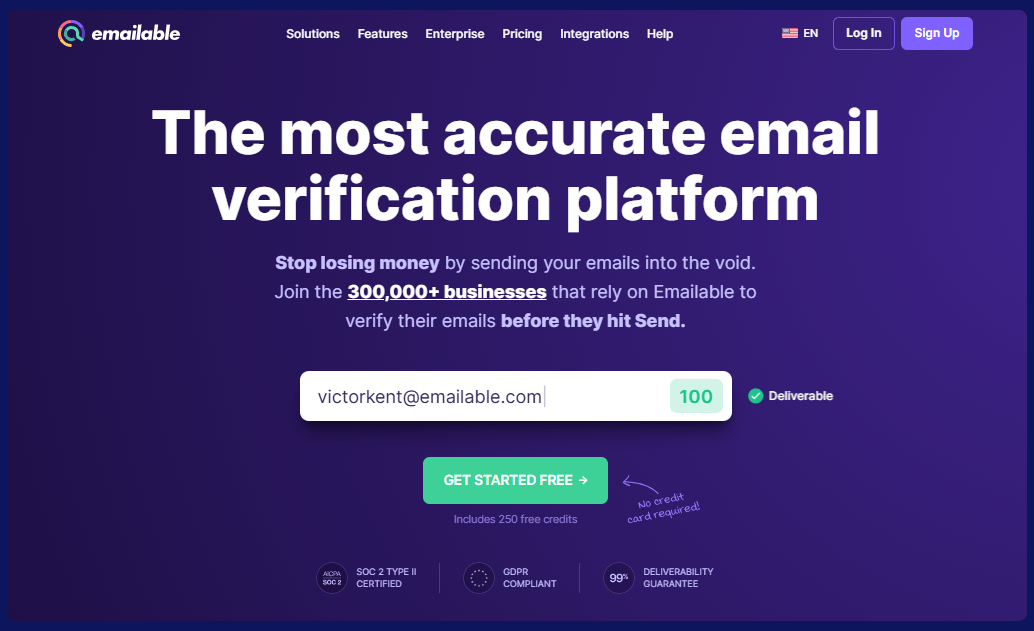
Emailable is designed for teams that need reliable verification at scale. It balances ease of use with deeper verification logic. The platform feels modern and stable when handling large lists. It supports ongoing verification as well, and that makes it suitable for recurring email campaigns.
Key features
Emailable offers 5 solutions: Bulk, Verifier, API, Widget, and Deliverability. As a result, it supports bulk verification and real time verification via API. It detects spam traps, catch all addresses, and invalid email addresses.
The verification process includes domain checks and inbox-level signals. Results are grouped to support filtering and list cleanup. It helps email marketers improve inbox placement and reduce spam folder risks.
Pricing and plans
There is a free trial with 250 free credits. Paid plans include pay as you go and monthly subscription options.
Our rating: 4.5/5
Emailable fits email marketers and sales teams scaling email campaigns across multiple tools.
How to make email verification a part of your strategy
The first step is deciding when verification happens by default. New leads should be verified as they come in, not weeks later. That applies to sign up forms, imports from partners, and lists built through lead generation. Real time verification helps here, but even simple daily or weekly checks can change outcomes fast.
Next, align verification with how you treat risk.
Not every email address needs the same response. Invalid addresses should be removed immediately. Risky emails and catch all addresses deserve a decision, not an automatic delete. Some teams keep them in a separate segment and watch engagement. Others exclude them from cold outreach but allow them in warmer campaigns. What matters is that the rule is clear and consistent.
Verification should also be tied to campaign readiness.
Before launching any email campaign, especially bulk email campaigns, lists should pass a quick verification pass. This step becomes part of campaign prep, like reviewing copy or setting timing. When it is built into the workflow, it stops feeling optional.
Another often missed step is re-verification.
Email addresses decay quietly. People change jobs. Domains expire. What was valid six months ago may now be risky. Automatic monthly re verification or scheduled bulk verification keeps lists healthy without manual effort. This is especially important for long-term newsletters and nurture sequences.
Finally, make verification visible. Teams should know where data comes from and how clean it is, but they should not need to debate results every time. Clear categories, shared rules, and predictable outcomes build trust over time.
When email verification becomes routine, its impact compounds. Sender reputation stabilizes. Inbox placement improves. Fewer campaigns are paused due to technical issues. Most importantly, teams stop firefighting and start focusing on what emails are actually supposed to do: communicate.
Best email verification tools in your hand
All the tools above handle the email verification process differently, and those differences show up quickly once you start using them at scale.
Many, like NeverBounce, Debounce, and MailerCheck, are built for speed above all else. They process large lists fast and give binary results that work well for quick cleanup. That approach suits teams that verify occasionally or work with short-lived campaigns where timing matters more than nuance.
Other tools, such as Snov.io, Kickbox, and Emailable, lean more heavily toward email marketing. They combine verification with many different options, like risk signals, spam trap patterns, and domain behavior. These tools offer more context. That context helps teams make decisions about catch all addresses, risky emails, and long-term sender reputation.
However, if you want both speed, clarity, flexibility, and strong features without added complexity, Bouncer fits naturally into that middle ground.
It does not overload users with secondary metrics. It explains what is valid, what is risky, and why. That makes it easier to act with confidence.
Bouncer works well when verification is part of everyday operations. It supports regular checks, re-verification, and clean data habits without demanding constant attention.
For teams that value consistency over noise, that quiet reliability matters. Try Bouncer email verification tool and boost your email marketing today.


