





Reviewed by Jakub Zięcina
We compared 15 of the most popular email verification tools for 2026 on six factors: verification accuracy, processing speed, pricing per 1,000 emails, catch-all handling, integrations, and real user reviews on G2 and Capterra. This guide replaces the guesswork with data you can act on.
For a vendor-specific example, our DeBounce email validation review shows the questions worth asking beyond a headline accuracy number.
TL;DR – the short version
- Bouncer: $8 per 1,000 PAYG verifications, 100 free signup credits, non-expiring purchased credits, and no charge for duplicate or unknown results.
- Accuracy claims: vendors use different datasets and definitions, so compare real-world results on the same representative sample rather than ranking tools by self-reported percentages.
- Best for raw speed: Mailfloss (cleans 10,000 emails in ~5 minutes) and Bouncer (real-time + bulk).
- Cheapest per email: EmailMarker at $3 per 1,000, but accuracy drops to ~74% on independent audits.
- Best for agencies: Emailable, NeverBounce, and Bouncer (multi-client workflows + API).
- Free access examples: Bouncer 100 signup credits, Kickbox 100 signup verifications, MailerCheck 10 signup credits, Hunter 50 monthly credits and Verifalia 25 daily credits.
If you only have time to test a few options, start with the tools that match your volume, integrations and workflow, then run the same sample through each before committing. Bouncer offers 100 free signup credits.
Quick comparison table (top 6)
| Tool | Best for | Speed (10k emails) | Price per 1k | Free credits | G2 rating |
| Bouncer | Overall + agencies | Real-time + bulk, 180k/hr | $8 | 100 | 4.8 / 5 |
| ZeroBounce | Compliance-heavy senders | ~43 min | $10 | 100 | 4.6 / 5 |
| EmailListVerify | Budget bulk cleaning | ~75 min | €5 (~$5.40) | 100 | 4.6 / 5 |
| MailerCheck | MailerLite users | “Within minutes” | $10 | 200 | 4.6 / 5 |
| Emailable | Freelancers + agencies | ~50 min | $7.60 | 250 | 4.6 / 5 |
| NeverBounce | Enterprises wanting 99.9% | ~200 min | $5 | 1,000 free check | 4.5 / 5 |
Speed figures sourced from independent test data on listcleaningadvice.com. Prices in USD unless noted.
How we ranked these tools
We didn’t just rank by popularity. Each tool was scored on:
- 1. Accuracy – self-reported plus third-party benchmarks where available.
- 2. Speed – measured time to verify 10,000 emails (independent benchmark data).
- 3. Pricing transparency – clear per-credit cost, expiry rules, hidden fees.
- 4. Catch-all and risk handling – how well the tool flags addresses that bounce despite passing basic SMTP checks.
- 5. Integrations – native connectors with major ESPs, CRMs, and developer APIs.
- 6. User feedback – aggregated G2 + Capterra reviews from the last 18 months.
Tools were grouped by use case (small business, agencies, enterprise, all-in-one, free) rather than ranked in one flat list. Different teams need different things, and “best” depends on volume, integrations, and budget.
What is an email verification tool?
An email verification tool checks whether an email address exists, can receive mail, and is safe to send to. It does this through a chain of checks: syntax validation, domain and MX record lookup, SMTP handshake, catch-all detection, disposable domain check, and risk scoring against known spam traps.
The output is a verdict – usually valid, invalid, risky, catch-all, or unknown – that tells you whether to keep, drop, or further investigate each address.
Why it matters:
- Sender reputation: ESPs like Gmail and Outlook penalise senders with high bounce rates. One bad campaign can throttle your inbox placement for months.
- Cost: ESPs charge per contact. Sending to dead addresses inflates your bill without producing opens or clicks.
- Compliance: Spam traps and complainer addresses can land you on blocklists.
- Data quality: A clean list improves the accuracy of every downstream metric you report on.
For a deeper dive, see our guide on how to verify email addresses.
Best email verification tools in 2026: full list
#1 Bouncer – best overall
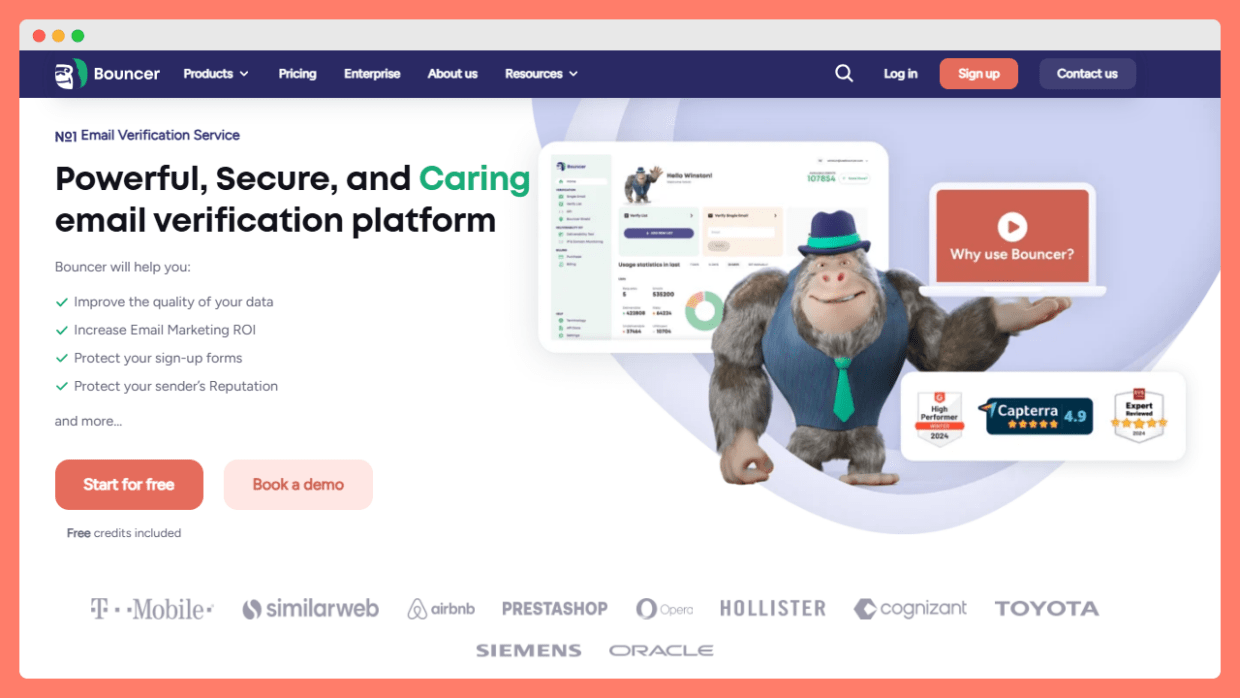
Best for: marketing teams, agencies, SaaS platforms, and anyone who needs accurate verification without paying enterprise prices.
Bouncer handles single-email checks, bulk lists up to 250,000 addresses, real-time API verification, and signup form protection through Bouncer Shield. It is built to balance accuracy, speed, and pricing without locking core features behind enterprise tiers.
Key features:
- email verification up to 250,000 emails per batch with bounce estimates and detailed result tags.
- Email verification API with sub-second response times.
- Bouncer Shield for real-time form protection against typos, traps, and shady signups.
- Toxicity check scoring addresses 0 to 5 against blacklist and complaint history.
- Deliverability kit covering inbox placement, blocklist monitoring, and SPF/DKIM/DMARC checks.
- Catch-all deep check for tricky Google Workspace and Microsoft 365 domains.
- AutoClean for automatic background list hygiene.
- Free email list sampling before you commit credits.
Speed: verifies up to 180,000 emails per hour, with real-time and bulk modes both available. No queueing delays during peak hours.
Pricing: transparent pay-as-you-go from $8 per 1,000 emails, scaling down with volume. Credits never expire. No charge for unknown results or duplicates. Monthly subscription plans also available. New accounts get 100 free verifications. See full Bouncer pricing.
Pros:
- Highest user-rated email verification tool on G2 (4.8/5) and Capterra (4.9/5).
- Real-time API plus bulk processing in one product.
- SOC 2 and GDPR compliant.
- No charge for duplicates or unknowns.
- Personal onboarding support.
Cons:
- Brand recognition is still building outside Europe.
- No built-in cold email sender (it’s a verification specialist, not an outreach platform).
Best for: users who want top-tier accuracy and integrations without enterprise overhead. Try Bouncer free.

Best email verification tools for small businesses
Small teams need affordable pricing, a strong core feature set, and the ability to scale up or down. These are the picks that fit.
#2 ZeroBounce
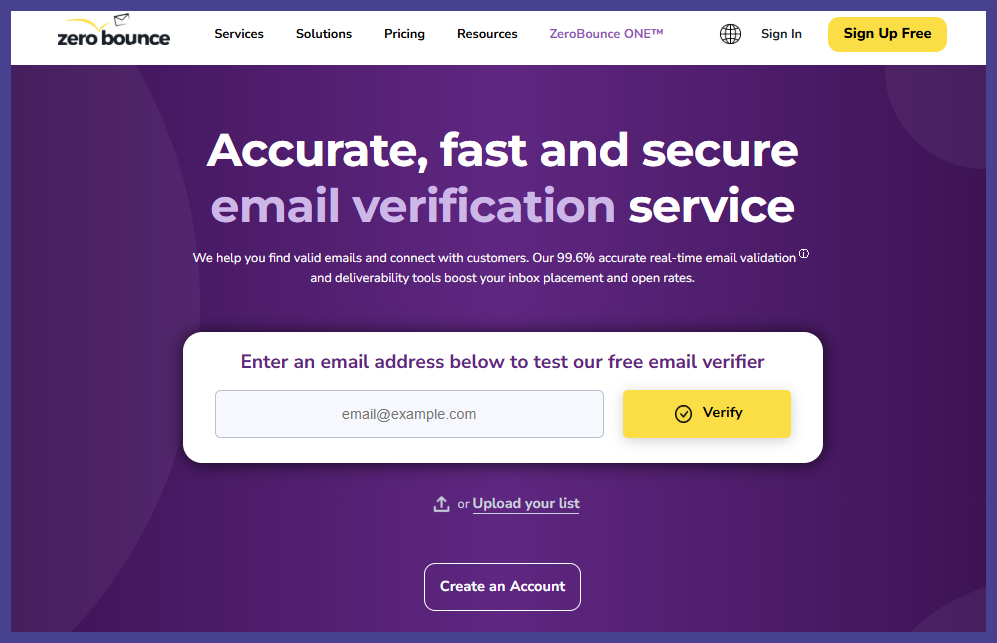
Best for: senders who want compliance certifications and email warmup baked in.
ZeroBounce is a long-running email verification platform with a broad feature set: validation, spam trap detection, blacklist monitoring, DMARC reporting, and email warmup. It claims 99% accuracy and serves marketers who want one tool for multiple deliverability tasks.
Key features:
- Email validation with claimed 99% accuracy.
- Spam trap detection.
- Catch-all and disposable domain checks.
- Blacklist monitor across 200+ providers.
- DMARC monitor.
- Built-in email warmup.
Speed: ~43 minutes for 10,000 emails. Slower than the top of the pack.
Pricing: ZeroBounce PAYG starts at $39 for 2,000 credits and $129 for 10,000. Free accounts receive 100 verification credits each month. See our ZeroBounce pricing breakdown.
Pros:
- Long-established brand with multiple compliance certifications.
- Bundles warmup and DMARC monitoring.
- 200+ blacklist coverage.
Cons:
- Speed is below average on bulk lists.
- Interface looks dated compared to newer tools (G2 review evidence).
- Feature depth can overwhelm small teams who only need verification.
For a head-to-head comparison, see Bouncer vs ZeroBounce.
#3 EmailListVerify (Email List Verify)
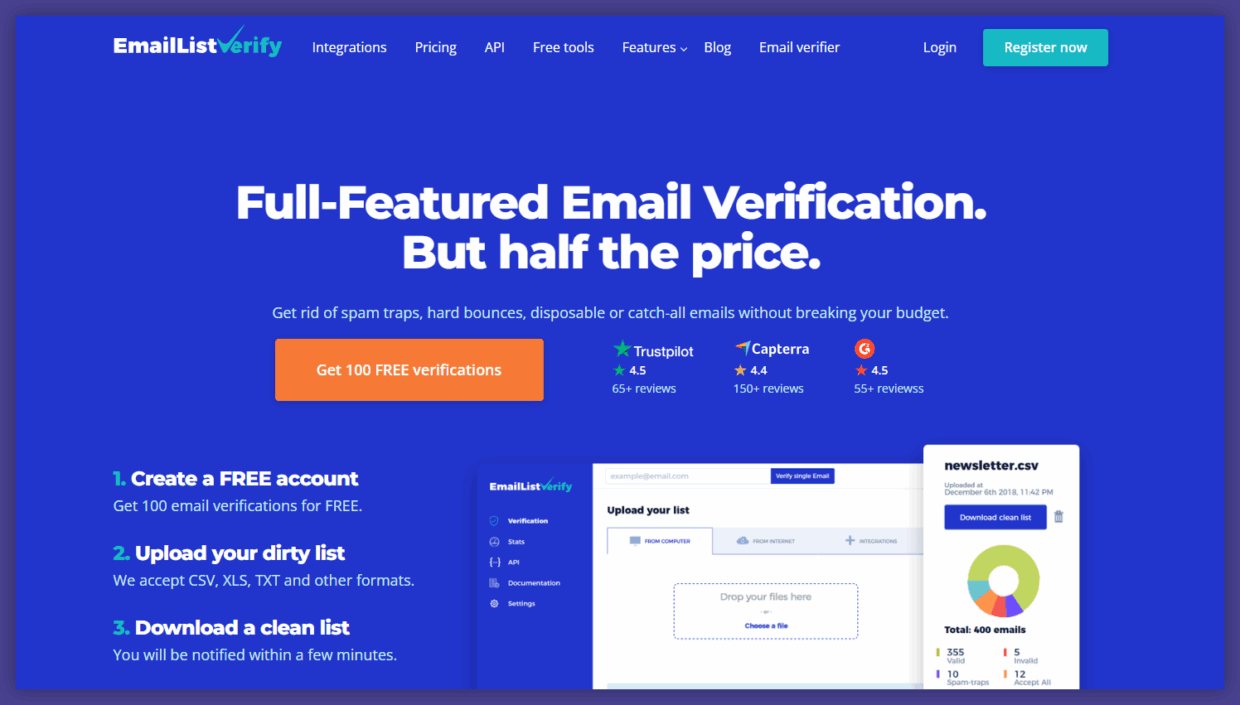
Best for: budget-conscious teams cleaning large one-off lists.
EmailListVerify markets itself on speed and price, with all the standard checks: domain validation, SMTP, spam traps, disposable cleaner, catch-all detection, syntax validation, and duplicate removal.
Key features:
- Domain and SMTP validation.
- Spam trap and disposable email checks.
- Catch-all and MTA validators.
- Hard bounce checker.
- Duplicate remover.
Speed: ~75 minutes for 10,000 emails. Slower than promised.
Pricing: pay-as-you-go from €5 (~$5.40) per 1,000 emails. Monthly plans from €16 for 5,000 credits. Up to $3,620 for 10 million.
Pros:
- Cheap entry price.
- Full set of core checks.
- 24/7 customer support reportedly fast.
Cons:
- Limited integrations compared to bigger players.
- Real speed lags behind marketing claims.
- Costs can creep up with monthly plans.
#4 MailerCheck
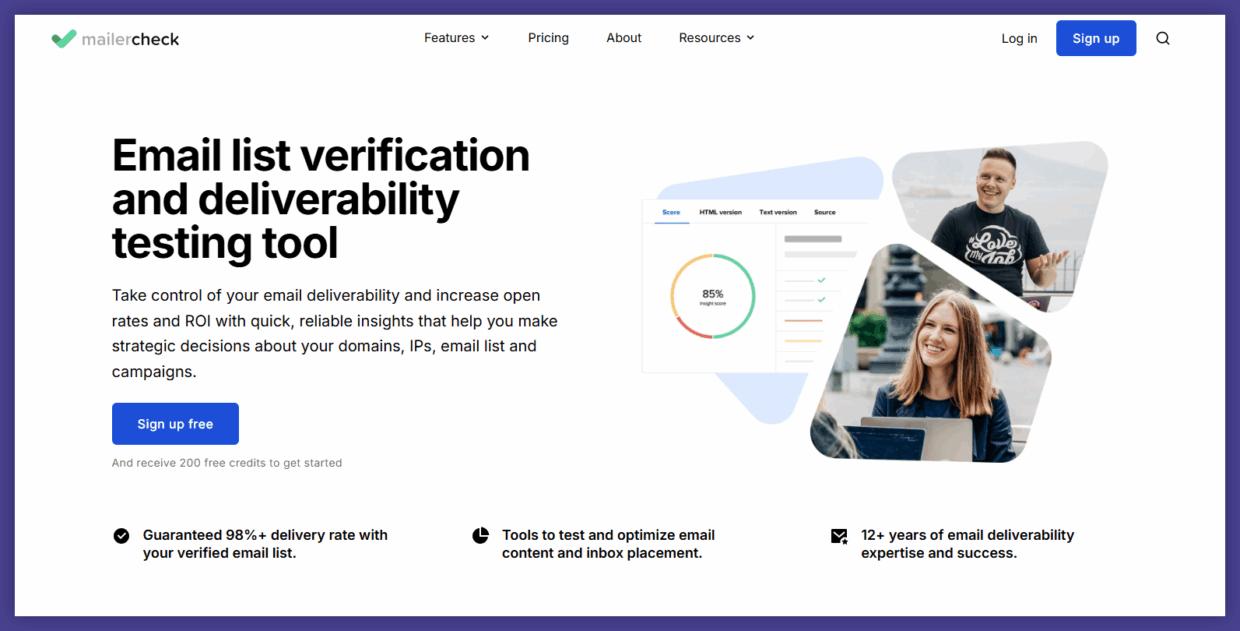
Best for: MailerLite users and beginners.
MailerCheck is built by the team behind MailerLite. It covers list verification, real-time API, inbox placement testing, DMARC monitoring, and blocklist alerts. It’s the simplest option for someone who already runs campaigns in MailerLite.
Key features:
- 3-step list verification.
- Real-time API verification.
- Inbox placement testing.
- DMARC monitoring.
- Blocklist alerts.
Speed: users report results “within minutes” (G2 review). Exact benchmark not published.
Pricing: MailerCheck verification starts at $10 per 1,000 credits. New accounts receive 10 free verification credits, and purchased credits do not expire.
Pros:
- Clean, modern UI.
- Tight integration with MailerLite.
- Free starter credits are generous.
Cons:
- Verification categories are limited compared to specialists.
- Some reviews flag valid emails as undeliverable (example).
- Per-credit pricing is on the high side.
Best email verification software for agencies and freelancers
Agencies need flexible verification that scales from 200 to 200,000 emails depending on the client. These tools handle that swing.
#5 Emailable
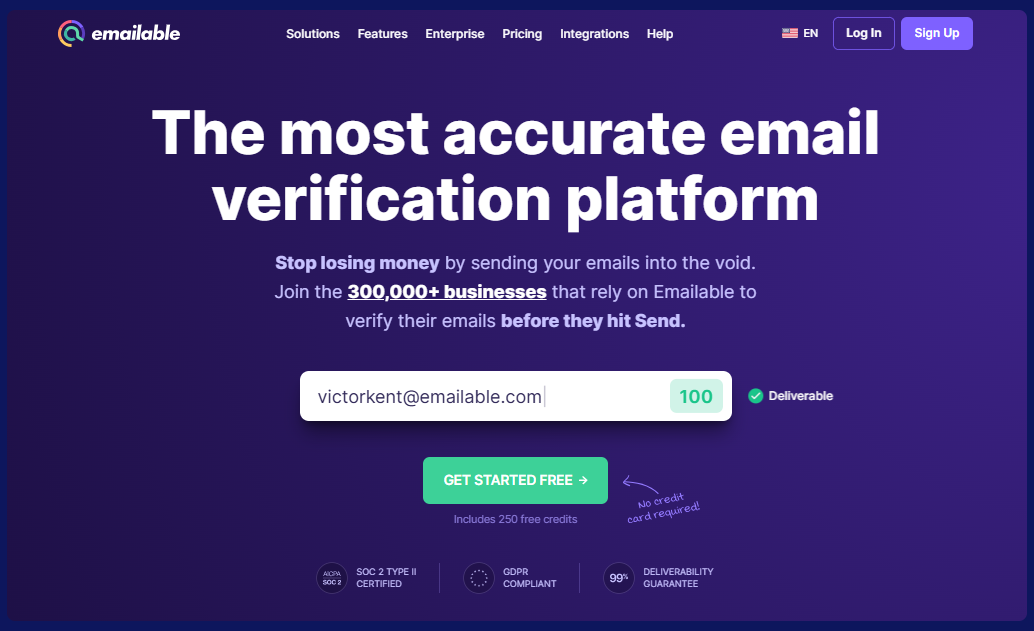
Best for: agencies running multiple client lists who want client-management features.
Emailable combines verification with inbox warmup and team/client tools. It’s marketed at agencies and freelancers managing multiple verification workflows.
Key features:
- Anti-greylisting verification engine.
- Risk detection (disposable, role-based, accept-all, no-reply).
- Quality score 0–100 per address.
- Data enrichment (SMTP provider, name correction).
- 50+ integrations and unlimited API keys.
Speed: ~50 minutes for 10,000 emails.
Pricing: pay-as-you-go from $38 for 5,000 emails ($7.60 per 1,000). Deliverability add-on from $149/month. 250 free credits, never expire.
Pros:
- Strong API speed.
- Good Mailchimp integration.
- Generous free credits.
Cons:
- Deliverability module is paywalled separately.
- Verified data only retained for 30 days (G2 review).
- No built-in list consolidation – export-and-handle workflow only.
#6 NeverBounce

IBest for: teams that want the highest accuracy claim on the market.
NeverBounce publishes high accuracy claims, but vendor methodologies are not directly comparable. Catch-all domains, role accounts and consumer mailboxes can produce materially different results across tools, so sample testing is more informative than a single headline percentage.
Key features:
- Bulk list cleaning.
- Real-time email verification.
- Automated list sync.
- API integration.
Speed: ~200 minutes for 10,000 emails. One of the slower options.
Pricing: NeverBounce combines PAYG and recurring options. Recent pricing references list $50 for 10,000 PAYG credits, while recurring Growth starts at $49/month for up to 10,000 emails.
Pros:
- Highest self-reported accuracy.
- Big-brand customer base.
- Solid HubSpot integration.
Cons:
- Price climbs fast at scale.
- Some users report higher bounce rates than the 99.9% claim suggests (G2 review).
- Customer support is frequently described as slow.
#7 DeBounce
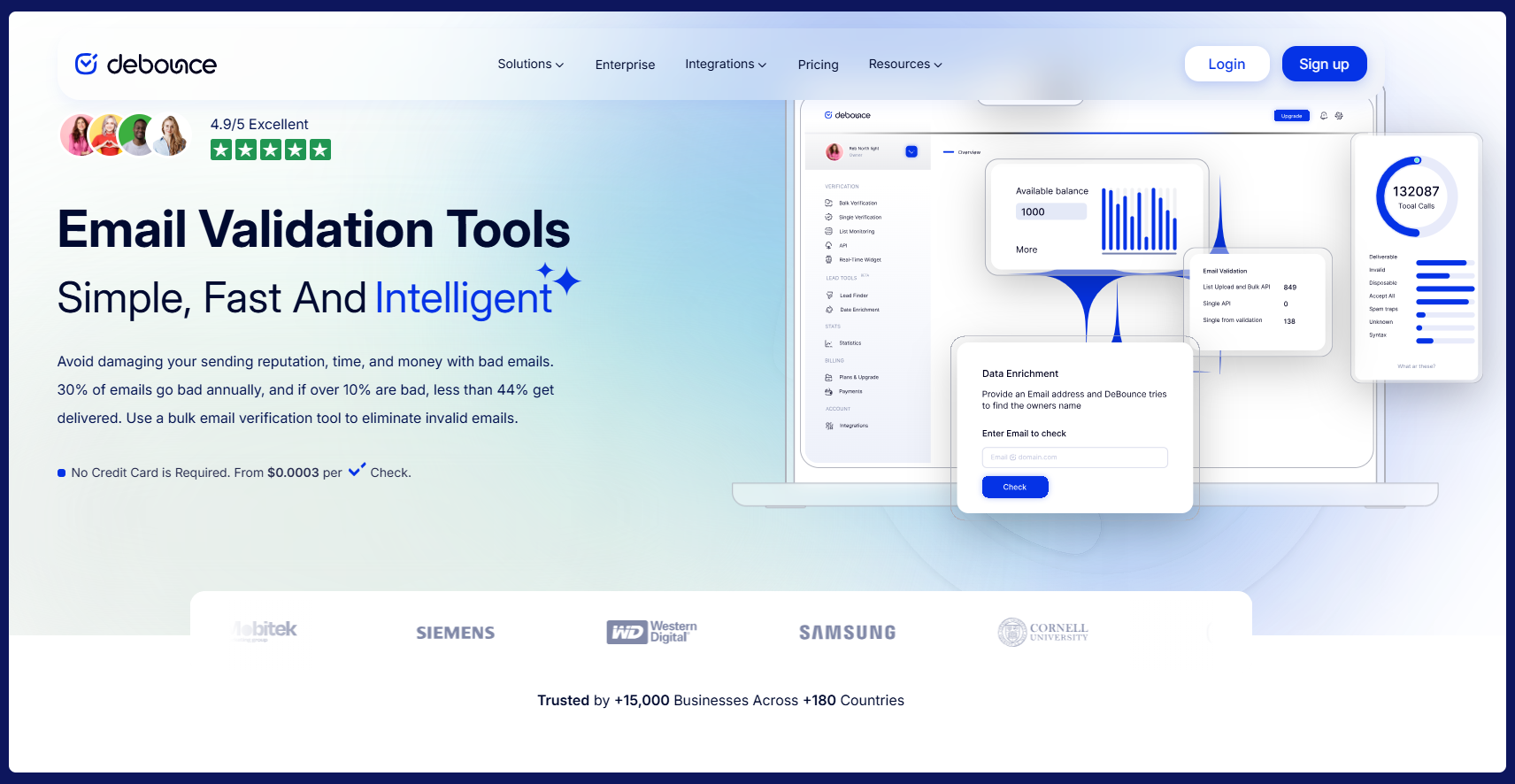
Best for: teams running occasional small batches on a tight budget.
DeBounce covers list validation, ongoing list monitoring, catch-all checks, an API, a real-time form widget, lead enrichment, and a lead finder.
Key features:
- Email list validation and monitoring.
- Catch-all validator.
- Validation API and real-time widget.
- Data enrichment.
- Lead finder.
Speed: ~950 minutes for 10,000 emails. The slowest in this group on bulk lists. Real-time API is fast for single checks.
Pricing: from $10 for 5,000 emails ($2 per 1,000). Up to 5 million addresses. Credits never expire.
Pros:
- One of the cheapest per-credit options.
- Credits never expire.
- Real-time widget works for forms.
Cons:
- Cleaned data retention is short (G2 review).
- Bulk speed is far behind competitors.
- Customer support can be slow (G2 review).
Best email verification tools for enterprises and SaaS platforms
Bigger lists, bigger consequences. These tools handle high volume without choking.
#8 Kickbox
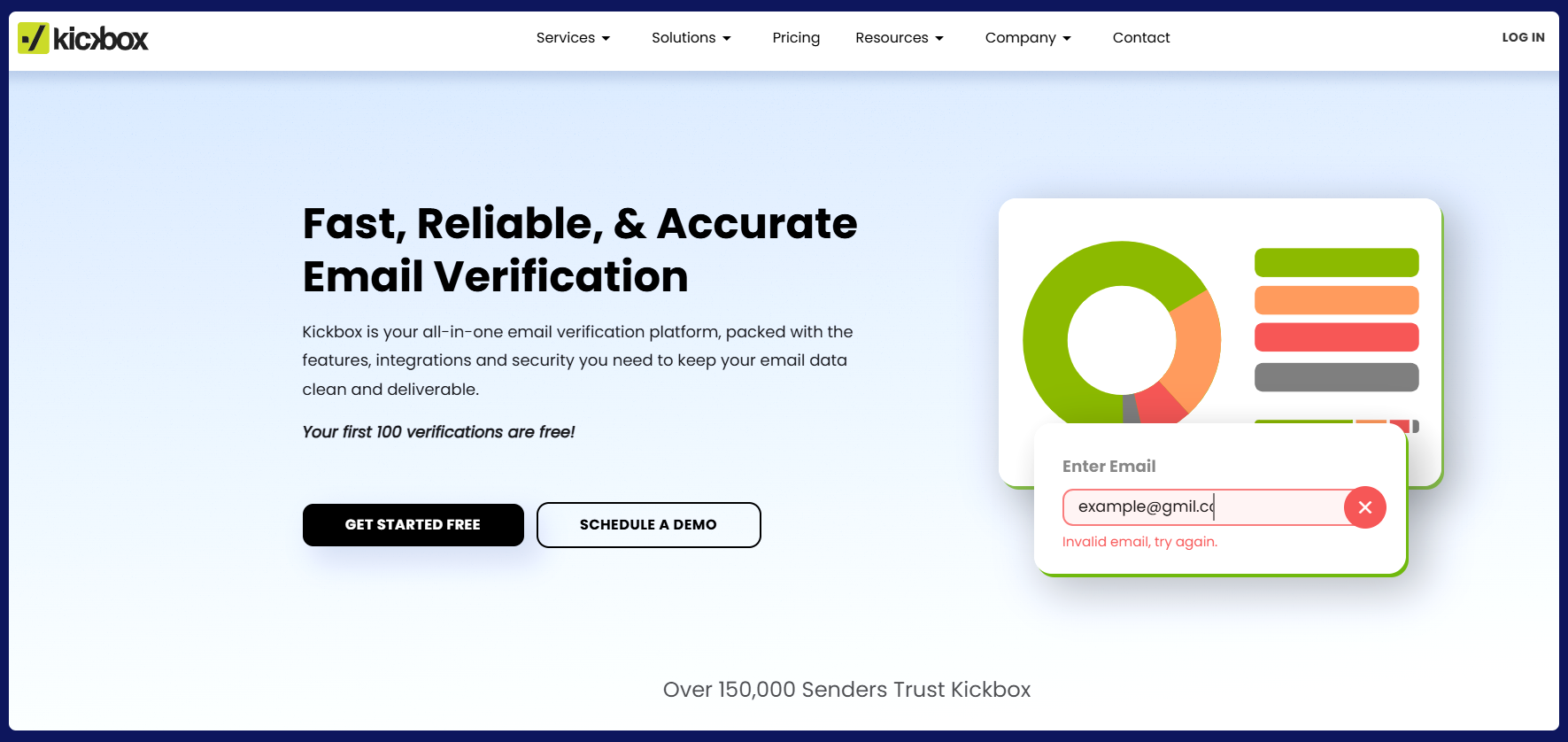
Best for: enterprise senders who care about ethical sourcing and want a deliverability consultant on call.
Kickbox prides itself on refusing to clean purchased or scraped lists. It bundles list verification, an API, deliverability consulting, and the Sendex™ scoring system.
Key features:
- List verification and API.
- Deliverability consulting.
- Free email verifier, spam checker, and disposable email checker.
- Sendex™ quality scoring.
Speed: users describe results in “minutes” without published benchmarks (Capterra reviews).
Pricing: 100 free verifications, then from $5 for 500 ($10 per 1,000 at the entry tier, dropping with volume). 5,000 verifications cost $40, not $50.
Pros:
- Strong ethical positioning around purchased lists.
- Deliverability consulting available.
- Clean dashboard and API.
Cons:
- Limited risk categorisation depth.
- Lacks deeper data enrichment options.
- Pricing can climb at frequent-use volumes.
#9 BriteVerify
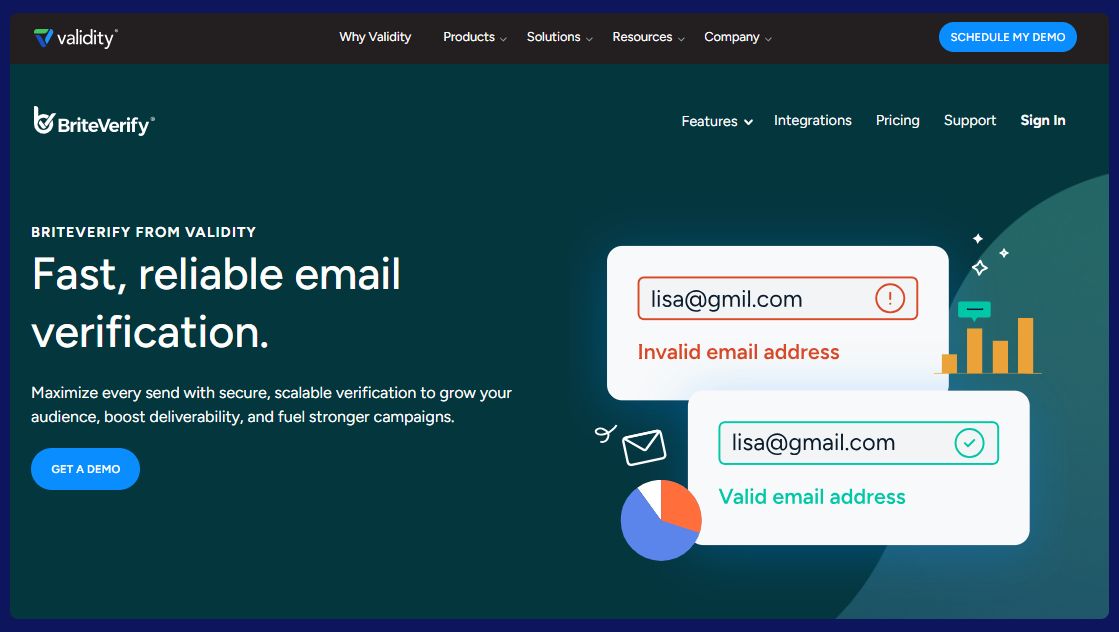
Best for: Validity-suite users running large datasets.
BriteVerify sits inside Validity’s wider data quality stack. It handles real-time validation, bulk verification, list cleaning, and CRM integrations.
Key features:
- Point-of-entry real-time validation.
- Bulk verification.
- List cleaning.
- CRM integrations including DemandTools.
Speed: ~50 minutes for 10,000 emails.
Pricing: contact sales. Plans bundle email verification with phone, address, and integration support.
Pros:
- Integrates well with Validity ecosystem.
- Solid bulk performance on clean data.
Cons:
- Less appealing for teams not already using Validity tools.
- Pricing opaque.
- Broader contact-validation scope can feel heavy for email-only needs.
#10 EmailMarker
Best for: budget-first teams who can accept lower accuracy.
EmailMarker is the cheapest option in this list at $3 per 1,000 verifications. It covers the basics: syntax validation, domain checks, real-time API, deduplication, and spam trap detection.
Key features:
- Real-time verification API (PHP, Python, Node.js, .NET).
- Syntax and domain validation.
- Spam trap and complaint control.
- Deduplication.
- Active mail check.
Speed: ~150 minutes for 10,000 emails.
Pricing: $3 per 1,000 verifications. $21 for 10,000. $589 for 1 million. Credits never expire.
Pros:
- Cheapest per-credit pricing.
- Credits don’t expire.
- Real-time API in major languages.
Cons:
- Independent audit puts accuracy at ~74% – well below claimed.
- Weak spam trap detection.
- Limited integrations (no native Mailchimp).
Best all-in-one email tools that include verification
These tools bundle verification into a wider outreach or marketing stack.
#11 Woodpecker
Best for: cold email senders who want verification baked into the campaign workflow.
Woodpecker is a cold email platform with built-in verification (powered by Bouncer), warmup, sequences, A/B testing, inbox rotation, and adaptive sending.
Key features:
- Free verification at send time.
- Free warmup.
- Inbox rotation across multiple sending accounts.
- Adaptive sending logic.
- Centralised inbox.
- Domain audit.
- Condition-based campaigns.
Speed: real-time at send – no manual upload.
Pricing: free 7-day trial (600 emails, 50 prospects). Starter $35/month for 6,000 emails. MAX tier offers unlimited at $9,999/month.
Pros:
- Verification + outreach in one product.
- Strong deliverability features.
- Free warmup included.
Cons:
- Overkill if you only need verification.
- Lead Finder needs polish (G2 review).
- UI could be tighter (G2 review).
#12 Hunter
Hunter.io is best known for email finding, with verification built into the same workflow. You feed it a name and company; it returns a verified address.
Key features:
- Email finder, domain search, and verifier.
- Cold email campaigns.
- Discover (B2B lead search).
- TechLookup.
- Signals (intent data).
- AI writing assistant.
Speed: seconds for single checks; bulk runs in the background.
Pricing: free plan with 50 credits/month. Paid from €34/month to €209/month.
Pros:
- Best-in-class email finding.
- Tight integration of finder, verifier, and outreach.
- Generous free tier.
Cons:
- Email finder accuracy has been questioned (G2 review).
- Verification is shallower than dedicated tools.
- Recent updates reportedly cut available data (G2 review).
#13 Mailgun

Best for: developers running transactional email infrastructure who also need verification.
Mailgun is primarily a transactional email service with high-speed verification, blocklist monitoring, inbox placement testing, and email previewing across 100+ clients.
Key features:
- High-speed email validation.
- Blocklist monitoring.
- Inbox placement testing.
- Email previewing on 100+ devices.
Speed: real-time. Mailgun claims 99% delivery within five minutes for up to 15 million messages.
Pricing: Mailgun’s sending plans and its Optimize/Validate products are separate buying considerations. Treat Send/Email API allowances as sending infrastructure, not as a recurring free verification quota.
Pros:
- Strong developer experience and API documentation.
- Solid IP reputation tracking.
- Free tier for testing.
Cons:
- Customer support and account handling get heavy criticism (G2 review).
- Verified businesses report unfair blocking (G2 review).
- Best fit for sending, not standalone verification.
Best free email verification tools and pay-as-you-go options
If you are researching lesser-known free and bulk options as well as the major vendors, our LeoPathu review explains what to check before relying on a smaller verification service.
If you’re not sure your list needs cleaning yet, start with a free tool or a pay-as-you-go credit pack.
#14 Mailfloss
Best for: teams who want set-and-forget daily list hygiene.
Mailfloss automates daily cleanup. Connect your ESP, set rules, and it removes invalid emails every day without manual effort. It also has a unique typo-fixer that converts “gmial” to “gmail” automatically.
Key features:
- 40+ ESP integrations (Mailchimp, HubSpot, ActiveCampaign).
- Autofloss daily cleaning.
- Decay protection for stale addresses.
- Auto-fix typos.
- Manual review mode.
- CSV exports and analytics.
Speed: 10,000 contacts in under 5 minutes. One of the fastest in this list.
Pricing: 7-day free trial. $29/month for 10,000 prepaid credits. Credits don’t expire.
Pros:
- Fully automatic daily cleaning.
- Typo-fixer is unique.
- Wide integration coverage.
Cons:
Smaller community than bigger tools.
No 24/7 support.
No money-back guarantee.
#15 Verifalia
Best for: technical teams running international lists.
Verifalia uses AI-powered checks across 40+ status codes and supports international addresses well. It offers real-time and bulk APIs with SDKs for major languages.
Key features:
- AI-powered email validation.
- 40+ status codes.
- Real-time and bulk API.
- No-code email capture widget.
- Team and reseller permissions.
- 6,000+ Zapier integrations.
Speed: ~50 minutes for 10,000 emails on standard plan. Higher tiers go slower but more thorough.
Pricing: Verifalia’s Free plan includes 25 daily credits. Paid plans provide larger daily allowances, and separate PAYG credit packs do not expire.
Pros:
- Strong international support.
- 40+ status codes for granular reporting.
- Detailed team permissions.
Cons:
- Limited public reviews on G2.
- Higher accuracy tiers are noticeably slower.
- Credits get consumed fast on high-quality checks.
Catch-all email handling – why it matters
Catch-all domains accept every email sent to them, then drop or forward them server-side. Basic SMTP checks pass these addresses as valid even when they bounce. Tools that handle catch-all well give you a risk score, not a binary verdict, so you can segment safer-to-send addresses from riskier ones.
Bouncer, Hunter, and Clearout currently lead on catch-all handling in independent reviews. For the full picture, see our guide on catch-all email verification.
Verify your email addresses today
A clean list isn’t optional. Bounce rates above 2% damage sender reputation; above 5% you start triggering spam filters and ESP warnings. The good news: starting is cheap and fast.
Bouncer combines transparent PAYG pricing with bulk verification, API access, catch-all handling and adjacent list-quality tools. Compare it with other shortlisted vendors using the same sample before choosing.
Try Bouncer free → or book a demo if you’re cleaning enterprise volume.

Frequently asked questions
NeverBounce advertises 99.9% accuracy, the highest claim on the market. Hunter ranked highest in their own published 3,000-email benchmark. In practice, the top tier (Bouncer, NeverBounce, Hunter, Kickbox, ZeroBounce) all sit in the 95–99% accuracy range on real-world business lists. Differences usually come down to catch-all handling rather than basic SMTP accuracy.
Yes. Free access varies: Bouncer offers 100 signup credits, Kickbox 100 signup verifications, MailerCheck 10 signup credits, Emailable 250 signup credits, Hunter 50 credits per month and Verifalia 25 credits per day. Bouncer also has a free email checker for individual checks.
Top-tier tools verify 95–99% of standard business addresses correctly. Accuracy drops on catch-all domains, role-based addresses, and B2C free-mail accounts. Independent benchmarks (Hunter, La Growth Machine, Sparkle.io) consistently show that real-world performance varies by 5–10 percentage points across providers, even when marketing claims look identical.
They run a chain of checks: syntax validation, domain and MX record lookup, SMTP handshake (asking the receiving server if the mailbox exists without sending mail), catch-all detection, disposable provider check, role-based detection, and risk scoring against known spam traps and complainer addresses. The output is a verdict: valid, invalid, risky, catch-all, or unknown.
Most senders should clean their list every 3 to 6 months, plus before any major campaign. Lists decay at roughly 22% per year as people change jobs, abandon addresses, or unsubscribe. Real-time verification at the point of signup catches most decay before it accumulates. Read our list cleaning frequency guide for more.
In practice, none. Both refer to checking whether an email address is real and safe to send to. Vendors use the terms interchangeably. Some tools split them as “validation” = format check only, “verification” = full SMTP and risk check, but this distinction isn’t standardised.
No. Verification reduces bounce-related reputation damage, but inbox placement also depends on sending volume, domain age, engagement rates, authentication setup (SPF, DKIM, DMARC), and content quality. Verification protects the foundation; it doesn’t replace responsible sending.
Among tools with proven accuracy above 95%, Bouncer at $8 per 1,000 and Verifalia at $7.90 per 1,000 are the most affordable. EmailMarker is cheaper at $3 per 1,000 but independent audits put its accuracy at around 74%, which can cost more in bounce damage than the savings cover.
Last modified:


